Ethernet is undoubtedly the leading standard for communication between office networks, computers, and IT servers today. Ethernet-based solutions are increasingly used at all levels of automation, where process and production sequences are controlled through various topologies using dedicated controllers, PLCs, and ERP (Enterprise Resource Planning) systems.
Analyzing the main characteristics of each of these standards, we can clearly see that there are applications where Profibus is the ideal solution and others where Ethernet should or should be used. Implementing an effective and secure network also requires the use of appropriate connectors, available in a wide variety and for highly flexible solutions.
However, in more complex plants where machines, sensors, actuators, and PCs proliferate, and where data monitoring or acquisition is desired, or when the ERP system needs to interact with the production process, choosing between one type of network or another is not an option because both are essential. Therefore, implementing a linking system that connects the different networks and fieldbuses in real time becomes necessary.
To make these two network types compatible and fully leverage their potential and functionality, Systeme Helmholz Profibus-Ethernet links are an ideal solution. These links have been successfully marketed since 2005 under the NetLink Helmholz® brand, and we will dedicate the rest of this article to them.
Systeme Helmholz Profibus-Ethernet Links
As we have seen, through the interaction between field networks (such as Profibus) and office networks (Ethernet); we can obtain visualization, acquisition of production data and remote diagnostics, programming, real-time monitoring, production planning and its linking with the physical processes that comprise it; these being just some of the best-known applications for Ethernet links.
For both wired and wireless connection points, Systeme Helmholz has developed products and solutions designed to enable the integration of all elements involved in the production process of an industrial facility. In what follows, we will focus on two of these products: the NetLink® WLAN and the new NetLink® PRO Compact.
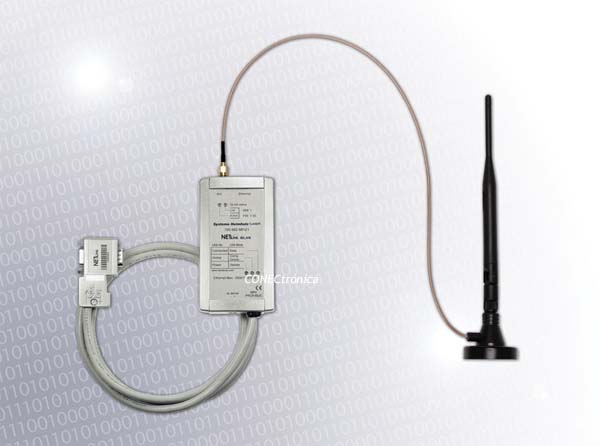
The NetLink® WLAN (Figure 1) is a Profibus-Ethernet Wireless link with integrated WLAN (Wi-Fi). This technology offers competitive advantages from its initial configuration, allowing, among other things, flexible programming, which can now be done wirelessly using the typical "Ad Hoc" and "Infrastructure" modes. This module enables remote access to network segments located more than 300 meters away without cables, using various antennas.
At the controller end, the NetLink® WLAN allows a total transmission speed of 12 Mbps with a maximum of 32 simultaneous connections via MPI or
PROFIBUS and in addition to the RJ45 connector, the WLAN interface (802.11 B/G) can be connected with up to
54 Mbps.
 Among its security features, it has the usual wireless security standards, such as WEP, WPA and WPA2 implemented.
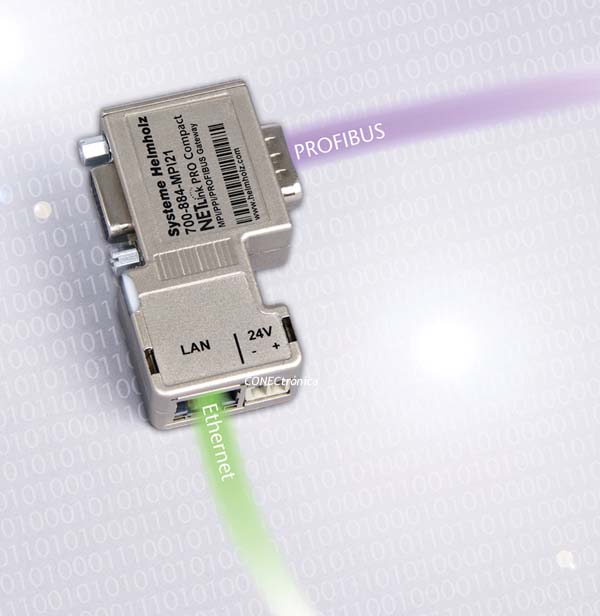
The new NetLink® PRO Compact (Figure 2) is the advanced logical evolution of Helmholz's Ethernet Gateway family and does exactly what its name suggests: provide a PROfibus-Ethernet network link. "Compact" refers to its new, sleek, and compact design; as you can see in the photos, it requires virtually no physical space. This compact link allows for up to 16 parallel connections on the LAN and dynamic address assignment via DHCP. Another new feature of the NetLink® PRO Compact is its ability to operate on the Profibus network without additional masters (single master).
The widely used ISO over TCP protocol (RFC1006) is automatically detected and allows communication with many standard applications, such as SCADA, HMI, and OPC displays and controls, without requiring additional hardware. Furthermore, the link's parameterization and diagnostic functions can be accessed through the integrated web interface. As you can see, installing additional diagnostic equipment is no longer necessary, since the network status can be viewed directly through NetLink.
Both the new NetLink® PRO Compact and the NetLink® WLAN connect directly to the CPU's MPI/PROfibus interface or to an active network station. They are powered via any active PROFIBUS device, and for passive network stations, the links can be supplied externally with 24 V. Either device can be easily configured for MPI/PPI/PROFIBUS networks, as the included driver integrates seamlessly into Siemens S7 engineering tools after installation; they are also compatible with all common S7® engineering tools.
Remote plant access:
The plant can be accessed remotely and securely via these links by connecting through a standard router. Furthermore, TCP/IP access can be restricted using the integrated security features. Additional new features allow for blocking or limiting write access to connected controllers through the web interface, thereby enhancing process security.
CPU-to-CPU Switching:
With NETLink interfaces, communication between two controllers is possible using the S7 base communication with the X_PUT and X_GET functions under MPI and PROFIBUS. We provide free sample projects for easy and quick implementation in your program.
Summary
Fieldbus-to-Ethernet links are already standard equipment in many plants. The new NetLink® Pro Compact and NetLink® WLAN from Helmholz Systems have added compact and powerful interfaces for wired and wireless applications to the Helmholz product range. These links enable the cost-effective integration of different plant areas connected via various communication networks, achieving, among other things: greater process control, reduced maintenance costs; remote programming, visualization, and acquisition of production data or diagnostics; real-time monitoring; and production planning.
While the configuration process is very simple, you're not alone. Free support is available in our sample projects to guide and assist you. If you have additional specific requirements beyond the standard offerings, our team of automation specialists can seamlessly address them, further expanding the product applicability to meet your needs.
Author:
Joel Hurley of Systeme Helmholz (Germany). Article provided by AN Consult España, SL.