 Unfortunately, some vendors indicate higher numbers than the competition, when in reality these do not demonstrate a higher quality than a system that claims to meet or exceed the requirements demanded by the standards.
One of the most notable cases is when a manufacturer offers a 350MHz cable and claims it is of higher quality. This document will attempt to debunk this myth and correct the misconception. For your information, Excel Networking has internally tested all Category 6 cables for 350MHz, but we do not require compliance at this frequency for the reasons explained below.
Standards Requirements
According to Cenelec (EN) or ISO, each Channel Class or Permanent Link is composed of Component Categories.
The quality requirements for these components, whether cables, hardware, or patch cords, are detailed in the general requirements of the respective standards, specifically EN50173-1: 2011 and ISO 11801: Ed 2.2: 2010.
The following extract from EN50172-1:2011 indicates the frequency requirements for each channel class.
5.2.2 Channel Quality for Balanced Cabling
5.2.2.1 General
This standard specifies the following classes of balanced cabling:
a) Class A: indicated up to 0.1 MHz
b) Class B: indicated up to 1 MHz
c) Class C: indicated up to 16 MHz
d) Class D: indicated up to 100 MHz
e) Class E: indicated up to 250 MHz
f) Class EA: indicated up to 500 MHz
g) Class F: indicated up to 600 MHz
h) Class FA: indicated up to 1000 MHz
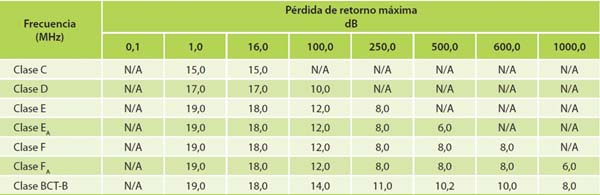
The standard then defines the quality of each of the measurements required at these specified frequencies. In the case of Return Loss, the table is as follows:
For true channel compliance, all elements MUST be of the specified Class or higher. However, it is the component's lower category that determines the Class, so if a 350MHz cable is used with Category 6 connection hardware and Category 6 patch cables, the channel will be Class E.
The additional frequency measurement is theoretically beneficial, but in practice, it creates several interesting problems, such as the fact that no field test equipment has the built-in capability to test beyond the 250MHz limit established by the standards for a Permanent Link or Class E Channel. It is possible to configure the equipment to perform testing beyond the standard's requirements, but it is the user's responsibility to export the data and establish new boundary lines using the existing formula for Category 6 in EN50173.
An example of such a formula for Insertion Loss is as follows:
The issue becomes even more complex when considering the use of a network analyzer. EN50346 specifies that the test parameters required in EN50173-1 indicate 401 scan measurement points for 250 MHz. How would this then apply to 350 MHz? Should the same points be used and an additional number calculated, or should these points be spaced out, consequently losing precision and accuracy in the results? Either way, the result is far from ideal.

Conclusion:
In theory, having a cable that indicates operation at a higher frequency might seem like an attractive option.
To grasp the reality and eliminate the confusion caused by marketing, these facts should be remembered and these questions considered:
- Do all components meet the requirements for 350MHz? If not, any supposed benefit would immediately disappear.
- There is NO effective method for testing at 350MHz once the installation is complete or "in the field."
- There are NO applications that operate at this extended frequency. If we're talking about Ethernet, Category 6 already offers additional headroom compared to Category 5e. For 1Gb Ethernet at 100MHz, the next level is 10Gb, which requires Class EA and 500MHz.
- If this additional frequency involves an extra cost and offers no benefit, the cost should be seriously questioned. This is a classic case where the manufacturer tries to "turn things around" and confuse the end user by making them believe that with a higher number they will get more for their money, when this is not the case.
Author:
Author: Paul Cave, Technical Manager, Excel