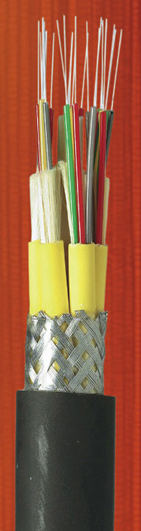
CDAM cables have been designed and manufactured in two variants: one with up to 12 fibers and another with 16 to 72 optical fibers (comprised of sub-cables).
The 12-fiber models feature a tight-fitting coating for superior moisture protection, dielectric yarns for tensile strength, an inner jacket serving as the armor seat, consisting of a steel wire braid, and an LSZH* outer jacket.
The 16- to 72-fiber cables are manufactured with a tight-fitting coating, as well as a central filler (GRP), sub-cables (groups of 4 optical fibers with dielectric yarns for tensile strength) with individual jackets, steel wire braid armor, and an LSZH* outer jacket.
Key features, aside from their robust and durable construction, include direct connectorization, flexibility and elasticity, high mechanical strength, excellent rodent resistance, and significant installation cost savings.
These compact, dark gray cables, with a temperature range of -20 to +70°C, are very easy to strip (gel-free), flame-retardant, produce low smoke, and are halogen-free (LSZH).
The technical specifications of CDAM tight-buffered cables, depending on the number of fibers, are: diameter between 7.6 and 9.9 mm (up to 12 fibers) and between 11.7 and 20.9 mm (between 16 and 72 fibers), weight from 80 to 407 kg/km, maximum installation tension from 1,250 to 4,000 N, maximum continuous tension from 700 to 3,000 N, crush resistance of 1,500 N, and a minimum bending radius of 20 x the outer diameter.
*LSZH is the standard manufacturing standard.
Flat 2-fiber indoor drop fiber optic cable.
GetConnect presents a flat, 2-fiber indoor drop cable.
This cable is one of the most comprehensive on the market. It offers numerous advantages: