
FTTH or FTTP PON Fiber Optic Connections
As previously mentioned, a direct point-to-point fiber optic connection between each user and the central office would be technically ideal, but would be prohibitively expensive under normal circumstances. A Passive Optical Network (PON) offers lower data transmission speeds but with a capacity that exceeds current requirements and at a much lower cost.
Economic Considerations:
Discussions about networks for individual consumers often start from a fictitious model in which everyone lives in single-family homes. In reality, even in developed Western countries, multi-unit dwellings (apartments, flats, townhouses, etc.) are predominant in many areas, frequently mixed with commercial buildings, while many others are located in semi-rural areas. Each type of construction presents different network requirements.
High-density housing (multiple units):
In a high-density area, the obvious solution for service delivery is a direct fiber optic connection to the building, with end users connected via copper or fiber. VDSL, PON, or simple switched Ethernet would be equally suitable, as the challenges are more practical than technical. Examples include where to locate the cabinets, what type of cabling is needed to connect each unit, and who owns or operates the equipment. Legal and administrative hurdles, which vary from country to country, can be substantial.
“Typical” residential area
As explained above, this is the environment for which PON or VDSL systems are usually designed.
Semi-rural areas:
This situation has always posed a problem for operators. The distances between the end user and a viable concentration point are frequently 10 km or more, on average, which necessitates the use of thicker copper wire and amplifiers or repeaters within a telephone line link or, more recently, radio systems. This is a very attractive scenario for PON systems, which are compatible with typical distances of 10-20 km, thus allowing them to provide all the necessary functions.
Commercial premises
vary in size from the corner store to facilities in huge complexes with thousands of employees. In many cases, the technologies used for high-density housing are most suitable, while others require individual point-to-point fiber optic access.
Employing modern distribution architectures (NGN/PON) can completely transform the structure of a metropolitan area network. While a typical medium-sized Western city with 2 or 3 million inhabitants might require 200-300 central offices (COs), PON can connect users located up to 20 km from a single exchange. Therefore, cities could, in theory, be served by a single exchange (in reality, probably four, for practical reasons), resulting in enormous savings. The problem lies in the cost of installing fiber optic cable for each user, especially due to the necessary public works and the issue of how to connect subscribers. However, wherever new cabling is required, the advantage of a fiber optic network is undeniable.
Sector Structure:
The introduction of any of the new broadband technologies can dramatically affect the structure of the telecommunications sector. Traditionally, a country's telephone industry consisted of a single, publicly owned company that owned the infrastructure and provided all services. With the proliferation of services, it is now common to find numerous organizations competing to provide them. It would be very difficult to compete with an organization that owns a VDSL or PON access network infrastructure. Many different organizations, leasing the facilities they need from the infrastructure owner, could then offer services. This will likely create a new business model that does not yet exist.
What sets fiber optic networks apart?
The speed and capacity characteristics of single-mode fiber are legendary, and this is the primary reason for its use. It goes without saying that, being non-electrical, radio interference or ground voltage differences between locations are not an issue. What also makes it very different from copper cables is the way the signal travels, both through the fiber itself and through splitters and concentrators. The signal can be split many more times: in the case of a 64-way split (assuming viable lossless components are used), the signal will suffer a loss of 6 x 3 = 18 dB.
Fiber optic cable, however, also has problems that copper doesn't. If the optical fiber is bent excessively, it loses signal, so the bending radius is important. In locations where fiber needs to be joined or coupled to equipment (such as in a splitter), it's necessary to form a loop with the excess fiber on both sides. This problem is mitigated somewhat by using single-mode fibers specifically designed for metropolitan environments (covered by standards G.652.D and G.657.A and B).
Passive Networks.
A previous article on VDSL pointed out that a practical VDSL system requires a cabinet containing active equipment at every concentration point (i.e., at almost every street intersection). A city of 2 to 3 million inhabitants would need about 3,000 of these cabinets, all of which would require regular maintenance and a reliable power supply, resulting in extremely high operating costs. A passive network offers considerably lower operating costs, but even then, costs would still arise from network upgrades and the repair of damaged cables. A passive optical network must also include, at a minimum, small cabinets (similar to junction boxes) for the splitter equipment.
Passive Optical Networks
There are three generic ways to build a passive optical network:
1. Point-to-point: a dedicated fiber (or fiber pair) between each end user and the central office. As explained above, this is a very expensive and disproportionate system relative to the requirements.
2. Point-to-multipoint, with a different wavelength for each user on a specific connection. This is another very good solution, but wavelength-sensitive multiplexers (xWDM) and suitable lasers are expensive and far too expensive for the intended requirements. However, xWDM appears to be a future technology currently under development.
3. Point-to-multipoint networks in which many users share the same optical wavelength. This solution provides all the necessary capacity and functions but at a significantly lower cost than either of the previous two alternatives. This shared-fiber network configuration has the enormous advantage of requiring only one transceiver at each user's location and at the central office. The cabling is also simpler compared to a point-to-point architecture, as only one connection at the central office is needed for up to 64 users (the possibility of 128 users for GPON is being explored). Furthermore, it provides a stable infrastructure that can be adapted in the future to almost any other conceivable architecture without requiring the installation of new user connections.
Design Considerations
The main aspect regarding PON development is the topography of the area, which includes the type and number of existing or planned buildings, as previously mentioned, a factor also referred to as “potential subscribers per square meter.” In addition, and although not directly related to the technical aspects, it is necessary to consider the three design elements described below.
Optical Power Budget:
A key factor in PON design is the optical link budget, which is the difference between the power produced by a laser transmitter and the minimum power required by a receiver for accurate signal recovery. This represents the amount of power that can be planned for use in the network. For the system to function, the sum of all losses must be less than the budget. The main losses are:
1. Power reduction over time: When planning the network, the laser's transmission power must be calculated based on its operating power level at the end of its lifespan.
2. Receiver sensitivity must also be estimated based on its performance at the end of its lifespan.
3. Power consumed by attenuation in the fiber, fiber splices (very low if properly made, or high otherwise), splitters and combiners (both logical and those associated with the building's construction), and data transmission speed.
In general, when the data transmission rate is doubled, the sensitivity of a given receiver is halved. Most PON standards offer different optional transmission rates. If all other factors are equal, changing from a 1 Gbps to a 2 Gbps transmission rate will result in a 3 dB reduction in the link budget.
Laser Characteristics:
When a semiconductor laser is activated, it tends to oscillate (rapidly vary its wavelength) briefly until it stabilizes. To minimize the effects of this oscillation, it is common practice to keep a communication semiconductor laser in a constantly on (emitting) state. However, in a shared network, when one user is transmitting, transmissions from other users (even at very low levels) will cause interference. Therefore, it is necessary to turn off each laser at the end of a data block or frame, leaving a time interval between the end of one user's transmission and the beginning of another.
Connection Speed:
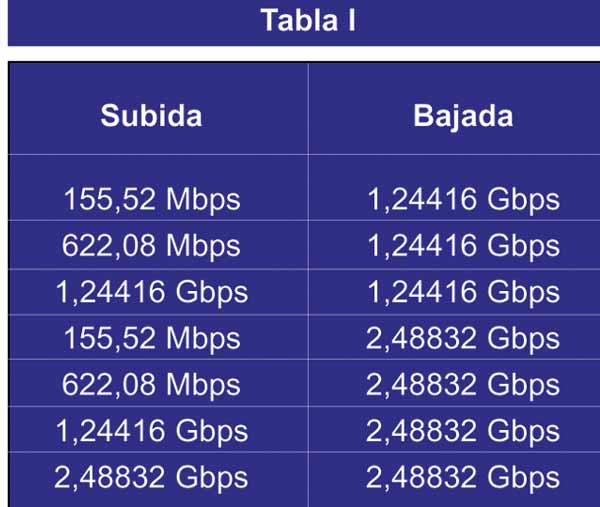
All connected users share the upstream and downstream channels. Each user is allocated a portion of the available capacity. For example, a PON with 10 users operating at 1 Gbps upstream and downstream could allocate 100 Mbps of capacity to each user. The available connection speeds according to the GPON standard are shown below. In 2008, the predominant choice appears to be 1.24416 Gbps upstream and 2.48832 Gbps downstream. See Table I.
Conclusion:
Most developed countries are experiencing a rapid increase in demand for high-speed internet access in homes and businesses. Furthermore, the nature of television distribution is poised for a revolutionary transformation. Of course, the demand for reliable access to traditional telephone service remains as important as ever. Existing copper wire access networks are simply insufficient to support the evolution of these services. The use of fiber optics, in one form or another, represents a sound technical solution to this problem. In locations where copper TTP connections to customer premises already exist, it is possible to implement an FTTN (Fiber To The Node) solution using VDSL technology.
Author: Patrick Gahwiller. Partner Account Manager, R&M.