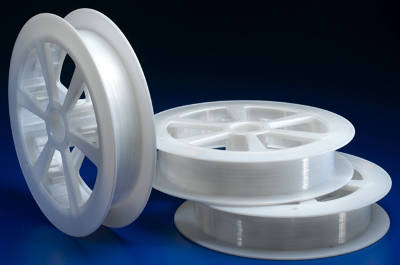
 Polymicro's 200/230 PolyClad optical fiber facilitates short and medium distance data communications in factory automation and process control applications and is suitable for harsh environments characterized by extreme temperatures, chemicals and radiation.
“Optimized with typical attenuation of ≤ 6 and ≤ 10 dB/km at 850 and 650 nm respectively, our new broadband HPCF (hard polymer clad fiber) fiber features strength that far exceeds the industry standard of 150 kpsi and a minimal bend radius to provide high levels of reliability,” says Imke Kuester, business development manager for optical fibers at Molex, adding: “Polymicro’s 200/230 PolyClad fiber is distinguished by its excellent performance and high resistance to extreme temperatures, chemicals and radiation, which can degrade fiber and reduce product lifespan.”
Compatible with crimping and cutting processes and compliant with the European RoHS Directive, the 200/230 PolyClad fiber features a large 200 µm core and a high numerical aperture for easy termination and high coupling efficiency with the light source. Connector displacements are minimized to ≤ 5 µm due to the high diameter ratio between the cladding and the core. With a tensile strength exceeding 50 kpsi, a minimum bend radius of ≥ 10 mm (STBR) and ≥ 16 mm (LTBR), and typical attenuation of ≤ 6 dB/km at 850 nm and ≤ 10 dB/km at 650 nm, Polymicro fiber is extremely reliable even in harsh environments.
The 200/230 PolyClad fiber has been designed for high-performance short- and medium-distance data communications in a wide range of factory automation and process control applications, including chemical plants, refineries, avionics, automotive, production and manufacturing plants, mobile platforms, wind turbines, power plants, and programmable logic controllers.