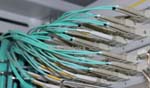
 In the case of standard multimode cables, where increasingly narrow attenuation margins already apply, improper use or mechanical stress can result in a rapid increase in connection attenuation, to the point of reducing transmission speeds or even causing failures. Multimode cables
with bend-optimized fibers offer high transmission reliability in LANs and data centers. For this reason, Datwyler has been using G50/125 mm bend-optimized fiber for OM2, OM3, and OM4 fiber categories since early 2011 – all without affecting the price for the customer.
Marginal Loss Margins:
For optical transmission lines using multimode cables, the following can be established: the higher the data transmission speed, the less realistic the attenuation values specified in the standards become. Two examples illustrate this: For the transmission of a 10Gbit/s Ethernet signal with a wavelength of 850 nm over an OM3 fiber exceeding 300 meters, the EN501731:2011 standard allows a maximum loss of 2.6 dB. According to this cable standard, glass fiber has an attenuation coefficient of 3.5 dB/km. The G50/125 µm OM3 fiber used by Datwyler typically has a kilometer attenuation of 2.5 dB. Even this fiber exhibits an attenuation of 0.75 dB over a length of 300 meters.
In the link described above, for which a maximum attenuation of 2.6 dB is defined, there is therefore a residual loss margin of 1.85 dB available for all connectors combined. This poses no problem when dealing with two connectors. However, in a channel with four connectors, only about 0.45 dB remains for each connector. On the other hand, the standard allows a maximum insertion loss of 0.5 dB for 95% of all fiber optic connectors, and even as high as 0.75 dB for the remaining 5%. This is where the conflict arises.
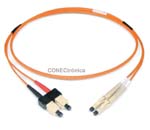 Regarding the transmission of 40 and 100 Gbit/sa over OM3 and OM4 fibers, the EEE 802.3ba:2010 standard defines insertion losses (IL) in the transmission line of a maximum of 1.9 dB (OM3) and 1.5 dB (OM4). Including the fibers and modal noise, this leaves only 1.5 dB / 1.0 dB for all connectors combined, which represents an extremely narrow margin in terms of practical application.
Naturally, the fiber optic connectors available today offer better performance. Their typical insertion loss is around 0.2 dB. But even this value can change rapidly due to minor contamination or wear1.
1 For more information on this topic see the White Paper “Keep your connector noses clean! Dirty fiber optic connectors lead to performance problems“ (Keep your connectors clean! Dirty fiber optic connectors lead to performance problems) (Datwyler, 2011).
Adverse effect on transmission.
So, what does this have to do with bend radii? It's common for small additional losses that depend on the installation and arise as a result of micro and macro bends to initially go unnoticed. These small additional losses related to connectors can, at a later stage, suddenly cause a link to exceed the maximum permissible value.
 During initial installation, attenuation is typically compensated for to precisely adhere to the permissible bend radii. This applies to installation cables, patch cables, and flexible patch cables. However, in day-to-day operation, things are often quite different. Specifically, regarding patch cables, the bend radius of a fiber optic patch cable is frequently reduced significantly.
The specified attenuation changes may, in the worst case, lead to a connection failure, but at a minimum to a reduction in transmission speed.
Instead of 10 Gbit/s, it could happen, for example, that only 1 Gbit/s is achieved. When a number of workstations depend on this transmission path, all connected users will have to share that lower transmission speed.
Risk Minimization:
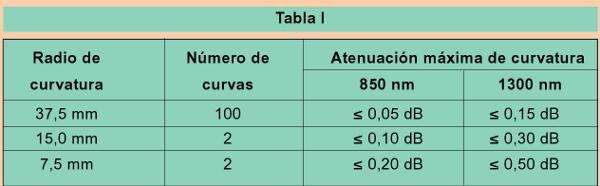
The use of G50/125 µm multimode fibers optimized for bends reduces the risk of additional attenuation resulting from typical usage failures and mechanical stresses. This is specifically shown in Table 1 regarding the macrobending characteristics of these fibers. Even with multiple full 360° bends, the additional attenuation remains comparatively small, and transmission has a higher degree of reliability.

Full Compatibility.
It has sometimes been suggested that the connection between bend-optimized fibers and traditional multimode fibers was not fully compatible. However, more comprehensive studies show (most recently, for example, in the German trade magazine LAN line 8/2011) that the new generation of fibers has no effect on the insertion loss of fiber optic connections or on the bandwidth of transmission lines.
For more information.
URKUNDE, SA
Kurutz-Gain industrialdea, 1-2
20850 Mendaro (Gipuzkoa)
Phone: (+34) 943 744 264
Fax: (+34) 943 744 294
www.urkunde.es