In addition to their exceptional transmission capabilities and long distances, they are completely immune to any type of electromagnetic interference, allowing for virtually unbreachable communications. The two most commonly used types of optical fiber are multimode (MM) fibers for short distances and single-mode (SM) fibers for long distances and/or high bandwidths.
Long-distance communication networks have used single-mode fiber optic cables for many years; they are also used in office buildings, public administrations, commercial buildings, etc., particularly in vertical cabling (backbones), usually terminated in fiber optic distribution boxes with SC or LC connectors. The dramatic increase in fiber optic connections, particularly in data centers, has led to significant concentrations of two-fiber patch cords.
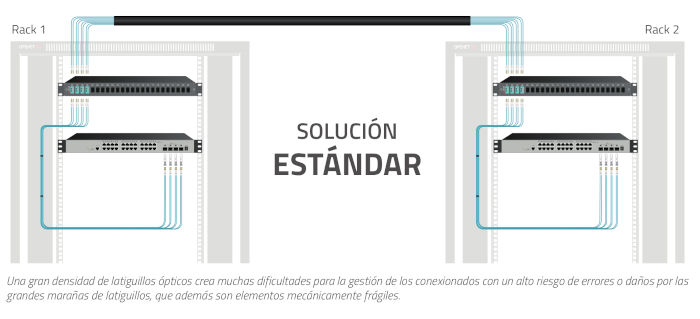
This high density of fiber optic patch cords creates numerous difficulties for managing connections, with a high risk of errors or damage due to the large tangles of cords, which are also mechanically fragile. The solution to these problems is the creation of a multifiber connector, known as MPO (Multifiber Push On), capable of simultaneously connecting 8, 12, 16, 24, 48, or 72 fibers in a single ferrule. For the high reliability demands of a data center, this type of connector is very safe and mechanically more robust than SC or LC connectors, while also allowing for a much higher connection density and simplifying management.
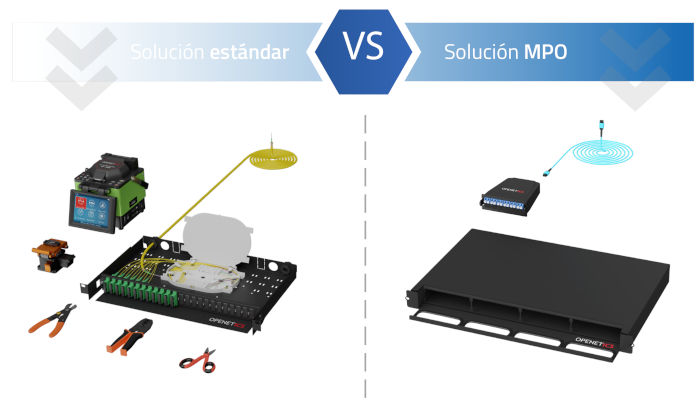
ADVANTAGES OF MPO FIBER OPTIC CONNECTORS
The use of fiber optic trunk cables with MPO connectors, usually 12 or 24 fibers, has many advantages for both the network administrator and the installation technicians, which we describe below:
• Trunk cable installations are much easier as they allow you to connect 12 or 24 fibers at once with a single MPO connector.
• The cables for these MPO connectors are very robust mechanically despite their small cross-section, facilitating the assembly and routing of trunk lines. They easily pass through very small openings and small-diameter conduits, as the MPO connector is only 13 mm wide.
• In challenging on-site work environments (confined spaces, limited resources and dirty environments) the use of fiber trunks with MPO connectors eliminates the need for tedious fiber handling and preparation, fusions, splicing, measurements, certifications and the need for highly specialized personnel.
All of this makes trunk lines with MPO fiber connectors the best technical and economic option. As can be seen in the image above, installing a fiber optic trunk line with standard cable and conventional connectors is an obsolete option.
MPO SOLUTION COMPONENTS
MPO connection cassettes (MM/SM)
Connection cassettes are metal or plastic boxes with a 12- or 24-fiber male MPO input connector on the back. Inside, the fibers are separated and connect to 12 or 24 numbered LC connectors on the front panel. These cassettes are supplied pre-assembled, fully wired, and with a laboratory certificate indicating the attenuation and return loss for each fiber, according to the different wavelengths at which they will operate. They are available for single-mode OS2 and multimode OM3, OM4, and OM5 fibers.
Patch panels 19” Removable MPO
These are metal panels for mounting on standard 19” profiles. The cassettes are securely installed on these panels without tools, and the backbone cable is secured with cable ties. These patch panels are mounted on extendable guides that allow for complete removal of the cassette assembly for installation and inspection.
The most common models according to their height are:
• 1 U: up to 4 cassettes.
• 2U: up to 8 cassettes.
• 3U: Up to 12 cassettes. Patch panel racks are also available to hold more than 12 cassettes.
From a technical, quality, and economic point of view, the use of MPO fiber optic trunks is undoubtedly the best option.
MPO SOLUTION
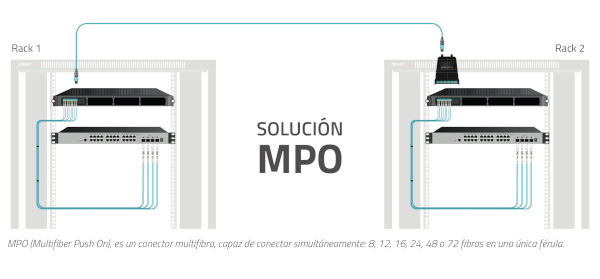
MPO (Multifiber Push On) is a multifiber connector, capable of simultaneously connecting: 8, 12, 16, 24, 48 or 72 fibers in a single ferrule.
STANDARD SOLUTION