Polymer optical fiber in cars, in industry – and now in homes. Decision-makers in telecommunications companies, the construction industry, installers, and individuals are discovering the advantages of this cost-effective yet strong and durable transmission medium for multimedia cabling.
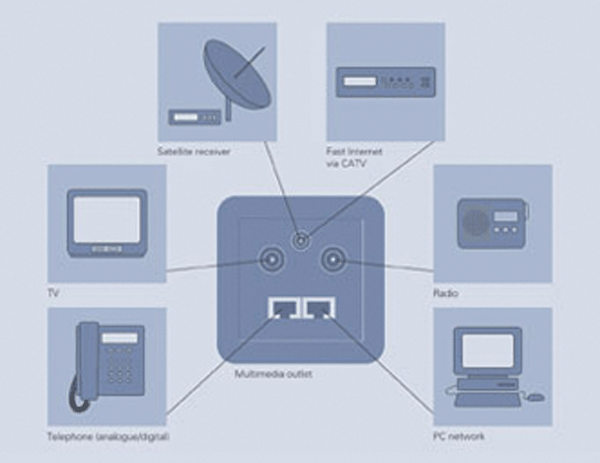
After years of reliable use in the automotive industry for specialized applications, Polymer Optical Fiber (POF) has largely gone unnoticed by the general public, its advantages for home cabling are now being recognized. High demand is expected for Triple Play services—telephone, internet, and television—through a single connection. Network operators are increasingly providing bandwidth to homes to carry these services. But how can this continue? More than 95 percent of existing homes lack multimedia connections in every room. Telephone line conduits are often too narrow to accommodate additional copper data cables, and WLAN and Powerline systems are too susceptible to external interference to carry multimedia content.
POF is a unique alternative for delivering Triple Play services to every room in a house. POF is very easy to install using existing wiring after the house is built, as fiber is non-conductive and can be safely run through electrical conduits. It is purely optical transmission. This offers a ray of hope for homeowners, installers, and telecommunications companies that need to deliver their services to customers. It is therefore no coincidence that Swisscom, the largest telecommunications operator in Switzerland, has also been using POF since the end of 2006.
 POF versus copper and conventional fiber - many advantages
The biggest advantage of POF compared to copper lies in its small size requirements while maintaining similar transmission performance. Like fiberglass cable, it presents no EMC issues. However, compared to glass, the polymer offers significant practical advantages, primarily because it is more malleable. Just compare the moldability of Plexiglas™ to window glass. Therefore, POF can withstand smaller bend radii and is more resistant to rough handling than fiber optic cables.
The much larger diameter of the fiber compared to optical fiber provides greater tolerance at the interfaces. Thus, POF can be more easily drawn into cable, polished, and assembled. This, in turn, reduces installation and maintenance costs. However, optical characteristics must be considered. POF is therefore suitable cabling for homes and industrial installations, but not for long-distance links or high bandwidths.
 Technical specifications
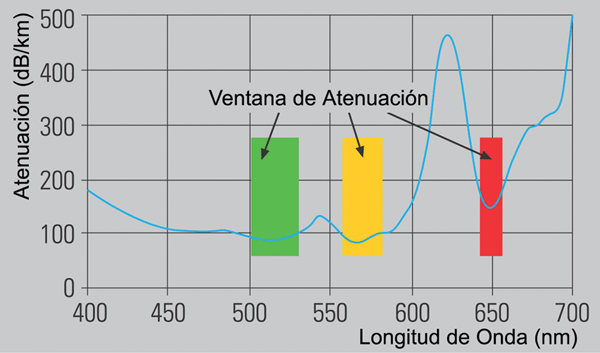
Wavelength and Attenuation: The usable wavelength ranges are determined, among other things, by the numerical aperture. This is a way of measuring how much light from a source actually reaches the fiber. Another criterion is attenuation. PMMA-POF has three transmission windows available, characterized by low attenuation. These are in the 525 nm, 575 nm, and 650 nm ranges. LEDs and transceivers for 650 nm are more widespread and readily available on the market at affordable prices. From a commercial standpoint, this is the most interesting wavelength since it appears as red light.
Reliability: Optical fiber conducts infrared light more efficiently than visible light. Transmission equipment uses infrared sources (LEDs or lasers), the output of which must be carefully calibrated to the center of the fiber due to its small diameter. Fiber optic cable (POF), however, conducts visible light. Because of its much larger diameter, small miscalculations or strong vibrations do not interfere. This makes it ideal for use in automotive manufacturing. A particular advantage is that a connection can be visually verified to ensure it is working.
Elasticity: POF withstands bend radii of less than 20 mm and operates in a temperature range of -40°C to +85°C. One million bend cycles are guaranteed. However, each bend produces some additional attenuation. Bending the fiber to its minimum radius typically results in a level loss of 10 to 15 percent.
Durability: POF does not oxidize, is insensitive to humidity and salty atmospheres, and ensures reliable connections for more than 20 years.
 POF for use in data networks.
POF is increasingly used for short-distance data communication. This type of application is where its advantages can be fully realized, for example:
- Anyone can install and connect it without the need for special tools.
- It is immune to high-frequency interference and does not produce interference signals.
- Fits in almost any conduit or pipe and can be safely installed alongside power lines.
- Provides sufficient bandwidth for normal distances, for both home and industrial use.
- Works with all existing transmission standards.
And in particular, it will be able to meet future bandwidth requirements that will make current transmissions seem primitive. The binary digital information of Zero and One is simply converted into On and Off light conditions. If ingenious modular processes are used, as has been common for DSL or WLAN for a long time, 1 Gigabit/second can be transmitted over 100 mA through POF – this has been confirmed in recent research reports.
POF – Polymer Optical Fiber
Polymer is the correct term for a synthetic material commonly referred to as plastic. An optical fiber is a medium that conducts light. It is used for optical examinations, illumination, and information transfer by encoding the light beam. POF resembles a nylon fabric and is mostly transparent to visible light.
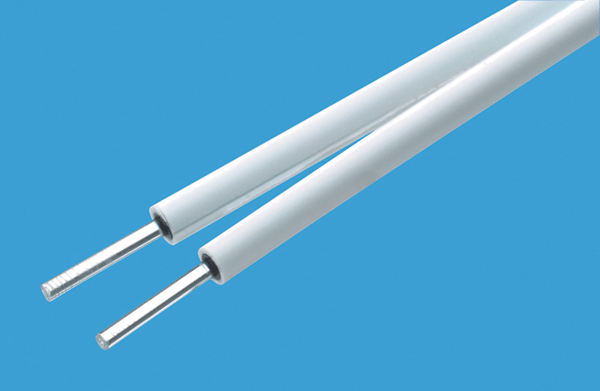
Typically, the fiber is composed of polymethyl methacrylate (PMMA) as the main material, coated with a fluorinated polymer. Light travels along the fiber without leaving it because it is reflected off the coating layer. PMMA-POF has a typical outer diameter of 1000 µm with a core diameter of 980 µm, meaning it is about eight times thicker than optical fibers. To make POF cable suitable for installation, it is coated with a polyethylene jacket. This gives the cable a diameter of 1.5 or 2.2 mm. It complies with international standards (EIA/TIA 569, CENELEC EN 50174-2).
POF – preferred applications
- Automotive (MOST®, Byteflight™).
- Robotics (eg Sercos, Profibus®, CAN, Industrial Ethernet).
- Multimedia (IEEE 1394, FireWire™, i-Link).
- Video monitoring, internal television systems.
- Digital Audio.
- Fast Ethernet, Triple Play.
 Author:
Juan Pablo Muñoz Hernández, Head of Engineering for R&M in Spain and Portugal