Next, we will review the different requirements for the various components of an optical cable, as well as the responses offered by the market and the keys to correctly identifying the offer.
It is increasingly common for those responsible for purchasing or installing fiber optic cables to encounter descriptions such as "multimode 'n' fiber cable for indoor/outdoor use, moisture-proof and rodent-proof," or "single-mode 'n' fiber cable, dielectric and with flame-retardant jacket." Is this sufficient for an accurate description of what is needed? What specific information is required to achieve a precise definition of the necessary specifications?
Let's examine the structure of this type of cable in some detail, so we can answer these questions:
Generic Description of a Fiber Optic Cable: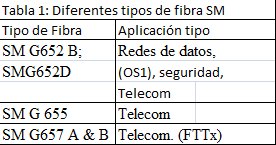 Optical cables consist of two basic components, each of which must be selected appropriately based on the specifications received or the work to be carried out:
- The optical core: Formed by the set of optical fibers, it constitutes the waveguide system responsible for data transmission. Its characteristics will be defined by the nature of the network to be installed. This will determine whether it is a cable with single-mode, multi-mode, or mixed fibers.
- The protective elements: Their purpose is to protect the optical core from the environment in which the cable will be located, and they consist of various elements (sheaths, armor, etc.) superimposed in concentric layers starting from the optical core. Depending on its composition, the cable will be for indoor use, outdoor use, installation in conduits, aerial use, etc.
The Optical Core: Fiber Types.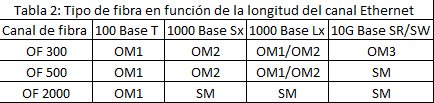 Basically, the optical fibers currently available on our
market are divided into two main groups, generally selected based on the application:
Single-mode optical fiber: For long-distance or high-bandwidth needs. It is clearly defined by the acronym SM followed by the corresponding standard, as shown in Table 1.
Cables supplied in standard formats by different manufacturers are usually made with fibers of the type listed in the first row of Table 1, so any other type must be expressly indicated.
Multimode optical fiber: Commonly used in local area networks (LANs), surveillance, or security systems.
Its definition consists of three parts:
- MM (Acronym corresponding to the MultiMode designation)
- Core/cladding ratio (Normally 50/125 or 62.5/125)
- Fiber type: OM1, OM2 or OM3 according to Table 2.
Security networks (industrial control and baseband video) use MM fibers (types OM1 or OM2 interchangeably), of 62.5/125 or 50/125 depending on the distance requirements.
Tight construction. This involves individually coating each fiber with an extruded plastic sheath, reaching a diameter of 900 µm. Aramid or fiberglass yarns are then placed around the fibers to achieve the necessary tensile strength. The cable is constructed using this base. Its main advantage is excellent moisture protection and considerable flexibility and mechanical strength. Its main drawback is the difficulty in manufacturing cables with more than 24 fibers.
Loose-tube construction: Individual fibers, maintaining their 250 µm outer diameter, are housed, up to 24 in number, inside plastic tubes containing a water-repellent gel that acts as a moisture barrier. Type-R cables have gel between the tubes for additional protection. This method allows the manufacture, using these tubes as a base element, of cables with a large number of fibers (single-tube up to 24 fibers and multi-tube beyond, up to 256 optical fibers) and relatively small outer diameters. The optical core thus constructed is complemented with an element to provide tensile strength (a flexible metallic or dielectric rod as the central element; or aramid or fiberglass yarns located peripherally). Disadvantages include the possibility of lack of moisture protection in vertical sections, due to the fluidity of the gel, and the relative fragility of individual fibers to breakage.
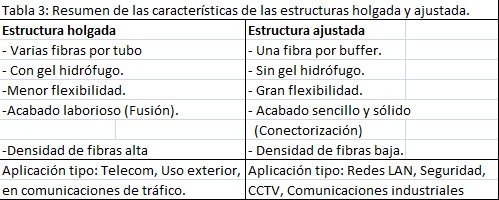
Table 3 summarizes the main characteristics of both types of structures.
Protective elements: The sheaths
are those parts of the cable that, in contact with its environment, form a barrier against potential damage from external agents.
Generally constructed from different plastic materials, whose characteristics are summarized in Table 4, they take the form of a single sheath in so-called "indoor" cables and of an inner sheath (close to the optical core) and an outer sheath (in contact with the environment) separated by armor. This double sheath serves to maintain the protection of the core in the event of damage to the first sheath, such as can occur in the case of rodent infestation or accidental puncture.
Protective Elements: Armor.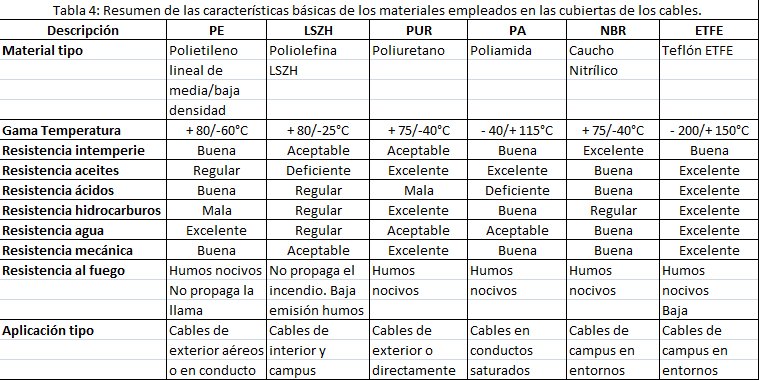 Its function within the cable is to provide additional protection against certain types of damage, such as crushing, rodent attacks, fire, etc.
It generally consists of elements (rods, yarns, braids, or sheets) of steel or fiberglass located between the two outer jackets (if present) or under the outer jacket in cables of this structure.
Metallic armor, perhaps more effective as protection against rodents, has the drawback of eliminating one of the desired advantages of a fiber optic link: its dielectric properties.
Dielectric armor is usually of several types:
- Fiberglass rods: very strong, they provide high rigidity to the cable.
- Fiberglass yarns: maintain flexibility, have a deterrent effect against rodents, but their effectiveness decreases at bends in the cable due to displacement.
- Fiberglass braid: Adds permanent protection to the previous advantages (dielectricity and deterrent effect), and in some cables (such as the OPTRAL CDAD type) it constitutes a fire barrier.
Once the above considerations have been taken into account, one important point remains to be analyzed:
How are all these characteristics translated into the naming of fiber optic cables, for easy and quick identification?
Identifying Fiber Optic Cables: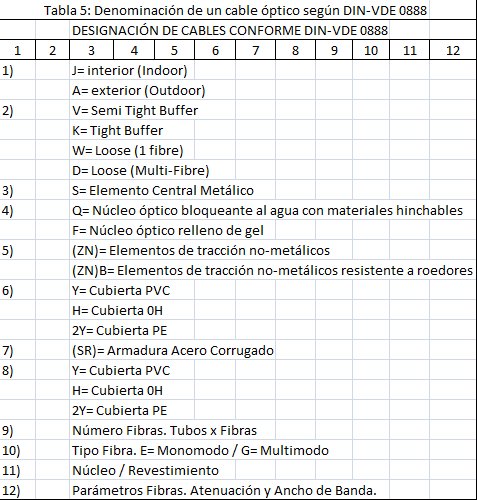 Table 5 describes the composition of the optical cable from the outside in, allowing for easy identification. For example, a
JK(ZN)H12G50/125OM3 type cable would correspond to:
- J: Indoor cable.
- K: Tight-fitting.
- ZN: Non-metallic tensile elements.
- H: LSZH (Zero Halogen) jacket.
- 12: 12 fibers.
- G: Multimode.
- 50/125 OM3.
Another way to refer to loose-structure cables, used by most agents present in the market, is usually by describing them, from the outside in, using symbols such as:
- P: Polyethylene
- T: LSZH thermoplastic material
- D: FV: Fiberglass
- S: Steel
- E: Watertight
- -R: Filler
- -1: Single tube.
Thus, a PESP-R 8 x SM cable would be a watertight cable with double filler, a loose-tube structure, a double PE jacket, and steel armor, containing 8 SM optical fibers.
Tight-tube cables, generally used in LAN and security applications, often use designations related to their generic application. Therefore, it is common to find identifiers such as CDI (Indoor Distribution Cable) or CDAD (Dielectric Armored Distribution Cable) in these cases. It is essential to verify its construction against the necessary requirements by referring to the corresponding technical description.
Conclusion
: In light of the above, when defining or selecting a fiber optic cable for a specific application, it is not sufficient to simply state the generic application (e.g., "indoor/outdoor" or "rodent-proof/moisture-proof"), but rather it is necessary to identify the different components of its structure (optical core, cladding or jacket, armor) to ensure the use of the appropriate material and the desired results. Generally, a lack of uniformity in the compared elements can lead to confusion. Let's look at an example:
- A cable with “metal armor and outdoor sheath, with 24 MM 50/125 optical fibers” may correspond to:
One SP-124x50 OM1 type cable: single-cover, steel armor, monotube, 8 fibers of 50/125 OM1 (suitable for Gigabit at 1300 nm)
A PESP-R 24 x 50 OM3 type cable: Double sheath cable, steel armor, 50/125 OM3 multitube (suitable for 10 Giga at 300 m.)
A CDAM 24 x 50 OM2 type cable: Tight structure cable, double jacket, steel fiber braid armor, 24 fibers 50/125 OM2 (suitable for Gigabit at 850 nm).
Obviously, the prices won't be the same, but neither will the performance, and the risk of making a mistake exists.
Therefore, it seems logical to conclude that, to correctly identify an optical cable, the following information is needed:
- Optical core: Fiber type and number, structure type (loose or tight), and strength element type (central or peripheral).
- Cladding: Number (single or double) and type (generally PE or LSZH. Special cases: PUR or NBR).
- Armor: Dielectric (rods, yarns, or braid) or metallic (corrugated steel sheet or braid).
- In general: Mechanical characteristics required by the project or installation type (tensile strength, bending radius, etc.).
Once this data is located, we will be able to know and compare the cable among the available alternatives.
Miguel Angel Matesanz. Commercial Director of C3 Cables and Components for Communications, SL.