 With the development of modern industrial and local area networks (LANs), the demands on data transmission speeds have steadily increased. Today, industrial networks and LANs operate at data transfer rates of up to 10 Gbit/s. Conventional transmission systems, with their inexpensive LED emitters and a maximum data transfer rate of 622 Mbit/s, are therefore no longer adequate for current data transfer needs. To achieve the high data transfer rates of modern industrial and local area networks, LED emitters have been replaced by laser emitters. This shift from LEDs to lasers has had a decisive impact on the manufacture of optical fibers. Multimode fibers with 850 nm laser diodes (VCSELs) are considered the most cost-effective solution for industrial networks and LANs, and are therefore commonly used in these types of networks. As part of the market shift from LEDs to lasers, a new generation of laser-optimized multimode fibers emerged in the late 1990s. This article highlights the differences between conventional multimode fibers and laser-optimized multimode fibers. Furthermore, it emphasizes the critical importance of selecting high-quality, laser-optimized multimode fibers to achieve high data transfer rates in industrial networks and LANs.
Optical Fiber Transmission with LEDs and Lasers:
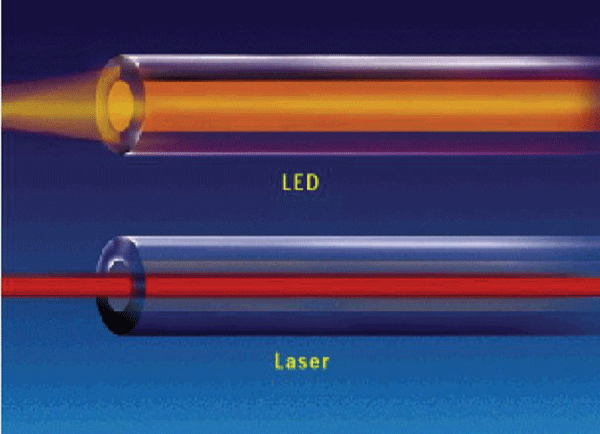
When light is coupled into a multimode fiber, it has several paths along the fiber core. Each of these paths is called a mode, hence the name "multimode fiber." The light emitted by an LED (Light Emitting Diode) differs from the very narrow beam of a laser due to its large beam angle (Figure 1). When coupled into a multimode fiber, the highly divergent beam of an LED "fills" the fiber core, thus exciting many modes. Under similar conditions, a laser in a multimode fiber excites only a few modes, which are, in principle, only those that pass through the central region of the fiber core.
Laser-Optimized Multimode Fiber:
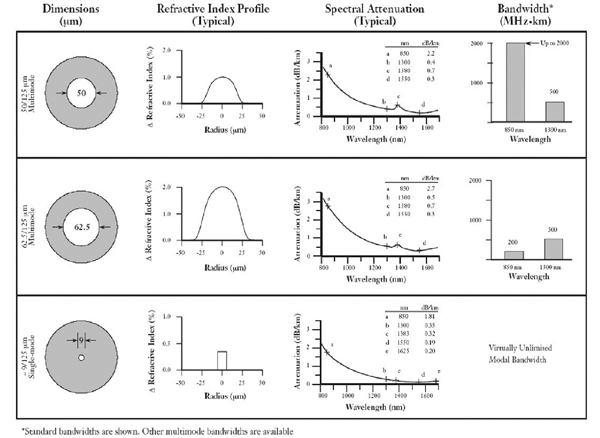
The region at the center of the optical fiber has a high refractive index and constitutes the optical path through which light can propagate by total internal reflection. 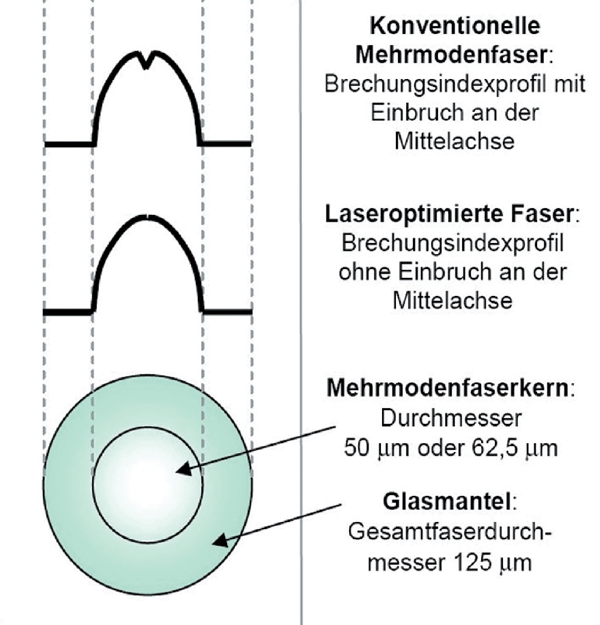 In multimode fibers, the refractive index decreases gradually with increasing distance from the fiber center to create a gradient-index profile (Figure 2). The gradient-index profile ensures that all light arrives simultaneously at the end of the fiber system, regardless of the modal transmission path used. Aberrations in arrival time are referred to as modal dispersion. The throughput capacity of a multimode fiber is rated in terms of bandwidth or maximum data transfer rate and range, and is expressed in MHz·km. Bandwidth is inversely proportional to modal dispersion.
When a laser is coupled into a multimode fiber, the laser light is spread over a very thin region of the fiber core, typically the central region. The ability of fibers to transmit lasers depends largely on the homogeneity of the refractive index gradient profile of the fiber core in this region. The refractive index profile of the core of a conventional multimode fiber exhibits an anomalous dip along the central axis, as shown in Figure 2.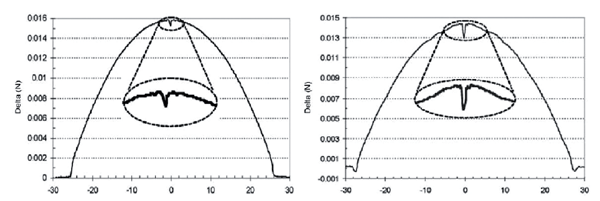 Clearly, such an anomaly at the center of the refractive index profile has a greater effect on the thin, concentrated beam of a laser than on the highly divergent light of an LED. To support modern transmission systems with high data transfer rates, lasers should be used instead of LEDs. Refractive index anomalies along the central axis manifest in laser signals as distortions in the transmitted signal and as high bit error rates. Thus, the maximum data transmission rate is limited in the system, so, paradoxically, the combination of a laser transducer and a conventional multimode fiber is not suitable for transmission systems with a data transfer rate of 10 GBit/s.
To solve this problem, it is necessary to optimize the refractive index profile at the center of a multimode fiber for laser transmissions. Although this is relatively expensive, the goal should be to eliminate all anomalies at the center of the refractive index profile. According to their own data, in 1998 Corning was the first optical fiber manufacturer to introduce a new generation of multimode fibers optimized for laser transmissions. The ideal refractive index profile of a laser-optimized multimode fiber is shown in Figure 2. It can be seen that all anomalies along the central axis have been eliminated, thus excluding system limitations or signal distortions caused by anomalous dips along the axis.
Laser Optimization and Manufacturing Methods:
Recent studies show that the quality of multimodal fibers, specifically the homogeneity of their refractive index profile, varies depending on the 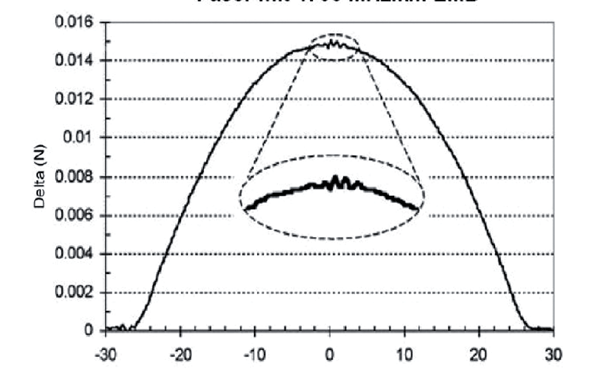 manufacturing method. Tests performed on laser-optimized fibers from leading suppliers, manufactured using MCVD (Modified Chemical Vapor Deposition) and PCVD (Plasma Chemical Vapor Deposition) methods at 10 GBit/s with lengths of 150, 300, and 500 meters and an wavelength of 850 nm, revealed that approximately 50 percent of the tested fibers exhibited an anomalous decrease in the central axis (Figure 3a). Furthermore, all affected fibers experienced failures in laser center determination. Conversely, according to experts, the OVD (Outside Vapor Deposition) fiber manufacturing method achieves optimal homogeneity in the refractive index profile, such that laser-optimized multimode fibers manufactured using this method exhibit virtually no central axis deflection (Figure 3b).
 Another significant challenge, unique to the MCVD and PCVD methods, lies in ensuring a homogeneous bandwidth along the entire fiber length. This problem can become apparent when certain sections of the fiber exhibit a bandwidth different from that determined for the entire fiber length. Given the high degree of fluctuation that occurs in laser optimization of multimode fibers, it is crucial to subject all multimode fibers intended for use in high-quality laser transmission systems to rigorous testing and classification procedures.
LED and Laser Performance Classification:
The high data transfer rate (determined from bandwidth and range) of a given fiber is determined by the delay between excited modes and by the energy sharing among the modes. For this reason, the performance of conventional multimode fibers (for use with LEDs) must be classified according to the OFL (Overfilled Launch) bandwidth measurement method, which simulates the coupling conditions of an LED. The coupling conditions for lasers are completely different. Therefore, new performance classification methods that take into account the special coupling conditions of a laser are needed for the new generation of multimode fibers.
Several classification methods exist: DMD, RML, and minEMBc. The RML (Restricted Mode Launch) bandwidth was the first standardized index for laser-optimized fibers according to the TIA-455-204 standard. This method is suitable for bandwidth forecasts up to 1 GBit/s. For transmission systems with data rates up to 10 GBit/s, the newest and most accurate method for determining the transmission capacity of multimode fibers with higher bandwidths is required: the minEMBc (minimum calculated Effective Modal Bandwidth) method. minEMBc is supported by the TIA/EIA 455-220 and IEC 60793-1-49 standards and, in the fiber optic industry, is considered the only reference measurement for large bandwidths, based on DMD and inherently scalable for forecasting various bit rates and lengths. In contrast, other measurement methods only provide a pass/fail result for 10 GBit/s over 300 meters.
For a 10 Gbit/s laser-optimized multimode fiber that is not classified according to the most modern and accurate bandwidth measurement methods, a complete performance guarantee cannot be offered. In particular, for multimode fibers manufactured according to MCVD or PCVD methods, the data supplied by the manufacturers may be subject to some fluctuations due to axial bandwidth inhomogeneity or because the anomalous refractive index drop along the central axis has not been completely eliminated.
Conclusion:
Modern industrial networks and LANs must enable data transmission at 12 Gbit/s and higher to support Gigabit Ethernet, 10 Gigabit Ethernet, and Fibre Channel protocols. Consequently, LEDs, whose data transfer rate is limited to 622 Mbit/s, have been replaced in such networks by lasers, particularly VCSELs with an 850 nm wavelength, as light sources. Furthermore, laser-optimized multimode fibers have superseded conventional multimode fibers, enabling cost-effective, high-performance laser transmission systems. However, differences exist among laser-optimized fibers depending on the manufacturing method. Fibers manufactured using the OVD method do not exhibit an anomalous decrease in the refractive index along the central axis and have good axial homogeneity. In contrast, fibers manufactured using the MCVD or PCVD methods have limitations in this regard. To ensure the performance of a large number of standard VCSELs, the throughput capability of 10 GBit/s fiber must be determined using the minEMBc index. Corning manufactures its multimode fibers (Infinicor) using the OVD method and uses the minEMBc index to classify its 10 GBit/s products.
Random testing is not enough.
Furthermore, this fiber optic supplier measures the laser bandwidth of every meter of every fiber reel because, according to their own information, they believe that random testing alone is insufficient. This is intended to guarantee that all fibers meet the manufacturer's specifications 100%. In this context, quality control is of paramount importance.
Bibliography
- P. Bell, Todd Wiggs, “Multimode fiber and the Vapor Deposition Manufacturing Process”, Corning Optical Fiber Guidelines, web publication, volume 10, July www.corning.com/opticalfiber/guidelines_magazine/eguidelines/vol10/view.aspx?article=2&page=1®ion=na&language=en 2005
Technical Sources
- Premises Fiber Selection Guide (Premises for the selection of optical fibers in industrial networks) http://www.corning.com/docs/opticalfiber/WP1160.pdf
- Evolution of 50/125 mm fiber since publication of IEEE 802.3ae (Evolution of 50/125 mm fiber since the publication of IEEE 802.3ae) http://www.corning.com/docs/opticalfiber/WP4253.pdf
- With calculated EMB, SR 10G is guaranteed (EMB calculation guarantees SR 100 http://www.com.ng.com/docs/opticalfiber/r3716.pdf)
Equinsa Networking