 In 2G and early 3G services, a small number of TDM E1/T1 links were sufficient, as each voice channel consumed only 8 kbps. However, the requirements of HSPA and LTE make the use of traditional E1/T1 links economically unfeasible, since the bandwidth consumed by a mobile broadband user can reach several Mbps. Thus, while 1-2 E1 links per base station were sufficient in a 2G network, HSPA would require 8-16 E1 links. LTE offers significantly higher bandwidth and spectral efficiency than its predecessor technologies. LTE will allow download speeds of over 150 Mbps and upload speeds of over 50 Mbps. LTE is an "all-IP" technology, which represents the transition from 3G, TDM, or ATM to IP carriers for transporting user traffic and signaling, entailing major changes to the backhaul network.
Due to coverage, terminal, and other factors, 4G and 3G/2G networks will coexist for several years. Therefore, depending on the infrastructure deployed by the operator and the radio technology (2G, 3G, 4G), the optimal technical and economic solution will involve equipment on different physical media: radio (PDH, SDH, Ethernet, or hybrid TDM-packet microwave equipment), copper (xDSL equipment), or fiber optic (GPON, P2P fiber, or WDM-PON equipment). The traffic generated by this equipment will be aggregated using SDH-NG, Carrier Ethernet, ATM, or IP/MPLS equipment. This gradual shift to IP transport will simplify network design, reduce infrastructure costs, and allow all access technologies to be managed over a single backbone network.
Although the most historically used physical media for “mobile backhaul” have been radio and copper, the reduction in the price of fiber optics and its well-known benefits, as well as the demanding requirements of LTE, have made it the ideal medium for making this connection between the radio access network and the operator's backbone network.
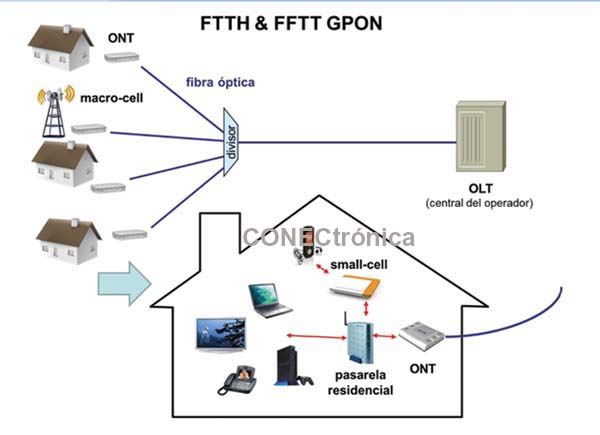
Thus, the terms FTTT (Fiber-To-The-Tower) and FTTCS (Fiber-To-The-Cell-Site) have emerged, by analogy to FTTH (Fiber-To-The-Home), FFTB (Fiber-To-The-Building), and FFTC (Fiber-To-The-Curb) in the residential and business markets. Fiber to the tower offers significant improvements in bandwidth, latency, and signal quality. Furthermore, fiber optic access networks offer advantages in terms of operating costs due to lower power requirements, reduced interference, and other factors. Operators can reuse the fiber optic infrastructure deployed for FTTH/B for FTTT/CS, increasing their return on investment. Moreover, some of these users may have "small cells" installed in or near their homes or offices to improve coverage and optimize data rates for their mobile devices. In this case, both “macro-cells” and “small-cells” would be connected to the operator's backbone network via fiber optic connections, although the “small-cells” would share the fiber with the rest of the end user's devices and services.
 The term FFTA (Fiber-To-The-Antenna) is also used when the fiber optic cable is run "higher," replacing traditional coaxial cable in new construction or upgrades of the interconnection between the base station and the antenna itself. Installing fiber all the way to the top of the antenna offers additional benefits, as the coaxial cables used by antennas are relatively wide and heavy, take up more space, are inefficient in terms of power, require more installation labor, and so on. Mobile operators pay the owners of the sites where the antenna is located depending on the number and size of the components installed, so the more compact they are, the lower the cost. In other words, the smaller size, greater flexibility, and lighter weight of fiber optic cable are preferable.