

- Details
- Category: Fiber Optic Fusion Splicers
-
By Carlos Martinez
Fusion fuse machine with high resistance to environmental conditions
Lately, fiber optic cable installation work is shifting from developed countries to BRIC countries and developing countries, where environmental working conditions are harsh and infrastructure is not very advanced.
Therefore, the market needs a fusion splicer capable of maintaining high performance even in demanding environments. To meet this market need, Fujikura has developed a new fusion splicer in the FSM-60 series.
In the BRIC countries and emerging markets, where the expansion of telecommunications infrastructure is experiencing rapid growth, fiber optic splicing is being carried out on a large scale.
With the diversification of fiber optic installation work and the increasing use of fiber optics, the demand for fusion splicers reflects a growing appreciation for functional improvements, such as lightweight design, reduced splicing time, and robust construction for use in harsh environments.
With the diversification of fiber optic installation work and the increasing use of fiber optics, the demand for fusion splicers reflects a growing appreciation for functional improvements, such as lightweight design, reduced splicing time, and robust construction for use in harsh environments.
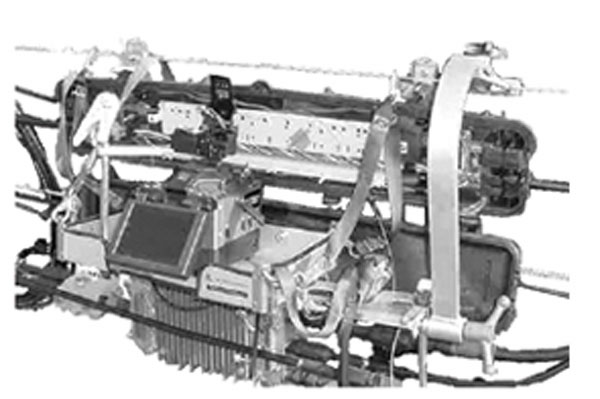
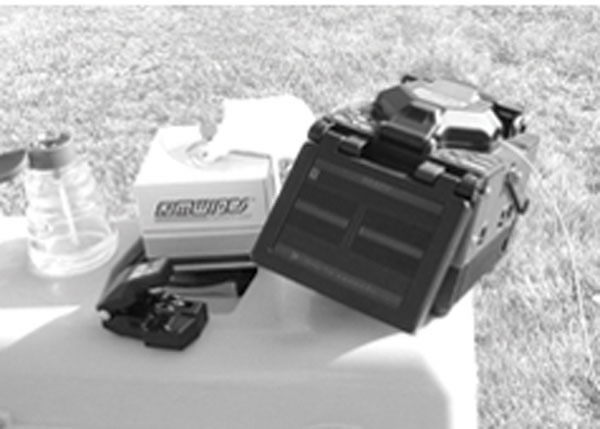
 The FSM-60 series has been developed to meet the need for resistance to shock, dust, and rain.
Product Overview
: Figure 1 shows the FSM-60S model.
Table I shows a comparison of the specifications between the single-fiber fusion splicer model and the ribbon-fiber model.
Features
Improved shock resistance
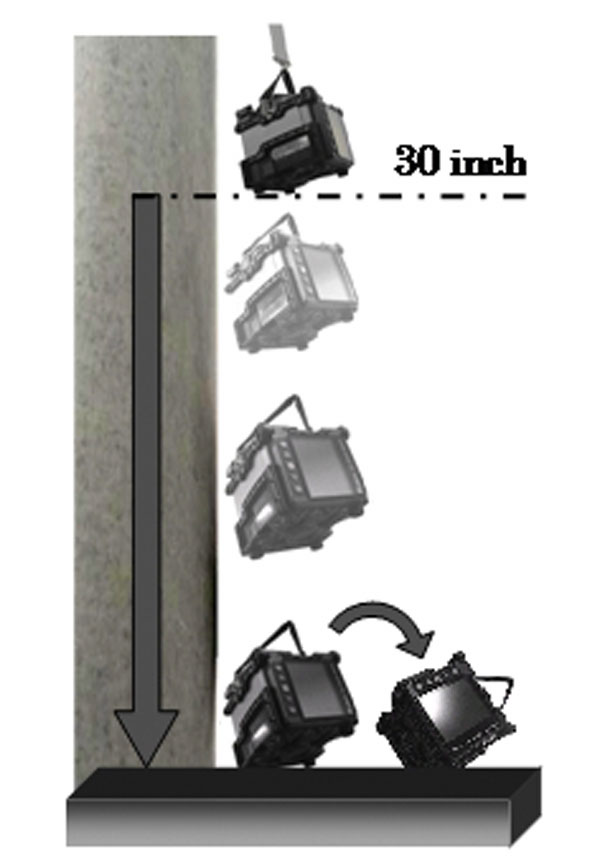
 The splicing procedure is performed in an environment ranging from the top of a telephone pole to a basement. As the operator carries, installs, and handles the fusion splicer in these work environments, the device can be bumped and damaged. (Figure 2 and Figure 3).
Installation of elastomer protectors
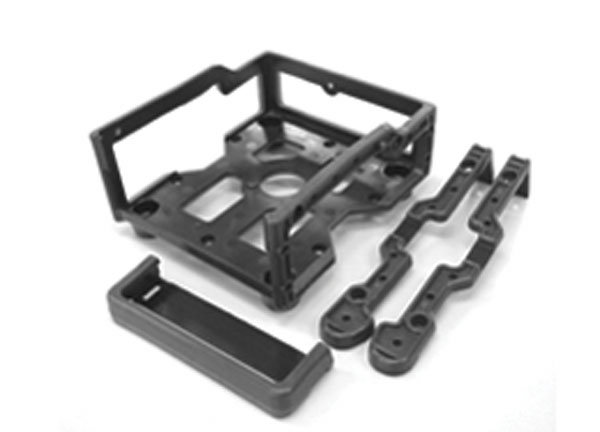
 In the FSM-60 series, elastomer pads have been installed around the unit to increase its impact resistance. Figure 4 shows the elastomer pads.
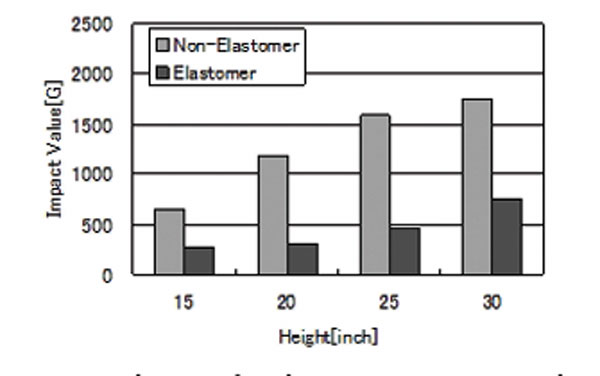
Figure 5 shows a comparison of the impact damping results with and without elastomer pads.
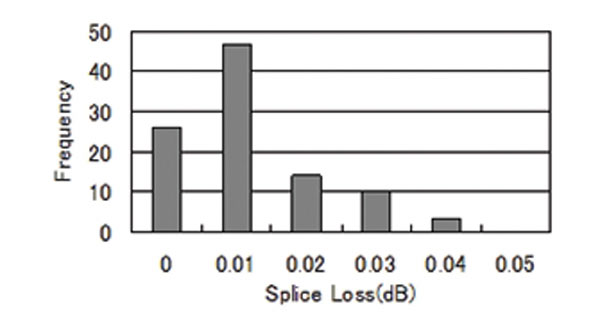
The impact on the fusion splicer can be reduced by half when it is equipped with elastomer pads, compared to the unit without them. However, the elastomer alone is not sufficient to withstand a 76 cm (30 inch) drop (Figure 6). Impact resistance is achieved by reducing the weight of the guide section, as shown in the following section. Figure 7 shows the fusion splicer test results.
Weight reduction in the guide section
 The guiding section is the area where impact resistance is most challenging. Since reducing the number of screws is insufficient to increase impact resistance, the internal structure was redesigned to reduce weight. This resulted in a lighter overall unit, and the measure proved effective.
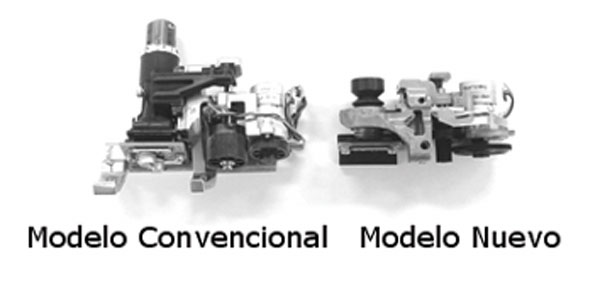
This section explains the weight reduction of the focus alignment unit in the core alignment fusion splicer. The focus alignment unit is the system that monitors the image of the optical fiber core and alternates the focus of the fibers within it. In the FSM-60S model, we have achieved a weight reduction of up to 30% compared to conventional models. Figure 8 shows the external view of the focus alignment unit in both a conventional model and the new model.
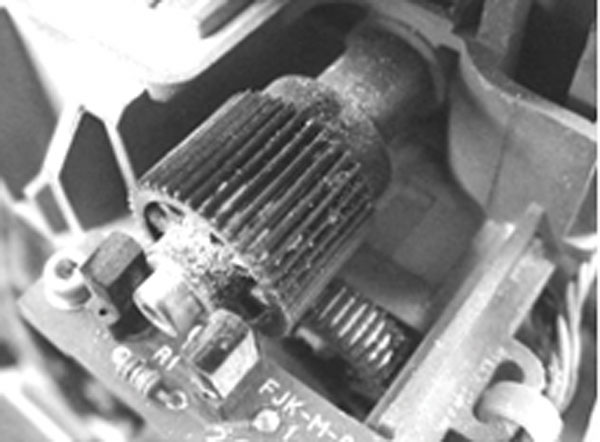
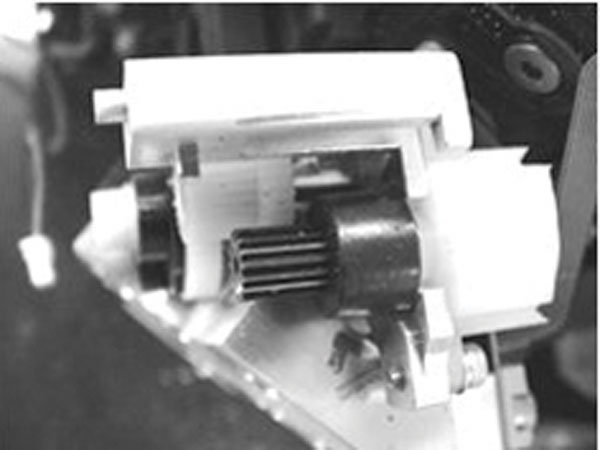
Figure 14. Internal condition of the gear after the dust test.
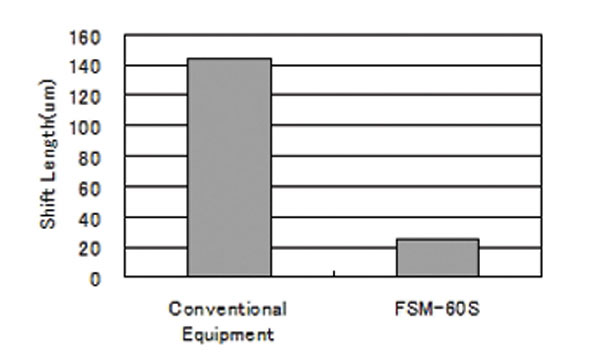
Figure 9 shows the camera deviation after a drop from a height of 76 cm. The camera deviation has been reduced to one-fifth compared to conventional models, and the structure has demonstrated its resistance to impacts.
Carrying handle dimensions
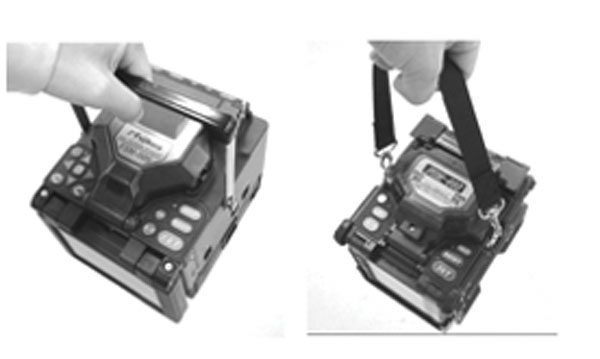
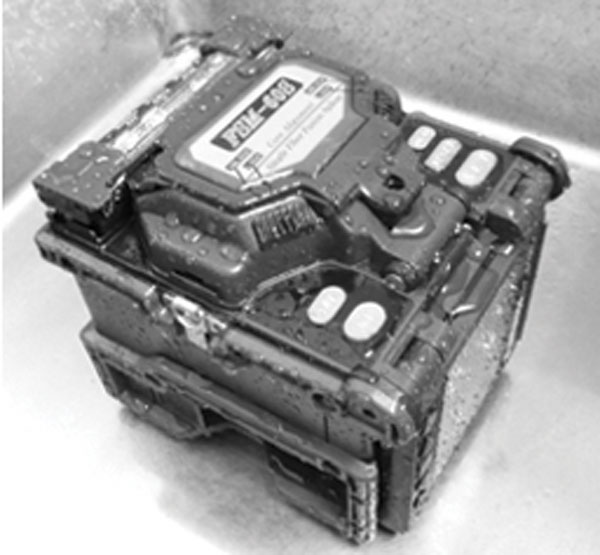 In the conventional fusion splicer, as shown in Figure 10, a metal carrying handle was used.
However, if the handle were struck by a fall, a micron-sized distortion would occur in the main body. Therefore, in the FSM-60 series, the handle has been changed from metal to fabric. This prevents the impact from being transmitted to the main body.
LCD Screen Measurements:
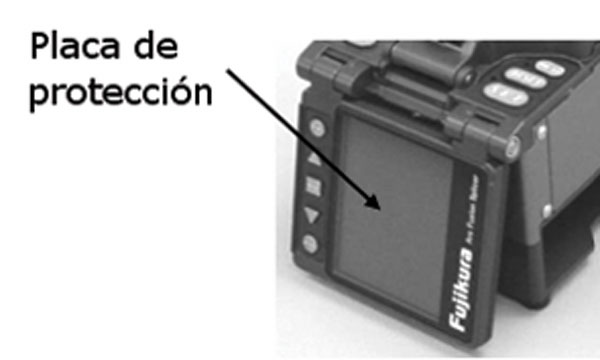
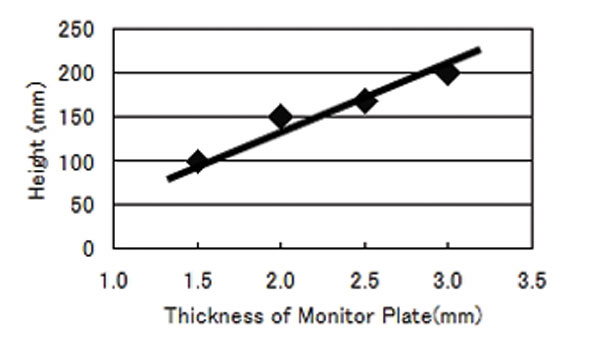
The LCD monitor is not damaged by a fall, but it can break if it hits an object on the ground. When the liquid crystal display is struck by a protrusion during transport of the fusion splicer, damage occurs. Therefore, as shown in Figure 11, we have installed a 3 mm thick protective film to prevent the monitor from breaking upon impact. Figure 12 shows the results of the film's protection test, which consisted of dropping 500 steel balls from a height of 200 mm. The 3mm protective film was undamaged, demonstrating the improvement in its effectiveness.
Improved dust resistance
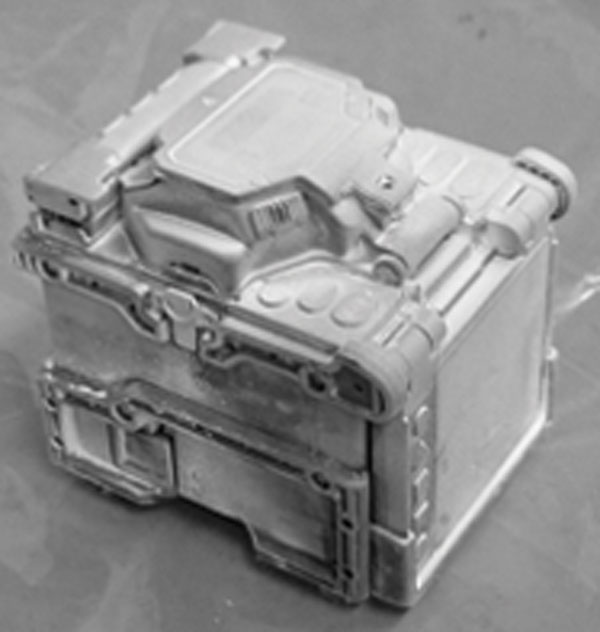
The splicing procedure is frequently performed outdoors, exposing the fusion tool to the ingress of sand or dust particles. If these coarse particles adhere to the gear or bearings, errors in the splicing procedure can occur. The FSM-60 series features a structure that prevents the ingress of sand or dust when the wind guard is closed. Figure 13 shows the appearance of the fusion tool after a dust test.
Figure 14 shows images of the gear from the conventional model and the FSM-60 series. Dust and sand ingress has been controlled, compared to the conventional model, by revising the component's structure.
Figure 14 shows images of the gear from the conventional model and the FSM-60 series. Dust and sand ingress has been controlled, compared to the conventional model, by revising the component's structure.
Improved Water Resistance:
The FSM-60 series features an exceptionally water-resistant structure that prevents water from penetrating the inside of the fusion splicer when the wind guard is closed. Figure 15 shows the results of the rain test. It confirms that no water penetrates the unit after withstanding a rainfall force exceeding R=10 mm/h for 10 minutes.
Conclusion
: The new FSM-60 product successfully incorporates improvements in resistance to impact, dust, and rain compared to conventional fusion splicers.
Fujikura Technical Review, 2009
Telecom Unitronics is the official distributor of Fujikura in Spain.
Authors:
Toshiro Mizushima, Makoto Iwamatsu, Ichiro Yano, and Noriyuki Kawanishi.
Precision Instruments Department, Fiber Optic Components and Systems Division
, FUJIKURA

-
-
AFL launches the new Fujikura 12S fusion splicer.
AFL introduces the new Fujikura 12S fusion splicer, the world's smallest, lightest, and most portable. Measuring just 12.09cm wide x 16.20cm deep x 5.69cm high, the feature-rich 12S splicer is designed to increase field efficiency. -
Power arc calibration for fusion of optical fibers with various diameters (and Part 2)
This article describes a new arc calibration method for a wide range of fiber sizes. This method heats the fiber with multiple short arcs of varying arc power. The melting point is then measured at the corner of the fiber ends instead of along the fiber axis.
-
Power arc calibration for the fusion of optical fibers with various diameters
A new arc calibration method has been developed for fusing optical fibers with a wide range of glass diameters. This method heats the fiber with several short arcs and measures the amount fused at the corners of the fiber terminations. The fusion rate at the...
-
External battery charger for SUMITOMO fusion splicers
The Fibercom team, as the official representative in Spain of Sumitomo Electric, adds the latest product presented by Sumitomo to its portfolio. -
Q102-M12+ Tape Fiber Splicer and JR-7 Thermal Stripper #sumitomosplicers
Sumitomo Electric announced the launch of the Q102-M12+ in 2023, an AI-powered ribbon fiber splicer, and an advanced thermal stripper, the JR-7. The Q102-M12+ is based on its predecessor, the Q102-M12, and features new technologies that improve splicing performance, the...



Newsletter
Latest News
UFV students achieve a 187.7 km HaLow Wi-Fi communication in the stratosphere
Nine students from the Higher Polytechnic School of the Francisco de Vitoria University (UFV)...
The ITU updates its guidance on precision time synchronization for critical networks and infrastructure
The International Telecommunication Union (ITU) has published a new edition of its manual...
FWA connections in Asia-Pacific will grow by 12.5% annually until 2031, according to GlobalData
Fixed wireless access (FWA) connections in the Asia-Pacific (APAC) region will register...
PowerON by Sonepar Spain brings together 6,000 professionals and 56 exhibitors in its first edition
PowerON by Sonepar Spain brings together 6,000 professionals and 56 exhibitors in its first edition...
Nokia agrees to sell its Enterprise Campus Edge business to AURELIU
Nokia has signed a definitive agreement for the planned sale of its Enterprise Campus Edge business...
Social networks
 |
 |
 |
 |
 |
Technical Courses and Seminars

Factory Tomorrow analyzes networks and infrastructure for industrial AI and Industry 4.0
The season consists of three episodes and features Phoenix Contact and Belden....

Mouser drives IoT development with its LoRaWAN resource center and new wireless connectivity solutions
Mouser Electronics, Inc. highlights its comprehensive LoRa® resource center as the market accelerates...

DataCom: Technical guide for networks, fiber optics and structured cabling
Digital transformation has turned data networks into a critical infrastructure for...
Taoglas launches The Antenna Podcast, a new technical space about antenna design and innovation
Antennas remain one of the most critical and, at the same time, most misunderstood elements in...
ISE 2026 Barcelona: Summits, Megatrends and the most ambitious content program in the AV sector
Returning to Barcelona in February 2026, Integrated Systems Europe (ISE) presents its program of...