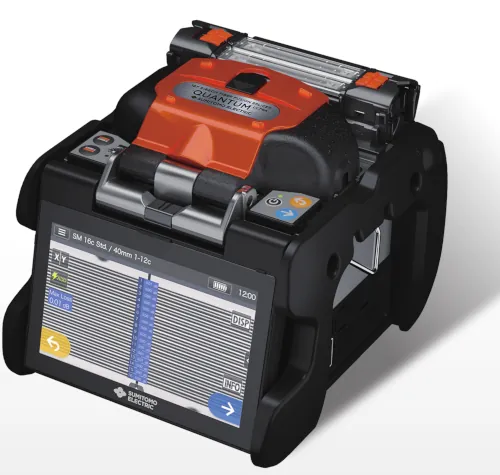
The Quantum-Ultra-Ribbon is part of Sumitomo's Quantum family (enhanced Q-series ribbon splicers). It is specifically designed for fusion splicing (models available for 12f and 16f depending on the version).
It can operate in field environments with dust/water protection and shock resistance (drop tests and IK/IP ratings are available in the datasheets).
Sumitomo Electric
NanoTune™ + AI for fibers is a fine-tuning alignment algorithm that optimizes fiber alignment in pleats, reducing losses and the need for reprocessing.
It incorporates ACAS (Auto Clamping Adjustment System)—an automatic clamping adjustment system that compensates for dimensional variations and facilitates the positioning of ribbons with a pitch of 200/250 µm.
It also includes patented V-grooves and coatings—V-grooves and lenses with a non-stick coating to reduce contamination and facilitate cleaning and maintenance.
Its dual independent heaters allow for consecutive heating operations (two shields at once/optimized workflow) and accelerate splicing and heating throughput in high-volume jobs.
Other features include data recording and management—splicing image capture, local storage, and support for SD cards and analysis software (SumiCloud/PC tools).
Its size is 128 × 154 × 130 mm (width × depth × height, without protective rubber), with a weight of 1.8 kg (without battery) / 2.1 kg (with BU-16 battery) (model Q102-M12+).
It offers a 5-inch WVGA touchscreen — smartphone-type interface.
Other features
- Power supply: AC 100–240 V (ADC series) / DC 10–15 V / 10.8 V Li-ion battery (e.g., BU-16, 6,400 mAh).
- Operating conditions: typical temperature −10 °C to 50 °C; storage −40 °C to 80 °C; altitude up to 3,660 m (according to datasheet).
- Typical splicing time: reference values in the Quantum family show times as low as ≈ 11 s (Quick mode for 12 fibers); for standard or higher fiber modes, the time increases depending on the program/algorithm.
- Typical warm-up time: example 28 s (with certain protectors and 1–12c Quick Mode).
- Splice and warm-up times per battery charge: ≈ 180 cycles (indicative value, depends on actual use and configuration).
- Image/data storage: internal + SD card slot (e.g., up to 50,200 images / 20,000 splices with a 16 GB SD card).
- Supported fiber types: SMF (G.652), MMF (G.651), DSF, NZDSF, and BIF (G.657) — cladding diameters 125 µm; various coatings (200/250/500/900 µm) and ribbon thickness ~200–400 µm.
- Interchangeable holders/V-grooves: special holders are available for 2–12 fibers (FHM-2 … FHM-12V), and pitch-changer versions are available for 200/250 µm. Specific kits are available for 16-fiber fibers.
Loss and Mechanical Testing Specifications
- Typical loss (indicative values): e.g., SMF ~0.05 dB, MMF ~0.02 dB, NZDSF/DSF ~0.08 dB (measured under factory conditions, cut-back method). These values are final inspection averages and may vary depending on the fiber, preparation, and environment.
- Durability: Shock tests (drop from 76 mm on 5 sides), equivalent IPx2 (splash) and IP5x (dust) resistance according to Sumitomo's internal tests. However, the data sheet specifies that it does not guarantee the absence of damage under all conditions.
Use cases and practical recommendations
Massive in high-density data centers / ODN: ideal when 12/16 fiber ribbon splices are required to reduce time per fiber and space in trays.
Field work (FTTx / metro deployment): the combination of powerful battery, mechanical robustness and double oven facilitates long days without the need for immediate return to the workshop.
Good practices: careful cleaning of V-grooves and lenses (non-stick coatings help, but dirt affects quality), pitch control (use holders suitable for 200/250 µm), and leak validation with OTDR when certification is required.