In the short time since their introduction, these fundamental building blocks are already finding their way into next-generation systems developed by leading network vendors. Applications enabled by SFF technology offer line speeds ranging from 100 Mb/s to 2.488 Gb/s. These include Fast Ethernet, Gigabit Ethernet, ATM, FDDI, and Fibre Channel.
New SFF design opportunities
The number of capabilities offered by SFF technology is substantial and compelling. Port counts are double those currently available in fiber optic connections, routers, and switches. SFF components themselves, such as those based on MT-RJ (MT-Registered Jack) technology, allow for fiber optic port spacing similar to that of RJ-45 copper interfaces. Along with its merits, working with SFF technology also presents interesting challenges for designers who need to create fast network equipment. These systems, by their very nature, must be quiet from an EMI perspective. Since many components running at higher clock speeds are packed into less space, there is a risk that EMI levels may increase. Considerable attention must be paid to optimizing EMI performance characteristics in this type of system. SFF transceivers based on the MT-RJ interface help minimize overall EMI levels due to their inherently small optical aperture and through EMI-minimizing design features.
Another challenge is finding ways to reduce power consumption. As port densities double and component counts increase, so does the amount of power a system requires. Managing this design aspect can become complicated, especially when developing equipment with supporting power characteristics. To help designers address these issues, the PHY driver ICs and SFF transceivers operate at a nominal voltage of 3.3 VDC, compared to traditional 1x9 fiber optic transceivers that operate at 5 VDC. As a result, determining power requirements becomes a more manageable design exercise, and using a single 3.3 VDC power source reduces overall system costs.
Characteristics of transmitter-receivers
Currently, there are two types of transceivers used in systems based on the MT-RJ small form factor technology. Both offer full-duplex capability. To support applications with line speeds up to 155 Mb/s, optical transceivers employing LEDs and laser light sources can be used. Examples include 100 Mb/s Fast Ethernet, 155 Mb/s ATM, and 100 Mb/s FDDI. For even faster applications such as 1.25 Gb/s Gigabit Ethernet and 1.063 Gb/s Fibre Channel, transceivers with vertical cavity surface emission (VCSEL) and Fabry-Perot laser sources are used for single-mode or multi-mode applications.
For facility network applications, optical transceivers are available in 2x5-pin dual in-line packages (DIPs) from multiple sources. These 10-pin devices have features comparable to duplex transceiver modules – SC1x9. For public network applications, a 2x10-pin standard is also available, offering additional functionality such as photodetector deflection, laser deflection control, laser power control, and other features. Both types of optical transceivers offer excellent EMI performance, thanks to the small openings in their connector housings.
With the improved real-board utilization offered by SFF optical transceivers, quad-channel or quad-channel digital signal processor (DSP) physical layer ICs can be used to create more efficient designs. Overall, fewer components and less mounting hardware are required when using this technology. Furthermore, the latest multi-channel ICs offer higher performance in smaller packages. When it is necessary to revise designs from SFF fiber to copper interfaces, the process also becomes much simpler. Most trace rerouting will be limited to the board regions where the optical transceivers and PHY chips reside. Fewer parts and easier design iterations mean lower overall system costs.
Links and connectors
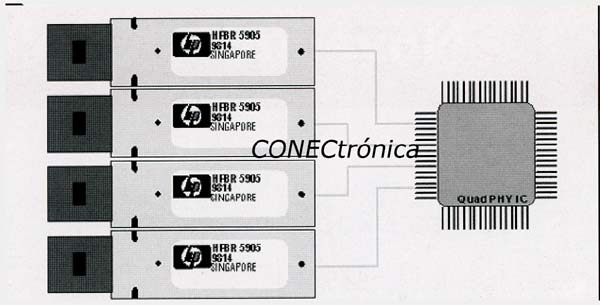 In addition to the transceivers and logic used in this architecture, a new type of connector is introduced with SFF products. System fiber optic links are designed to connect and disconnect in much the same way as current telephone cables. Therefore, the space requirements for the switch, wall outlets, and patch panels are the same as for conventional copper RJ-45 connectors.
The installation process is simplified with this new technology. For systems built using MT-RJ technology, the setup is similar to cabling a Category 5 cable installation. The optical fibers terminate at the back of patch panels and outlets using a punch-down device. This dramatically reduces installation time and the potential for errors associated with traditional fiber field terminations. With the MT-RJ-style connectorless jack, the fibers are cut and inserted, terminating with the turn of an actuator. Factory-preset jumpers are used for interconnecting equipment at outlets and panel fronts.
Cabletron Systems leverages small form factor technology
One of the early adopters, Cabletron Systems, quickly recognized the potential of fiber optic switching products based on SFF components. A new line of Fast Ethernet switching modules with higher-speed WAN and LAN primary links could better serve its manufacturing and government customers. Offering twice the number of ports at a relatively lower cost would give customers greater control over their existing fiber infrastructure. Furthermore, the low EMI characteristics of SFF-based systems would be attractive in many manufacturing applications where process equipment needs to operate close to workstations. For government, where security is a major concern, especially for personnel managing restricted network segments, SFF-based switches offer added security. When upgrading a 20-kilometer network, fiber optics provide a much higher degree of transmission security than twisted copper walls.
From an enabling technology perspective, by eliminating SC-style connectors in favor of SFF system components and adding a faster ASIC switching engine, Cabletron Systems discovered it could increase the density of a Fast Ethernet (FX) Switching Module from 8 ports to 16 ports. With a full complement of its new FX modules installed in the company's SmartSwitch 6000 system, a total of 80 100BASE-FX (MT-RJ) ports supporting multimode fiber (MMF) and/or single-mode fiber (SMF) can be brought to market. This is the ideal solution for high-bandwidth and multimedia traffic applications.
Fast track design
Work on the FX switching module began in August 1998 and was completed in December. Components from an existing production switching module served as its base architecture. Because SSF technology is inherently non-invasive to most of the surrounding circuitry, the media access control (MAC) and physical layer (PHY) functions would be virtually unaffected. Current chips were evaluated by vendors and approved for use in FX. The major design change was determining what modifications were needed on the circuit board, as the eight existing magnetic transceivers would be replaced by sixteen optical transceivers. In an otherwise straightforward process, new trace paths were created between the physical media IC controllers and the optical transceivers. On the signal buses between these components, attention had to be paid to ECL terminations, as well as to modifying most of the high-speed data lines.
Since this design was a first attempt and the power requirements of a new 3.3 VDC system could only be hypothetically calculated by the designers and their EDA tools, a power supply simulator was used to determine the actual power draw of the prototype FX module. The engineers determined that the system rack's power supply could deliver more power than required. EMI emissions were shown to be negligible once the system was powered on and operational. The number of firmware changes required to manage the operation of the new FX module was a pleasant surprise to the design team's software engineers. Only 3% of the design code needed to be modified.
Cabletron Systems' Fast Ethernet Switching Module has already entered the market with great success. And, as demonstrated by the Cabletron engineering team, opportunities and savings abound when designing fast fiber optic network products using SFF technology. New high-density systems combining the best of existing technology investments with advanced optical transceivers and fiber optic connectors can be rapidly scaled and brought to market very cost-effectively. As more products incorporating this new technology are introduced, system prices will begin their descent toward the level at which widespread adoption will occur. This technology has arrived at the perfect time.
Agilent Technologies
Author: Kevin Wade. Product Marketing Manager. SmartSwitch 6000. Cabletron Systems, Agilent Technologies