 The growing demand for narrowband services in current radio systems has reduced the availability of the high capacity required by broadband wireless systems within the radio spectrum. To overcome this limitation, the use of millimeter wave radio links (26-100 GHz) is being considered for applications in micro/picocellular broadband systems, fixed wireless access systems, and wireless local area networks. The complexity of these radio links can be simplified by sharing millimeter wave transmitters and receivers among different radio channels using subcarrier multiplexing.
In these wireless networks, the high atmospheric attenuation at millimeter frequencies allows for the development of cellular architectures with improved frequency reuse and, therefore, simpler spectrum management. However, given the smaller coverage area, the need for a greater number of base stations necessitates their functionally simple design. If the base stations are connected to a control station, routing and processing functions are centralized, thus simplifying the base station equipment. The ideal medium for these connections is fiber optic cable for the three reasons listed above. Furthermore, if the radio signals are transmitted over the fiber at millimeter frequencies, the base stations are simplified even further, as their equipment is reduced to optoelectronic components and electrical amplifiers, eliminating the need for frequency converters. By delivering the signals directly from the control station via fiber optic cable, the need to generate the high-frequency carrier at the base station, which may also be located in a difficult-to-access area, is eliminated. Therefore, to deploy these systems on a large scale, it is necessary to find low-cost methods for generating and detecting the optical signal at millimeter frequencies.
Generation techniques
 Currently, the maximum modulation frequency of laser diodes is around 30 GHz, making direct modulation at millimeter frequencies impractical. On the other hand, while electro-optical modulators operating at frequencies up to 50 GHz, or even optimized for a particular band (e.g., 60 GHz), are commercially available, these devices are expensive and require high voltages. Nevertheless, optical modulation at millimeter frequencies using cheaper, low-frequency optoelectronic components is being actively researched. In fact, the research focuses on discovering new techniques rather than improving the performance or functionality of existing devices. Specifically, different methods have been studied: modulation of laser response resonances, harmonic generation, and coherent optical mixing.
The first technique has been demonstrated using external cavity lasers, where frequencies occurring at multiples of the cavity's round-trip time are enhanced. On the other hand, harmonic generation techniques allow the use of optoelectronic components at relatively low frequencies as an integral part of the millimeter-wave system. In all these components, their nonlinear optical response to the input electrical signal is exploited. Thus, both lasers and electro-optical modulators can be used for this purpose, achieving efficient millimeter-wave frequency generation using higher-order harmonics. Finally, coherent optical mixing can also be used to generate millimeter-wave signals. If two coherent optical carriers are incident on the same photodiode, a signal component will be generated at the photodiode's output at the different frequency of the two carriers. For example, a 0.5 nm difference at a center wavelength of 1550 nm will produce a signal beat at a frequency slightly above 60 GHz. However, this technique generally suffers from problems such as stability and spectral purity of the generated signals. Harmonic generation, on the other hand, produces signals with spectral purity derived from the reference oscillator used, making it possible to synthesize signals with linewidths below 1 Hz.
Another method used to generate millimeter-wave signals employs a frequency-modulated laser with a control signal applied to one of its terminals. The optical spectrum of a frequency-modulated laser contains several lines separated by the modulation signal frequency, and millimeter-wave frequencies can be generated by beating these sidebands in a photodetector. However, a pure FM signal has a constant intensity and will not produce any photocurrent at harmonics of the modulation frequency. Therefore, the signal is propagated through a dispersive optical fiber so that the relative phase of the sidebands is altered, allowing harmonics of the modulating signal to be obtained at the photodetector output.
Although the FM-1M (frequency-intensity) conversion technique described above has proven effective for generating millimeter-wave signals, it requires lasers with large frequency deviations to achieve good efficiencies. Furthermore, this technique is not suitable for short fiber lengths or dispersion-shifted fibers. To overcome these limitations, the use of phase modulators in conjunction with diffraction gratings on optical fiber as a dispersive element has also been proposed.
Possible alternatives to this technique include the use of external modulators, such as Mach-Zehnder or electroabsorption modulators. The generation of harmonics at the modulation frequency in a Mach-Zehnder modulator is based on the nonlinear characteristic of its transfer function. Specifically, the characteristic is sinusoidal, with three typical operating regions. The linear region is the normal operating region, although by using high modulation excursions it is possible to obtain harmonics of order 3, 5, 7, ... as a consequence of its odd-order behavior. Additionally, the nonlinear regions known as MITB (minimum transmission bias) and MATB (maximum transmission bias) produce harmonics of order 2, 4, 6, ... as a consequence of its even-order behavior (regions around the minimum and maximum of its transfer function, respectively). Finally, electroabsorption modulators are a promising alternative for harmonic generation because their transfer function is more nonlinear than that of Mach-Zehnder modulators.
Signal detection
 Regarding detection, commercially available high-speed photodiodes are expensive and have low efficiency. The search for high-efficiency, potentially low-cost photodiodes for millimeter frequencies is also under investigation. Examples include monolithically integrated photodiodes with optical preamplifiers and bipolar heterojunction phototransistors (photoHBTs).
The main limitation of photodetectors is their low responsiveness. Since optical preamplification has proven to be an efficient method for improving the signal-to-noise ratio in many systems, a monolithic photodiode and optical preamplifier constitute a photodetector with high effective responsiveness. With this device, bandwidth values of 33 GHz and a responsiveness of 89 A/W have been achieved. Therefore, the combination of high optical gain and wide bandwidth makes this device ideal for fiber optic applications at millimeter frequencies.
The photoHBT is another example of a high-gain photodetector. In this case, the gain in the electrical domain is achieved through the action of a transistor. Conveniently, this device is simply a heterojunction bipolar transistor (HBT) constructed with a window for the optical input. The InGaAs layer used in the base-collector of InP-based devices ensures strong absorption at the desired wavelength around 1550 nm. Although this device can be used simply as a photodetector, it can also be employed in applications that take advantage of its dual behavior as a photodiode and active electronic element. One example is an optically injected locked oscillator, which is an important component in fiber optic radio systems because it allows the design of low-cost, high-power oscillators without limitations on spectral purity requirements.
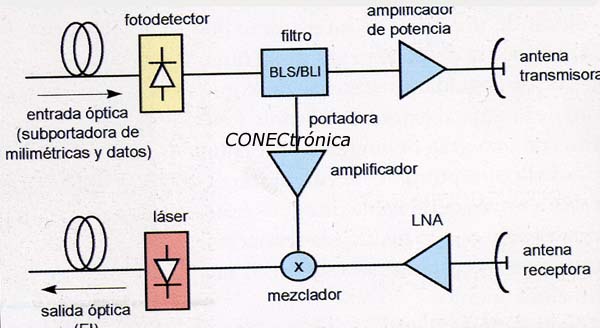
A block diagram of a typical millimeter wave transceiver configuration is shown in Figure 1. The incoming optical signal is photodetected, and one of its sidebands is filtered out for amplification and transmission to the mobile station. The filter also provides the millimeter wave carrier for the return link. The signal received from the mobile station is amplified before being converted to IF and transmitted back over the optical fiber using a laser. This configuration greatly simplifies the optoelectronics of the return link, as a directly modulated low-frequency laser can be used.
Transmission over fiber optic links
The chromatic dispersion of the fiber has a significant influence on the achievable transmission distance in intensity modulation-directed detection (MI-DD) optical communication systems that carry millimeter wave signals above 20 GHz. In an MI-DD link, the millimeter wave subcarrier is transmitted by means of two modulation sidebands (upper and lower) on either side of the optical carrier. Due to dispersion and the high frequency separation between the two sidebands and the optical carrier, the phase of each of the frequency components of the transmitted optical signal experiences a differential phase shift. After detection, this phase difference results in a decrease in recovered electrical power and, therefore, a degradation of the carrier-to-noise ratio.
The electrical power at the photodetector output varies periodically depending on the transmission distance, exhibiting transmission maxima and minima (nulls). This periodic behavior is due to constructive or destructive interference that occurs in the photodetector between the two modulation bands, which have different phase shifts depending on the modulation frequency and the length of the optical fiber. This variation becomes more rapid as the modulation frequency increases. For example, for a subcarrier frequency of 30 GHz, the first transmission null occurs around 4 km of fiber, while for a frequency of 60 GHz, this null shifts to a distance of only 1 km. Therefore, analog optical systems operating at millimeter wave frequencies are quite limited.
The permissible dispersion-induced power penalty for a given communications link depends on the power balance and the available margin in each case. However, for general analysis purposes, a maximum power penalty of 1 dB is typically used. This value ensures minimal influence of dispersion on the overall system performance in terms of carrier-to-noise ratio.
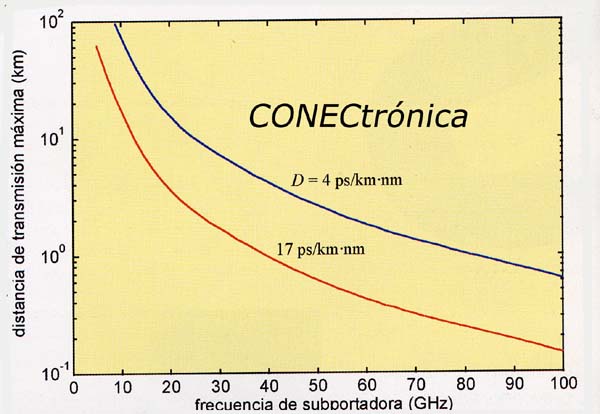
 The dependence of transmission distance on the chromatic dispersion of the fiber and the subcarrier frequency of millimeter-wave fibers is shown in Figure 2. It can be deduced that the distance has a 1/D dependence on the dispersion and a 1/f dependence on the subcarrier frequency. Therefore, an increase in dispersion or frequency limits the achievable transmission distance.
Performance can be significantly improved by using dispersion-shifted fibers. However, as can be seen in Figure 2, the tolerance imposed on the dispersion value in this case is very strict, since a change in the dispersion value of a few ps/km.nm leads to large variations in the maximum achievable distance (steeper curve for reduced values of the chromatic dispersion parameter). Although the fiber dispersion does not usually vary significantly, the relative variations are greater as the dispersion parameter value decreases. Therefore, this aspect must be carefully considered in systems using dispersion-shifted fibers.
MODAL System
The MODAL (Microwave Optical Duplex Antenna Link) system refers to a research project of RACE II (Research and Development for Advanced Communications in Europe) aimed at finding applications of photonic techniques for generating millimeter-frequency signals for the provision of mobile telecommunications services in Europe.
In the case of mobile communications, UMTS (Universal Mobile Telecommunication System) is expected to provide most of the required capacity. However, because UMTS operates at low microwave frequencies, it will not be able to provide broadband services. Therefore, future high-capacity wireless networks are expected to use millimeter wave spectrum as the access medium. To this end, two sub-bands for mobile broadband applications have been identified in Europe: the 62-63 GHz band for base station-to-mobile links, and the 65-66 GHz band for mobile-to-base station links. These bands are particularly attractive for high-capacity systems due to the adequate availability of radio spectrum. One such system is the so-called MBS (Mobile Broadband System), which is currently under active research.
The MODAL project has contributed to the development of these types of systems by researching fiber optic-based techniques for interconnecting remote antenna units with a central base station. Additionally, optical methods for generating the millimeter-wave frequencies required by these systems were also investigated. The consortium participating in the project initially consisted of Alcatel-SEL, the University of Wales, the University of Aveiro, the National Technical University of Athens, and CET, later joined by new members such as GEC-Marconi, Caswell, Thomson-CSF, the University of Lille, and the Fraunhofer Institute.
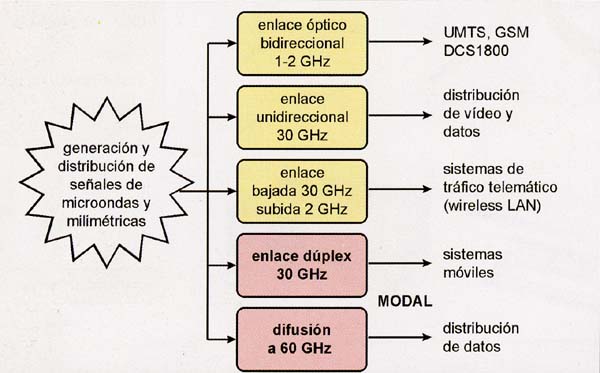
The MODAL project originally aimed to demonstrate a bidirectional fiber optic link operating at 30 GHz. The decision to operate at 30 GHz was based on the commercial availability of optoelectronic devices in this frequency range. Subsequently, the project's objectives were expanded, and the operating frequency was increased to 60 GHz, including the development of new MMIC circuits and optoelectronic devices to enable these higher frequencies. Figure 3 summarizes the scope and applications of the MODAL project.
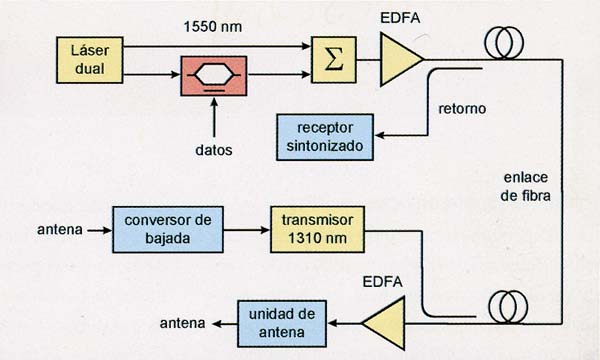
The MODAL system topology is shown in Figure 4. For the downlink (base station to mobile), a dual-frequency optical source and a low-frequency linear electro-optical modulator are used as transmitters. This transmission technique is best suited for working with modulated subcarriers, as other methods lack sufficient linearity at high frequencies. The operating wavelength was 1550 nm to allow the integration of erbium-doped fiber amplifiers (EDFAs) into the system, thereby achieving a sufficient optical power level to provide the required electrical signal quality at the remote antenna unit's input.
The dual-source optical generation method involves providing the millimeter-wave carrier by leveraging the nonlinear photodetection process. The optical source generates two coherent optical carriers separated by precisely the desired millimeter-wave frequency. One of these carriers is then modulated with the low-frequency data signal and combined with the other carrier for transmission over the fiber optic link. In this case, since only one carrier is modulated, fiber chromatic dispersion does not limit the system's range. At the receiver, the nonlinear beating of the two optical carriers at the photodiode generates the millimeter-wave carrier onto which the transmitted data will be modulated.
For the return link, a wavelength of 1300 nm (second window) was chosen, allowing the same fiber link to be used in both directions. This uplink (mobile to base station) uses a highly linear laser diode as its optical transmitter to minimize intermodulation distortion, along with a tuned, low-noise receiver with a wide dynamic range to accommodate the broad range of signal levels associated with the mobile environment.
Author: Francisco Ramos Pascual. Telecommunications Engineer. Professor of Radiocommunications at the Polytechnic University of Valencia.