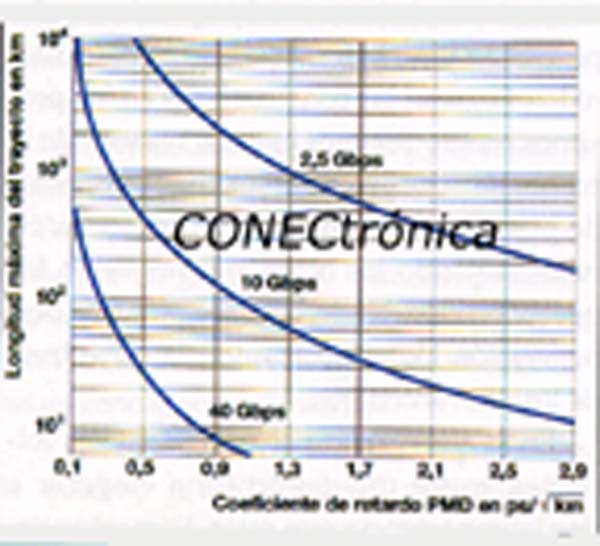
 The first commercial 10 Gbps connections became operational last year. The next generation (40 Gbps) has been announced for this year. At the same time, DWDM technology has greatly increased the transmission capacity of optical fibers. The ITU-T has already defined 40 or 80 wavelengths, a number that will undoubtedly double in the future.
Due to these advances, some properties of fibers have acquired a relevance they previously lacked.
At conventional speeds, fiber losses (attenuation) are what limit the maximum range. But dispersion is becoming increasingly important. There are two main types: chromatic dispersion (CD) and polarization-mode dispersion (PMD).
Chromatic dispersion
 The refractive index of an optical fiber depends on the wavelength of light. Since the speed of light propagation depends on the refractive index, the expansion of the light pulse becomes problematic at high speeds as distance increases, even with very narrow spectra. This means that chromatic dispersion at 10 Gbps is a problem even at distances of only 25 km. There is a type of dispersion-corrected fiber (DSF) with low chromatic dispersion in the third optical window at 1550 nm. However, when used with DWDM, it exhibits pronounced nonlinearity, such as the "four-wave mixing" effect. The newer non-zero dispersion-shifted fiber (NZ-DSF) offers a compromise between dispersion and DWDM characteristics. However, it also requires active compensation for chromatic dispersion if it is to be used for long distances.
Polarization mode dispersion
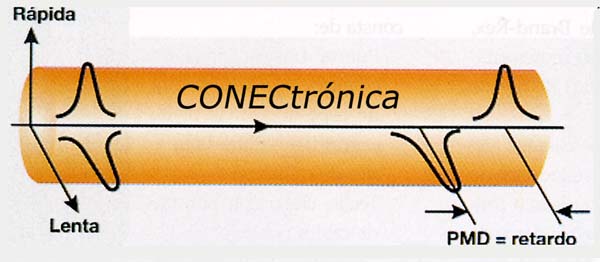
In this case, the dispersion is due to the fact that the speed of light propagation is not the same in all polarization planes. Due to the fiber's double refraction, the polarization can be linear, elliptical, or circular. Furthermore, polarization modes can change along the fiber. Polarization mode dispersion affects transmission quality less than chromatic dispersion. However, the lack of satisfactory compensation techniques tends to highlight its importance. Unlike chromatic dispersion, polarization mode dispersion (PMD) is not a constant, fiber-specific value that can be considered during link planning, but rather depends on how the fiber is installed. Its value varies according to external factors such as mechanical stress, pressure, and even temperature. When planning high-speed links on the ground wires of high-voltage power lines, it is best to define generous tolerances. Nevertheless, PMD can exhibit high values even in cables installed under normal conditions.
 Considering all these aspects, it is not unreasonable to measure PMD in the acceptance tests (in addition to the usual reflectometric measurements) of high-speed fiber links. Besides evaluating the losses of connectors, splices, and couplers, PMD measurement should be part of the link qualification process.
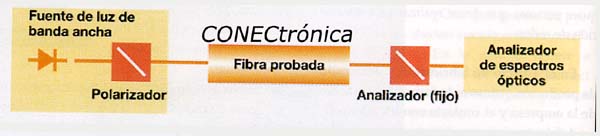
Depending on the technique used, measuring PMD can be quite complex. The "fixed analyzer" method is economical and reasonable for field applications. In this method, PMD is measured using an optical spectrum analyzer, which is required anyway when installing DWDM systems. The only additional equipment needed is a special light source, a polarizer, and the corresponding evaluation software.
Author: Peter Winterling. Fiber optic sales director. Actema Germany. Eningen, Germany