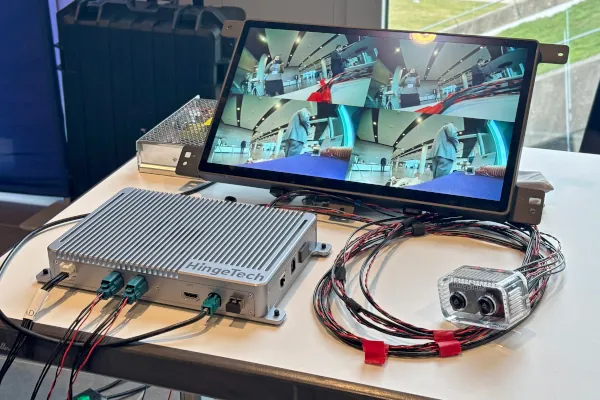
The system leverages optical connectivity for high-resolution camera data links over a fiber optic backbone and supports both zoned and centralized architectures.
The KD7251 implements IEEE 802.3cz-compliant nGBASE-AU physical layers for multi-gigabit optical communication over multimode glass fiber. It supports high-speed sensor interconnection and backbone communication in software-defined vehicles (SDVs).
Yang Jun, CTO of Hinge Technology, commented: “At the Automotive Ethernet Congress in Munich, we presented our latest camera system in its first live public demonstration, incorporating 10 Gb/s optical links based on KD’s KD7251. The system showcased lossless transmission of high-resolution video streams and real-time data exchange over a fiber optic backbone. By combining multiple 10 Gb/s camera inputs and directly comparing them to 1 Gb/s links, we demonstrated clear advantages in image quality, latency, and overall system performance for next-generation automotive applications. This proves that multi-gigabit optical connectivity is ready for deployment in vehicles.”
Pablo Blazquéz, Business Development Manager for Europe at KD, stated: “By integrating KD’s KD7251 into its ecosystem, Hinge Technology demonstrates a robust and future-proof optical architecture. Their solution supports both 1 Gb/s and 10 Gb/s camera connectivity and then aggregates the video streams over a 10 Gb/s optical backbone enabled by the KD7251. This highlights a scalable optical platform that can make a real difference not only in the Asian automotive market but also in robotics, where reliable, high-bandwidth connectivity is becoming increasingly critical.”
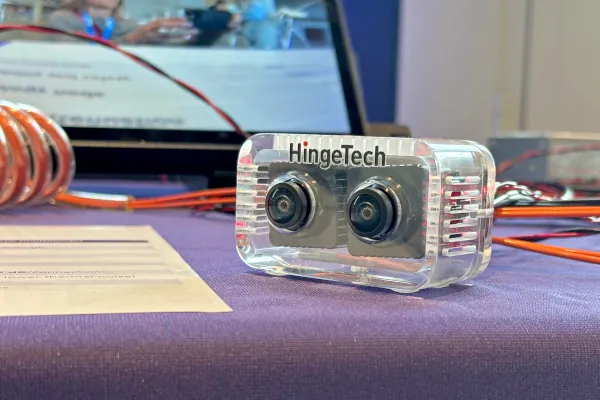
Multi-camera architecture with 10 Gb/s optical data transmission.
The system presented is based on a multi-camera architecture with optical links throughout the vehicle network. Two 10 Gb/s optical cameras are connected to each of the two electronic control units (ECUs), and data is transmitted via a fiber optic backbone between the ECUs. One ECU aggregates and processes a total of four high-resolution video streams for functions such as image stitching and display output. Additionally, a 1 Gb/s optical camera link has been integrated for direct comparison between gigabit and multi-gigabit transmission.
The KD7251 enables multi-gigabit optical links for in-vehicle networks.
The core of the system, the KD7251 is a single-chip optoelectronic transceiver with an integrated optical interface, combining optical and electronic functionality in a compact device. It enables multi-gigabit data transmission over multimode glass optical fiber (OM3), supporting data rates up to 10 Gb/s, as well as backward compatibility at lower speeds, allowing for flexible integration of various camera and sensor types. With low latency, robust electromagnetic compatibility (EMC) performance, and compliance with automotive industry requirements such as ASIL-B functional safety and extended temperature ranges, the KD7251 is designed to deliver reliable high-speed connectivity in demanding in-vehicle environments. Its integrated bridging capabilities also allow for the direct connection of camera sensors and processing units.