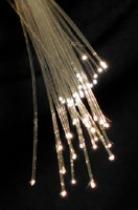
The new class of optical fiber, which allows for more efficient and liberal manipulation of light, promises to open the door to more versatile laser-radar technology.
This technology could be applied to the development of better surgical and medical lasers, improved laser countermeasures for military use, and more environmentally sensitive lasers such as those used to measure contaminants and detect the spread of chemical agents in bioterrorism. The team's research will be published in the journal Advanced Materials.
"It's become a cliché to say that optical fibers are the cornerstone of the modern information age," said Badding. "These long, thin fibers, which are three times thicker than a human hair, can transmit more than a terabyte (the equivalent of 250 DVDs) of information per second. Still, there are always ways to improve existing technology." Badding explained that optical fiber technology has always been limited by the use of a glass core. "Glass has a random arrangement of atoms," Badding said. "In contrast, a crystalline substance like zinc selenide is very ordered. That allows light to be carried at longer wavelengths, especially those in the mid-infrared."
Unlike silica crystal, which is traditionally used in optical fibers, zinc selenide is a compound semiconductor. "We've known for a long time that zinc selenide is a useful compound, able to manipulate light in ways that silica cannot," Badding said. "The trick was getting this compound into a fiber structure, something that's never been done before." Using a novel high-pressure chemical deposition technique developed by Justin Sparks, a graduate student in the Chemistry Department, Badding and his team deposited zinc selenide guide cores inside silica crystal capillaries to form the new class of optical fibers. "High-pressure deposition is the only method that allows the formation of such long, thin zinc selenide fiber cores in such a small space," Badding said.
Scientists discovered that zinc selenide optical fibers could be useful in two ways. First, the new fibers were found to be more efficient at converting light from one color to another. "When traditional optical fibers are used for samples, displays, and art, it's not always possible to achieve the desired colors," explained Badding. "Zinc selenide, through a process called nonlinear frequency conversion, is better able to change colors."
Second, as Badding and his team expected, they found that the new class of fiber provides greater flexibility not only in the visible spectrum but also in the infrared—electromagnetic radiation with wavelengths longer than those of visible light. Existing optical fiber technology is not efficient at transmitting infrared light. However, the zinc selenide optical fibers that Badding's team has developed are capable of transmitting longer wavelengths of infrared light. "Exploiting these wavelengths is very interesting because it represents a step toward manufacturing fibers that can serve as infrared lasers," Badding explained. "For example, the military currently uses laser-radar technology that can handle near-infrared, or a range of 2 to 2.5 microns. A device capable of handling mid-infrared, or the entire 5-micron range, would be more accurate. The fibers we've created can transmit wavelengths up to 15 microns."
Badding also explained that detecting environmental contaminants and toxins could be another application of improved laser-radar technology capable of interacting with light of longer wavelengths.
"Different molecules absorb light at different wavelengths; for example, water absorbs, or stops, light at wavelengths of 2.6 microns," Badding said. “However, molecules of certain pollutants or other toxic substances can absorb light at much longer wavelengths. If we can transport light at longer wavelengths through the atmosphere, we can see what substances are out there much more clearly.”
Badding also mentions that the zinc selenide optical fiber could open new avenues of research that might improve laser-assisted surgery techniques, such as corrective eye surgery.
In addition to Badding and Sparks, other researchers who contributed to this study included Rongrui He of the Penn State Research Institute’s Department of Chemistry and Materials; Mahesh Krishnamurthi and Venkatraman Gopalan of Penn State’s Department of Materials Science and Engineering and the Materials Research Institute; and Pier J.A. Sazio, Anna C. Peacock, and Noel Healy of the University of Southampton’s Optoelectronics Research Centre. Technical assistance for this research was provided by the Engineering and Physical Sciences Research Council, the National Science Foundation, and the Pennsylvania State University Center for Materials Science and Research.
Apollo and Alcatel-Lucent break the speed barrier in underwater communications networks
Apollo and Alcatel-Lucent have announced an industry milestone: a successful demonstration of data transmission at approximately 3 terabits per second (Tbit/s), based on 40 Gbit/s channels, per fiber pair in a submarine network. Apollo is a...