to promote new investments in wireless access networks, increase the coverage of mobile broadband services in rural areas, reducing the "digital divide", and foster innovation and competition in the sector.
These spectrum measures aim to provide legal certainty and predictability for both operators and equipment manufacturers, establishing a stable and future-proof framework with a horizon up to 2030. They also address the spectrum demand that will be generated by the development and widespread adoption of smartphones, tablets, e-readers, etc., as well as new mobile communication services.
The Royal Decree is expected to be approved in the first quarter of 2011, with the frequency auction process taking place in the second quarter.
The objectives of this draft Royal Decree are as follows:
* To authorize technological neutrality (refarming) for operators holding radio spectrum in the 900 MHz and 1800 MHz bands, while guaranteeing the maintenance of the economic and financial equilibrium of their concessions and competitive market conditions.
* Establish the legal framework that allows the auction of a total of 310 MHz in the following frequency bands: 800 MHz (digital dividend), 900 MHz, 1800 MHz, and 2.6 GHz.
* Extend the authorization for operators to apply the principles of technological and service neutrality, as well as the resale of spectrum.
With these actions, the current spectrum dedicated to mobile communications services will increase by 70%. Currently, 360 MHz are available, to which 250 MHz will be added in the digital dividend and 2.6 GHz bands.
Refarming and auction of spectrum in the 900 MHz band
. This refarming process, by allowing the use of this 900 MHz band for the provision of UMTS services, makes it possible to offer mobile broadband services with better indoor coverage and increase service quality. Furthermore, given the superior propagation characteristics of this band compared to the 2100 MHz band currently used for UMTS services, coverage of these mobile broadband services will increase in rural areas.
The flexibility afforded by refarming in spectrum use in the 900 MHz band requires additional measures to prevent distortion of competition in the affected mobile markets.
Specifically, authorizing Telefónica, Vodafone, and Orange to carry out refarming in this band means that the Administration will recover part of the spectrum in this frequency band: 2 x 2.2 MHz for Telefónica, 2 x 2 MHz for Vodafone, and 2 x 1 MHz for Orange.
In addition, Telefónica and Vodafone will be required to invest in rural communities with fewer than 1,000 inhabitants.
Operators currently assigned 2 x 10 MHz in the 900 MHz band must offer a wholesale service on their 900 MHz networks using UMTS technology.
As compensation for the recovery of spectrum assigned to operators, the concession periods are extended to a maximum of 2030.
Regarding auctions in this band, a 2 x 5 MHz block will be available during 2011. Telefónica Móviles and Vodafone are not eligible to participate in this public auction.
Two additional blocks will also be auctioned: one of 2 x 5 MHz and another of 2 x 4.8 MHz. These blocks come from Telefónica Móviles' 2 x 8.8 MHz, whose concession period expires in 2015, and from the 2 x 1 MHz recovered from Vodafone. These blocks will be available from February 2015. All operators are eligible to participate in this auction.
Refarming and spectrum auction in the 1800 MHz band.
Authorizing refarming in this band for each operator will mean that the Administration will recover a 2 x 5 MHz block from each operator. As compensation for this return, the 1800 MHz concession period will be extended from 2028 to 2030.
The frequencies recovered by the Administration in the 1800 MHz band will be put out to public auction. All operators that do not currently hold frequencies in this band may participate in this auction.
Auction of the 800 MHz band (digital dividend).
The Government has decided to dedicate the 790-862 MHz band (digital dividend), formerly used for television broadcasting, to the provision of electronic communications services (mobile broadband).
Specifically, the 2 x 30 MHz of usable digital dividend spectrum will be auctioned in 6 blocks of 2 x 5 MHz. These frequencies will be available to operators before the end of 2014.
Auction of the 2.6 GHz band:
The 2.6 GHz band (2,500 to 2,690 MHz) is currently free of any uses that would prevent its auction. 55 MHz FDD and 50 MHz TDD will be auctioned for national concessions, and 15 MHz FDD for concessions with a scope smaller than national, presumably during the first half of 2011.
General criteria for the auctions:
In all auction processes, technological neutrality (any technology may be used in these frequency bands) and service neutrality (fixed, mobile, or nomadic electronic communications services may be provided) will be authorized, as well as the secondary market for spectrum (resale of spectrum).
The concessions will have a duration until 2030. Concessions with a scope below the national level will be granted for the territorial areas of the Autonomous Communities of Galicia, Asturias, the Basque Country, Extremadura, and the rest of Spain.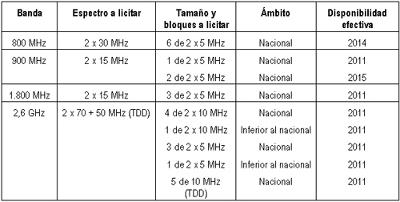 Limits on the use of frequencies:
In order to prevent spectrum hoarding and thus guarantee greater competition in mobile communications services, a limit is established on the total spectrum that an operator may hold below 1 GHz once the auctions have been carried out: 2 x 20 MHz in the 900 MHz and 800 MHz frequency bands. Likewise, a limit is established on the total FDD spectrum that an operator may hold above 1 GHz once the auctions have been carried out: 2 x 55 MHz in the 1,800 MHz, 2,100 MHz, and 2.6 GHz bands.
New General Telecommunications Law.
The draft bill amending the current General Telecommunications Law has also been submitted to the CATSI (Spanish Telecommunications Regulatory Council). This
bill aims to incorporate the European Directives on Better Regulation and Citizens' Rights into Spanish law. This represents a further step in the legislative process, which will continue with the required reports from the Telecommunications Market Commission (CMT), the National Competition Commission (CNC), the Spanish Data Protection Agency, and the Interministerial Consumer Commission.
The draft bill is expected to be submitted to the Council of State in mid-February 2011 and approved by the Council of Ministers in a second round of voting at the end of March 2011.
The proposed amendments provide greater legal certainty and flexibility for operators, improve the protection of users' rights, and strengthen the powers of the CMT.