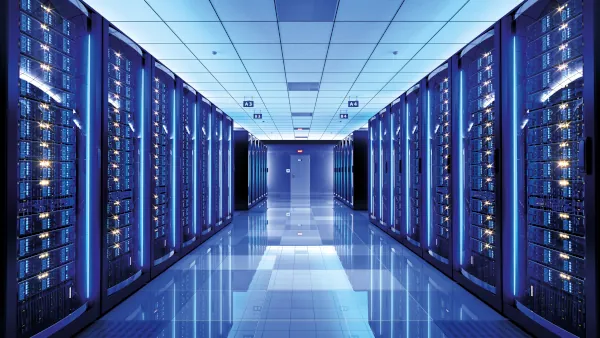
And behind that capacity lies a less visible, though critical, reality: energy.
According to the International Energy Agency, data center electricity consumption could double this year, exceeding 1,000 TWh—a figure comparable to Japan's total consumption. Goldman Sachs Research estimates that data center energy demand will grow by 165% by 2030, driven primarily by generative AI. The impact is no longer marginal.
The new electrical paradigm
Traditional racks have given way to ultra-high-density GPU architectures. Power per rack already exceeds 50 kW in many installations and continues to rise. The data center is no longer just an IT infrastructure but a critical energy infrastructure, where stable power, power quality, and operational continuity are design requirements, not contingency plans. A micro-interruption, harmonic distortion, or a momentary voltage drop can cause anything from calculation errors to losses of millions of dollars. Operating margins have practically disappeared.
Electrical continuity: zero tolerance for failure
When a training process has been running for weeks, consuming thousands of GPU hours, an outage isn't just an inconvenience: it's a catastrophe. Data corruption, the loss of entire processes, and the associated financial impact make power continuity an absolute operational requirement. The solution lies in systems capable of maintaining stability even in the face of severe power disturbances and that can scale with the installation without interrupting operations. Designed specifically for ultra-high-density GPU architectures, Delphys XL supports environments where power per rack exceeds 50 kW, combining robustness and efficiency in HPC and AI installations. Modulys XM complements this foundation with extreme modularity: it allows for capacity expansion without shutting down the installation, adapting power growth to the pace of AI workloads and eliminating unnecessary oversizing.
Monitoring: measuring is deciding
As energy density increases, management based on estimates becomes unfeasible. Operators need complete, real-time visibility: consumption per circuit, overloads, imbalances, efficiency, and demand trends. In facilities where energy represents one of the largest operating costs, accurate measurement ceases to be a technical function and becomes a competitive advantage.
Digiware allows this level of granularity to be introduced into next-generation data centers: early detection of anomalies, continuous optimization of energy use, and complete visibility of the electrical infrastructure in real time.
Power quality: the invisible risk
GPU servers, advanced cooling systems, and electronic converters generate harmonics, fluctuations, and disturbances that, in conventional environments, cause efficiency losses, but in an AI data center, they can escalate to unexpected shutdowns, equipment overheating, or operational outages. When thousands of GPUs are working simultaneously, maintaining electrical stability is as important as ensuring power availability. Diris Q800 enables advanced monitoring of the power grid and real-time detection of disturbances, harmonics, or power quality deviations before they become incidents.
The new equation
The modern electrical design of an AI data center simultaneously pursues three objectives: maximum availability, maximum efficiency, and maximum monitoring capacity. Energy management ceases to be reactive, becoming a continuous process of optimization. Because the true limit to the growth of artificial intelligence will not be solely computing power. It will be the ability to power that infrastructure reliably, efficiently, and sustainably.