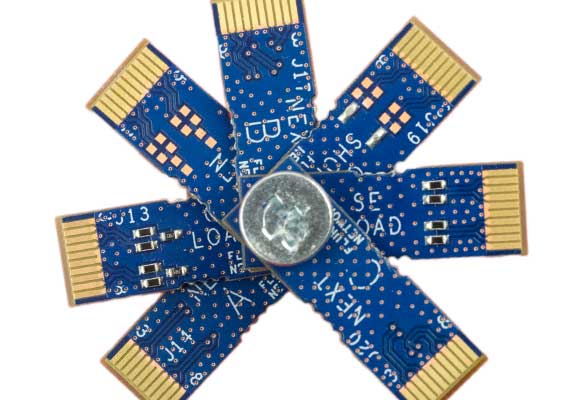
Furthermore, cable testing device manufacturers will soon release new Category 8 field testing devices, enabling contractors to test and verify the actual performance of Category 8 cabling and obtain the cabling manufacturer's warranty for the end user.
“Category 8 will play a critical role in data centers and mission-critical environments as they upgrade to 25/40GBASE-T,” says Mark Dearing, senior product manager at Leviton. “Cable manufacturers are designing solutions with the added quality and flexibility needed to meet the demands of new applications. But even the most advanced infrastructure relies on high-quality installation practices to ensure the network performs optimally. Proper testing and obtaining the required certification in the field translates to fewer disruptions, downtime, and unexpected costs in the future.”
This article takes a detailed look at the new standards for Category 8 cable testers and how they were developed.
How It Was Done:
In 2011, TIA issued its first Project Authorization Request (PAR), the official “call for interest” for the next generation of cabling (understanding “cabling” to mean both the cable and the connector together). This prompted cable manufacturers to begin developing Category 8 prototypes and also spurred the ANSI/TIA and ISO/IEC committees to start developing new standards for Category 8 cabling and testing devices.
The TIA and IEC committees are composed of representatives from cable manufacturers, cabling and field testing systems, as well as installers and users of cabling systems. Although many of these vendors are competitors in the market, working together is beneficial for them in developing a common set of product standards. This ensures that all Category 8 cabling will deliver the same performance levels, regardless of the manufacturer, and that all Category 8 field testers will certify all Category 8 cabling to the agreed-upon performance measurement levels.
The committees have been developing the standards for several years. The final results are:
• ANSI/TIA-568-C.2-1, an update to the 568-C.2 standard established for balanced twisted-pair cabling, includes requirements for Category 8 cabling and components. (ISO/IEC 11801, the international equivalent of these standards, will also be updated with Class I and Class II cabling parameters.)
• ANSI/TIA 1152A, an update to the 2016 standard for field testing instruments used to test balanced twisted-pair cabling, was approved for publication in October 2016 and provides specifications for instruments used to test Category 8 cabling. (IEC 61935-1, the international equivalent testing standard, will also be updated.)
Developing Testing Standards:
It is important to understand that testing Category 8 cabling is not simply a matter of increasing the upper frequency of the test module. In addition to a wider frequency range, Category 8 cabling requires stricter performance specifications in the tester and new adapters capable of supporting that performance.
To develop Category 8 field testers, manufacturers and committee members developed new testing requirements and methodologies, including:
• Test accessories specified up to 2 GHz, for use in laboratory testing environments
• An RJ45 reference connector specified at 2 GHz
• Cable and connector performance requirements
• Products to be tested
These elements were developed in parallel: while cabling manufacturers were developing Category 8 prototypes, cabling and tester companies were also developing laboratory test accessories, methodologies, and test connectors, so they would be ready to test Category 8 prototypes once they became available.
Laboratory Test Accessories
To develop a standardized cabling tester, the TIA and IEC committees first had to agree on standards for testing Category 8 cabling in a laboratory environment. This required them to develop test accessories to connect Category 8 cabling to a vector network analyzer (VNA). (The VNA is the “benchmark” against which the final test device is compared to ensure that the tester provides accurate measurements.)
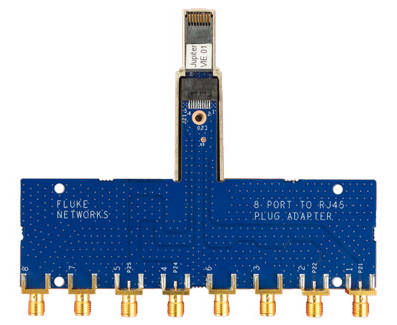 The accessory in photo #1 connects Category 8 links and components to the VNA. This accessory was jointly developed by the TIA and ISO committees and was designed to handle frequencies up to 2 GHz.
The TIA 1183-1 standard for test accessories was published in January 2016. Because cable tester manufacturers can create their own versions of previous lab test accessories, the requirements for these accessories needed to be standardized. The goal of this standard is to ensure that all test accessories created by cable tester manufacturers will connect to their VNA in a way that provides accurate and consistent measurements when testing Category 8 cable samples or RJ45 connectors from different cable manufacturers.
Standardized RJ45 Connectors:
A standardized RJ45 connector is required for field measurements. These test connectors have highly controlled electrical performance and enable consistent and accurate measurements of connectors and links from various manufacturers. The “Jupiter” RJ45 connector, developed through a collaborative effort by cabling and cable testing manufacturers, was used as the industry standard for testing Category 8 cabling and components.
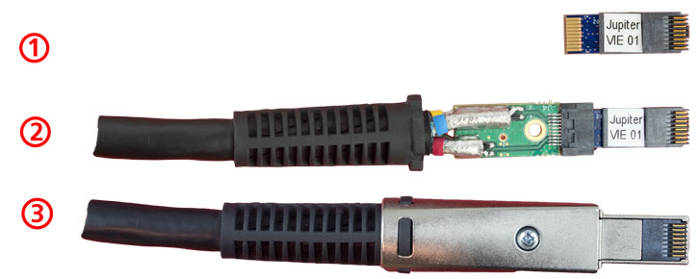 Photo #2 shows (1) the original “Jupiter” tip, (2) the “Jupiter” tip installed inside a permanent link adapter (open), and (3) the mounted permanent link adapter, which is a component of the field tester.
Laboratory test connectors are typically handled with great care, and patch cord connectors may only be inserted a few times. But field tester connectors will be inserted thousands of times whenever the contractor uses the device for field testing. Therefore, every tester manufacturer must design a version of the plug and connector that is robust enough to withstand repeated use in the field.
Cable and Connector Performance Requirements:
The TIA and IEC standards for Category 8 cabling and connectors needed to be finalized to a certain degree so that tester manufacturers would know the performance measurement criteria for testing Category 8 cabling. Once the standards were finalized, manufacturers could accurately test prototype Category 8 cabling using those measurement criteria, which facilitated the development of their final test products.
Over the past year, cabling manufacturers have provided prototype Category 8 samples to tester manufacturers, allowing them to test these samples against the TIA and IEC cabling and connector performance measurement criteria using their VNAs (Value-Added Networks). This crucial step has enabled manufacturers to develop handheld devices for accurately testing Category 8 cabling in the field.
Final Approval:
As a final step before product launch, tester manufacturers send their Category 8 field testers to cabling manufacturers for approval. Cabling manufacturers test their Category 8 cabling, first with a field tester, then with a VNA, and then compare the tests to ensure both devices obtain the exact same results. This demonstrates that the field tester can accurately measure Category 8 cabling according to the same performance requirements as a laboratory VNA, allowing cabling manufacturers to confidently offer warranties for installations certified with these testers.
Certain performance requirements (such as transfer conversion loss and inter-pair resistance imbalance) were first specified in Category 8 cabling standards. While these tests are required for cabling and components, they are considered optional for installed cabling due to their complexity. Contractors are not required to perform them when certifying Category 8 cabling for warranty purposes. However, if contractors have a Category 8 tester that can meet these requirements, it is highly recommended that they include these tests. A comprehensive suite of tests will assure your customers that the installed Category 8 cabling is functioning correctly and can handle their applications.
By creating these standards, we have helped ensure that these products perform as intended in real-world applications, regardless of the manufacturer.
The success of any standards project depends largely on close collaboration among committee members and the cooperation of the cabling and cable testing device manufacturers they represent. This mutual collaboration has resulted in a robust platform of standards, cabling products, and field testing solutions. We have walked this path together and are rapidly approaching our destination with a successful Category 8 launch.
Article provided by Fluke Networks