These methodologies address power-related challenges, such as the use of current and future devices or the scheduling of virtual machines across data centers, among others.
Regarding programming models, the project has focused on shifting from a shared-memory model to one centered on actors and message exchange. This allows programmers to achieve greater energy efficiency while simultaneously increasing their awareness of energy-related issues. Two illustrative approaches are:
• Individualized programming solutions for heterogeneous GPU/CPU architectures. Managing the GPU directly through optimized code can reduce energy consumption by approximately 80%. However, this requires specialization that reduces programmability. The ParaDIME project has developed techniques based on domain-specific languages that generate code for both the CPU and the GPU, enabling energy savings of up to 40% and, crucially, making these architectures more accessible to a wider range of programmers.
• Tools that promote greater awareness of power and costs. These tools assess the power requirements of a single process running in a virtualized environment. They can also be used for user-centric cost models, to implement task scheduling that considers energy consumption, and as an indicator of the amount of heterogeneous resources consumed by an application.
Regarding execution time, the ParaDIME project has developed a large, decentralized infrastructure consisting of small data centers that provide heating and hot water. This system would lead to increased efficiency, as demonstrated by the project's industrial partner, the German company Cloud&Heat. ParaDIME researchers have developed:
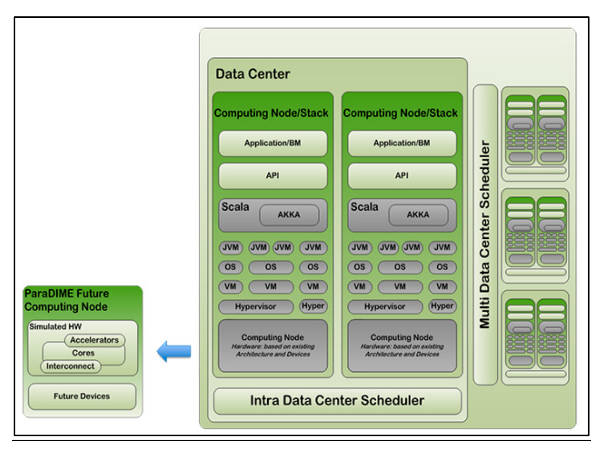
• A multi-data center scheduler: This schedules tasks across different data centers, achieving a balance between data center loads and heating/cooling needs. This has resulted in up to a 50% reduction in CO2 emissions and energy consumption.
• A cross-data center scheduler: Technologies have been developed to reduce both the time required to reactivate virtual machines and the costs associated with their migration. The QEMU community (an open-source virtual machine emulator and emulator) is analyzing parts of this work. Institutions currently using QEMU to virtualize their workloads will benefit from migration code for virtual machines optimized by the ParaDIME project. In addition, the ParaDIME project has contributed a feature that tracks changes to block devices, which has already been incorporated into the latest Linux kernel.
At the hardware level, ParaDIME project researchers have proposed and simulated various methodologies to improve compute node efficiency, including:
• Scheduling tasks across heterogeneous cores (e.g., big.LITTLE processors, or systems that combine FPGA, GPU, and CPU cores). An average of 40% energy consumption can be saved by combining FPGA, GPU, and CPU cores compared to a multicore processor. ParaDIME scheduling also reduces power consumption by an average of 20% and energy consumption by 30% across different types of heterogeneous platforms. The ParaDIME project has also analyzed power estimation tools for a variety of cores.
A significant reduction in supply voltage is achieved. Energy savings are obtained by combining this reduction with low-cost error detection and correction techniques. Furthermore, ParaDIME researchers have studied this methodology in circuits built with future devices. The ParaDIME methodology saves up to 60% of the energy consumed by the L1 data cache.

- Details
- Category: Data Centers
-
By Carlos Martinez
Infrastructure that reduces energy consumption of computing node components by up to 60% and emissions from distributed data centers by up to 50%
Researchers from the ParaDIME project have developed a set of methodologies that allow for savings of between 30% and 60% in the energy consumption of data centers.

Unlabeled
-
-
Extreme Networks launches the new BlackDiamond 8900 modules for data centers
Extreme Networks introduces the new BlackDiamond 8900 modules for the BlackDiamond 8800 switch. This new architecture for next-generation data centers is the only one that combines scalability of up to 582 10Gb Ethernet ports in a single rack, with maximum energy efficiency and...
-
Fujitsu ETERNUS DX8900 S4 optimized for Flash
Fujitsu introduces the ETERNUS DX8900 S4 solution, offering petabyte-scale flash-optimized storage for the data center. This system reduces complexity by eliminating the need to vary storage tiers for different workloads and consolidates storage silos...
-
Powerful PDU with 8 IEC-C13 sockets and general overload protection
PDU-Rack presents its Powerfull PDU with 8 IEC-C13 sockets and General Overload Protection. Available in single-phase versions from 16 A to 64 A.
-
Raritan integrates JouleX Energy Manager with its intelligent energy distribution units
Raritan announces that it has expanded the functionality of its Intelligent Power Distribution Units (IPDUs). The company's new partnership with energy management specialist JouleX has enabled the integration of JouleX Manager energy management software... -
Will liquid cooling dominate thermal management in data centers?
Over the past 16 years, the thermal design power (TDP) of GPUs has quadrupled. With the growing demand for AI, cloud computing, and cryptocurrency mining, IDTechEx expects the power consumption of server and data center boards to continue increasing. With the lifespan...




Newsletter
Latest News
Agriculture and livestock farming lead the IoT in Spain with 44.8% of devices
The agricultural and livestock sector is consolidating its position as a leader in the implementation of the Internet of Things in...
Broadband Forum introduces the Matter Service API to power the open smart home
The Matter Service API is the first standardized solution in history that offers...
Wireless Logic agrees to acquire Algar Telecom's IoT business in Brazil
Wireless Logic has announced the signing of an agreement to acquire the IoT connectivity business of...
The EU launches a €10 billion tender to create up to seven AI Gigafactories in Europe
The EU has launched a tender to establish up to seven AI Gigafactories across Europe,...
Cybergune: the new cybersecurity community of the Basque Country
The Basque Cybersecurity Industries Association (Cybasque) has launched Cybergune, the new...
Social networks
 |
 |
 |
 |
 |

Subscribe to CONECtrónica magazine
You can subscribe to the Conectrónica magazine in 2 formats.
Digital Format: 5 downloadable PDF editions at an annual cost of 60 Euros (VAT included)
Paper Format: 5 editions to be received by mail at an annual cost of 180 Euros (VAT included).
Contact our subscriptions department at subscriptions@conectronica.com
Payment via Bizum or bank transfer
Technical Courses and Seminars
Mouser and Telit Cinterion are organizing a webinar on cellular IoT with CMB100
The development of cellular IoT may require independent hardware platforms in the stages...

Mouser drives IoT development with its LoRaWAN resource center and new wireless connectivity solutions
Mouser Electronics, Inc. highlights its comprehensive LoRa® resource center as the market accelerates...

DataCom: Technical guide for networks, fiber optics and structured cabling
Digital transformation has turned data networks into a critical infrastructure for...
Taoglas launches The Antenna Podcast, a new technical space about antenna design and innovation
Antennas remain one of the most critical and, at the same time, most misunderstood elements in...
ISE 2026 Barcelona: Summits, Megatrends and the most ambitious content program in the AV sector
Returning to Barcelona in February 2026, Integrated Systems Europe (ISE) presents its program of...
Optical Networks
Nokia launches Mobile Core Early Access to accelerate 5G innovation
Nokia has announced "Mobile Core Early Access," a live hosted environment that offers a preview...
Nokia unveils the first commercial AI-RAN platform for mobile networks
Nokia today announced the industry's first commercial AI-RAN platform, marking one of...
Televés renews Overlight with more efficient optical transmitters and a Quattro receiver that is 60% more compact
Televés expands its Overlight solution for distributing television signals over fiber optics with a...
VIAVI launches AI Experts: artificial intelligence to accelerate network validation and diagnosis
VIAVI Solutions Inc. has announced the launch of AI Experts, the first addition to its...
The glass box imperative: governance of intent-based automation in AI-native networks
Connectivity is a fundamental infrastructure, and reliability standards continue to rise...
Multidimensional reconfigurable add/delete optical multiplexer for WDM-MDM systems
In the rapidly evolving field of optical networks, the demands for greater flexibility and...
LAN 2026: Standards, Trends and New Developments in Local Area Networks
The local area network (LAN) ecosystem is undergoing a phase of accelerated transformation in 2026, driven by...