The new Cisco UCS M5 generation, the fifth in UCS history, increases the performance and simplicity of unified computing for data-intensive workloads, edge applications, and distributed application architectures, facilitating the digital transformation of organizations.
Designed with the new Intel® Xeon® Scalable processors, Cisco UCS M5 systems can support a greater number of workloads by being equipped with twice the memory capacity and delivering up to 86 percent greater performance compared to the previous generation. This is especially important for data-intensive workloads such as real-time analytics and in-memory computing.
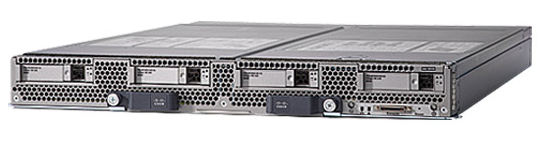 The M5 generation of systems is the highest-performing in UCS history and includes:
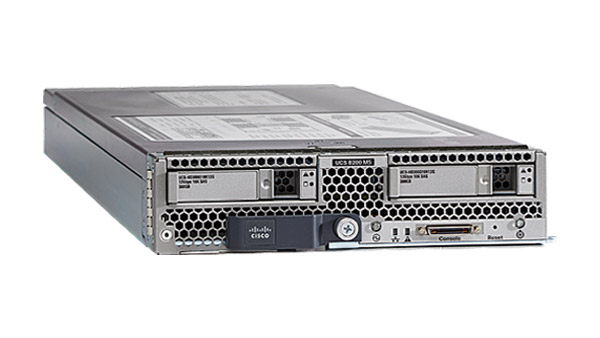
• Cisco UCS B200 M5 Blade Server: At half the size, the powerful B200 blade server delivers performance, versatility, and density for traditional or distributed multi-tier applications. It is an industry leader in GPU density for small form factor general-purpose blade servers, supporting up to two GPUs.
• Cisco UCS B480 M5 Blade Server: Delivers market-leading performance, versatility, and density for multiple workloads: mission-critical, memory-intensive, or virtualized workloads for distributed databases.
• Cisco UCS C220 M5 Rack Server: This high-density, two-socket rack server is one of the most versatile for general-purpose applications, providing high performance and efficiency for a wide range of workloads, including virtualization, collaboration, and bare-metal applications.
• Cisco UCS C240 M5 Rack Server: An enterprise-class rack server with storage and communications I/O capabilities optimized for Big Data analytics, software-defined storage, and bare-metal applications.
• Cisco UCS C480 M5 Rack Server: With an innovative modular architecture to facilitate technology upgrades, the C480 model expands scalability for in-memory databases, Big Data analytics, virtualization, VDI (Virtual Desktop Infrastructure), and bare-metal applications, now tripling GPU support—up to six GPUs supported—and disk capacity (up to 32 disks).
Infrastructure automation and optimization with Cisco Enterprise Cloud Suite.
According to IDC[i], IT departments demand greater planning capabilities and optimized use of data center infrastructure. With the announcement of Cisco UCS Director 6.5 (part of Cisco Enterprise Cloud Suite) and its integration with Cisco Workload Optimization Manager, organizations can adopt a multi-cloud strategy with superior performance and achieve greater efficiency in on-premises infrastructure.
• UCS Director 6.5 allows IT departments to complete 80 percent of operational tasks from a single console. The new version expands automation capabilities beyond infrastructure, automating native PowerShell functions, virtual machine mobility across vCenter data centers, and VMware VMRC console support. It also includes automation enhancements for FlexPod, Cisco HyperFlex, and added support for the UCS M5 series and UCS S-Series servers.
Workload Optimization Manager leverages adaptive analytics to continuously accommodate the infrastructure required for demanding workloads in both on-premises and multi-cloud environments. Tight integration with Cisco UCS allows customers to reduce costs by reclaiming idle or underutilized resources while optimizing their compute resources for cloud and virtualized environments. The new Cisco UCS Director version 6.5 also integrates with Workload Optimization Manager, facilitating the automatic creation of a new virtual machine or the configuration of a physical server with UCS Director. Workload Optimization Manager then reallocates resources to ensure application performance and cost efficiency.

Fifth generation of Cisco UCS servers
Cisco has announced a new generation of servers and software that expands its innovative Cisco Unified Computing System (UCS) platform.
Unlabeled
-
-
Extreme Networks launches the new BlackDiamond 8900 modules for data centers
Extreme Networks introduces the new BlackDiamond 8900 modules for the BlackDiamond 8800 switch. This new architecture for next-generation data centers is the only one that combines scalability of up to 582 10Gb Ethernet ports in a single rack, with maximum energy efficiency and...
-
Fujitsu ETERNUS DX8900 S4 optimized for Flash
Fujitsu introduces the ETERNUS DX8900 S4 solution, offering petabyte-scale flash-optimized storage for the data center. This system reduces complexity by eliminating the need to vary storage tiers for different workloads and consolidates storage silos...
-
Powerful PDU with 8 IEC-C13 sockets and general overload protection
PDU-Rack presents its Powerfull PDU with 8 IEC-C13 sockets and General Overload Protection. Available in single-phase versions from 16 A to 64 A.
-
Raritan integrates JouleX Energy Manager with its intelligent energy distribution units
Raritan announces that it has expanded the functionality of its Intelligent Power Distribution Units (IPDUs). The company's new partnership with energy management specialist JouleX has enabled the integration of JouleX Manager energy management software... -
Will liquid cooling dominate thermal management in data centers?
Over the past 16 years, the thermal design power (TDP) of GPUs has quadrupled. With the growing demand for AI, cloud computing, and cryptocurrency mining, IDTechEx expects the power consumption of server and data center boards to continue increasing. With the lifespan...



Newsletter
Latest News
RETN launches new trunk route between Romania and Moldova to strengthen connectivity in Eastern Europe
RETN announces the launch of a new end-to-end trunk route linking Drobeta,...
GCF and TCCA integrate interoperability testing into the MCS certification for 5G and LTE networks
The Global Certification Forum (GCF) and TCCA announce that interoperability testing (IOP) is now...
SQuA is born, the alliance that will boost the quantum technology ecosystem in Spain
Spain will have, for the first time, a specific association for the development of its ecosystem...
Telefónica and Sony test 5G mmWave at the Movistar Arena with record upload speeds
Telefónica, in collaboration with Sony, has conducted a pioneering test at the Movistar Arena...
Samsung and Qualcomm validate 5G PC1 technology to improve performance and FWA coverage
Samsung Electronics Co., Ltd. has announced a breakthrough in fixed wireless access technology...
Social networks
 |
 |
 |
 |
 |

Subscribe to CONECtrónica magazine
You can subscribe to the Conectrónica magazine in 2 formats.
Digital Format: 5 downloadable PDF editions at an annual cost of 60 Euros (VAT included)
Paper Format: 5 editions to be received by mail at an annual cost of 180 Euros (VAT included).
Contact our subscriptions department at subscriptions@conectronica.com
Payment via Bizum or bank transfer
Technical Courses and Seminars

DataCom: Technical guide for networks, fiber optics and structured cabling
Digital transformation has turned data networks into a critical infrastructure for...
Taoglas launches The Antenna Podcast, a new technical space about antenna design and innovation
Antennas remain one of the most critical and, at the same time, most misunderstood elements in...
ISE 2026 Barcelona: Summits, Megatrends and the most ambitious content program in the AV sector
Returning to Barcelona in February 2026, Integrated Systems Europe (ISE) presents its program of...
E-book: the future of satellite communications
Mouser Electronics, Inc., in collaboration with Qorvo and other technology innovators...
European project “Engineers of the Future” with free online training for young people and teachers on cybersecurity, green energy and automation
The GAIA Cluster has participated in the European project "Engineers of the Future", co-financed by...
Optical Networks
Multidimensional reconfigurable add/delete optical multiplexer for WDM-MDM systems
In the rapidly evolving field of optical networks, the demands for greater flexibility and...
LAN 2026: Standards, Trends and New Developments in Local Area Networks
The local area network (LAN) ecosystem is undergoing a phase of accelerated transformation in 2026, driven by...
Evolution of optical networks: ROADM, OpenROADM and OpenZR+ in the 400G and 800G era
The rapid increase in data traffic is driving the construction of new infrastructure worldwide...
Legrand launches Chroma Link, the fiber optic solution for high-density AI networks
Legrand has announced the launch of Chroma Link™, a fiber optic cabling solution with...
Hollow Core Fiber (HCF) Deployment and Testing
Hollow Core Fibers (HCF) represent a significant evolution...
Network infrastructure in the age of AI: why fiber optics is key beyond bandwidth
New requirements for network infrastructures: why, in the age of AI, fiber optics...
Nokia drives optical networks for the AI era with new coherent solutions and multi-fiber amplifiers
Nokia has announced a suite of new optical network innovations designed to address...