Commonly used thermal fillers for relatively low thermal conductivity
Alumina fillers have low electrical conductivity, a very high melting point (over 2000 degrees Celsius), and are chemically inert. Therefore, they are a suitable choice for electrically sensitive applications. In addition to these properties, alumina fillers are relatively inexpensive; for example, spherical alumina fillers cost around US$6 per kilogram, depending on the volume and the supplier. Thanks to their cost-effectiveness, they are the most widely used fillers for thermal imaging coils (TICs), especially for electric vehicle batteries.

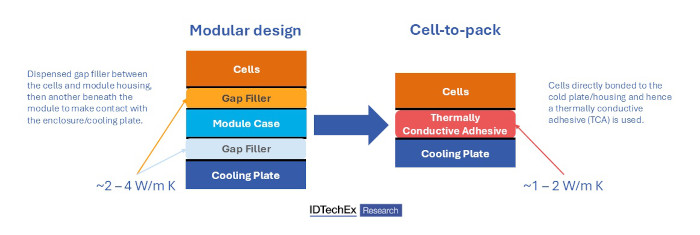
Within electric vehicle batteries, a major trend is the transition from modular battery configurations to cell-to-pack battery architecture, which reduces the thermal conductivity requirement. This transition opens new opportunities for aluminum hydroxide (ATH). Despite its low thermal conductivity, ATH can be obtained at a lower cost, making it an ideal choice for the cost-conscious automotive industry. It also possesses flame-retardant and fire-protective qualities, which could be advantageous for electric vehicle applications where there may be potential fire hazards.
Advanced thermal loads with high thermal conductivity
Aluminum nitride and graphene, on the other hand, have very high thermal conductivity, but they are expensive, meaning their uses are more suited to high-end applications. Magnesium oxide is another option for high thermal conductivity and is non-toxic and inexpensive, although it is not widely used and requires specific treatments, as the raw compound cannot be used directly as a filler material.
Primarily used as an additive rather than a primary filler, boron nitride (BN) also boasts high thermal conductivity, is an electrical insulator, is non-toxic, and possesses excellent chemical and thermal stability. However, BN fillers are significantly more expensive. According to research by IDTechEx, the cost of BN fillers can be more than 10 times higher than that of alumina fillers.
Data center applications
High-power components will be the primary users of advanced thermal interface materials (TIMs) due to the heat generated by components such as servers, switches, and power supplies. Within data center components, servers are the largest users of TIMs because of their high number of drives, large processors, and chipsets. With the increasing demand for cloud computing, artificial intelligence, and high-performance computing, as well as the growing thermal design capabilities of key components like GPUs and CPUs, the need for these advanced TIMs for servers will continue to rise, presenting a significant demand opportunity for the TIM industry.
For electric vehicle battery applications, alumina is expected to remain dominant. Although fillers such as boron nitride have much higher thermal conductivity and may be preferable, they are significantly more expensive, meaning their adoption will likely be limited to high-end applications.