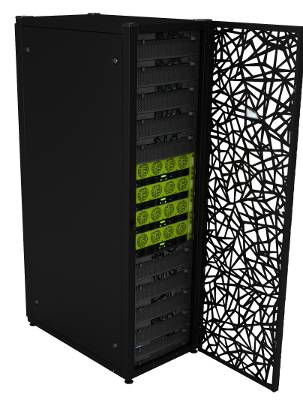
 “Bullion servers use less physical equipment, concentrating a lot of power in larger components, simplifying the data center concept,” explains Alicia De La Fuente, Director of Corporate Servers at Bull.
“Everything is done with standard hardware and software technology, and Bull’s R&D is key,” De La Fuente indicates. “The key lies in the design and optimization of the systems and the connectivity between the different components, which allows us, with smaller systems, to serve very high load levels. Compared to other providers, they would need more hardware to do the same with the same level of reliability and stability.”
Designed for virtualization, Bullion servers are the result of Bull's experience in other fields such as mainframes and high-performance computing (HPC), with which they share technology, design, and expertise. “Our approach to virtualization is very different from the competition. They build very large clusters based on many small components, which is very complex because to make a system with many elements function as one, they need a collaborative environment on top of it, which arbitrates how all the elements work and interact. Our servers eliminate the interconnection aspect because the machine communicates automatically, without the need for external networks, and they don't need software to manage complexity because instead of 50 servers, there are only 2. We simplify the data center: fewer servers, much more powerful, and of course, completely reliable.”
Bullion servers offer the highest scalability on the market and have the greatest capacity for hosting virtual machines. “Here we are also different. The competition uses a horizontal scalability model, while ours is vertical scalability: a single system to which resources are added as more power is needed, using Intel processors, the same ones our competitors have used. Standard virtualization software, such as VMware, Microsoft, or Red Hat, runs on this platform. The performance of the competition's systems is limited by their internal design, which is optimal up to a certain size, at which point bottlenecks begin to appear. We, on the other hand, are on the 6th generation of an architecture that allows you to scale without encountering these bottlenecks.”
Bullion systems are the most powerful on the market in their class—standard virtualizable servers with x86 processor technology. An unbeaten position since September 2012 in the conventional x86 server segment, with a performance of 4,110 according to the SPECint®_rate2006 test on a system with 160 Intel® Xeon® E7 cores and 4 Terabytes of RAM, a position that will be renewed with the upcoming announcement of new bullion models, which will integrate the recently announced Intel E7v2 processors. “In addition to being the most powerful, scalable, and feature-rich servers,” explains Alicia De La Fuente, “they are also the most energy-efficient, reducing consumption by almost 50%, thanks, among other things, to our active-passive power supplies, a system that allows a non-productive power supply to be available but not consume power.”
The current bullion server is the result of two Bull projects. The first focused on developing the most powerful server in the HPC environment, and the second in the mainframe environment, combining power and reliability, and enabling the execution of mainframe services on the same technology. “We’ve been working on vertical scalability for years and learned with Itanium how to communicate many boards internally. But it’s not enough to be able to virtualize the largest number of machines; we must also guarantee that the systems don’t crash, something that Bullion also does.”