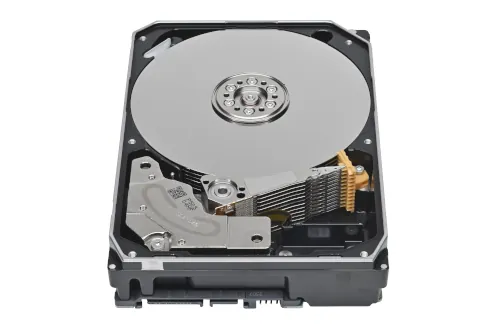
The new series uses stepped magnetic recording (SMR) technology to offer storage capacities ranging from 30 to 34 TB. Toshiba also plans to begin shipping samples of M12 drives with conventional magnetic recording (CMR) technology, which will reach capacities of up to 28 TB, in the third quarter of 2026.
The M12 series increases storage capacity in the standard 3.5-inch nearline HDD form factor. M12 series drives leverage Toshiba's proprietary design and analysis technologies, developed through the creation of compact and slim products. They surpass previous generations of enterprise hard drives (the MG11 series with CMR and the MA11 series with SMR) by incorporating an additional magnetic platter, for a total of 11 platters. Furthermore, the recording media used in the M12 series replaces the standard aluminum substrate with glass, offering greater durability and enabling a thinner design.
Their casings are filled with helium, and the drives combine Toshiba's proprietary Flux Control Microwave-Assisted Magnetic Recording (FC-MAMR™) technology with SMR, achieving capacities of 30 to 34 TB. SMR technology increases recording density by overlapping data tracks, similar to roof tiles. However, due to this overlap, random write operations can lead to performance degradation. To address this, the M12 Series HDDs adopt a host-managed SMR architecture, in which the host system manages the placement and rewriting of data within the drive. This approach enables more efficient data management and reduces performance degradation in server and storage system environments.
The new SMR HDDs achieve a maximum data transfer rate of 282 MiB/s, an improvement of approximately 8%, while power consumption per terabyte (W/TB) is approximately 18% lower than the previous generation of products. Designed for continuous 24/7 operation, the M12 series supports an annual workload of 550 TB and offers an MTTF/MTBF[6] of 2.5 million hours, with an annual failure rate (AFR) of 0.35%. Looking ahead, Toshiba plans to further increase HDD capacity by adopting next-generation recording technologies, such as Heat-Assisted Magnetic Recording (HAMR), as well as products with a 12-disk configuration. Increased HDD capacity is key to meeting the ever-growing storage demands of data centers.