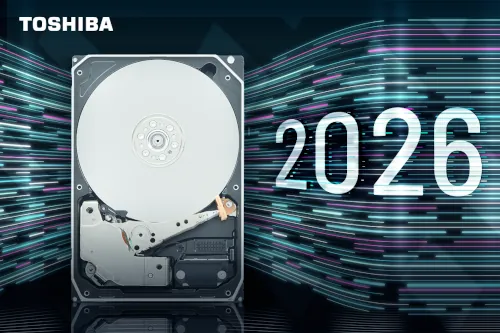
Toshiba notes that global storage demand will double to nearly 20,000 exabytes by 2029, according to IDC. This growth is largely driven by AI-related workloads, which generate massive volumes of data that must be stored, analyzed, and preserved long-term for regulatory and business reasons. In this scenario, HDDs will continue to be the most cost-effective option per terabyte for online storage, backups, and mass archiving. Video surveillance is one of the sectors where storage needs are transforming most rapidly. The rise of AI-based video analytics, coupled with continuous high-resolution recording, demands solutions capable of delivering high capacity, sustained performance, and maximum reliability in 24/7 operating environments. In response to these demands, Toshiba recently launched the S300 AI hard drives, designed for intelligent video surveillance systems.
HDD and SSD, complementary technologies
Toshiba emphasizes that, in data centers, HDDs and SSDs, far from being mutually exclusive technologies, fulfill distinct functions. While SSDs provide speed and low latency for intensive processing tasks, HDDs allow for the sustainable and cost-effective storage of large volumes of data. In AI applications, for example, SSDs are key for training and analysis, and HDDs for storing historical data and large datasets. In this scenario, and according to TrendForce, the shortage of nearline hard drives has led to delivery times ranging from weeks to a year. And, although some providers are considering the use of SSDs, especially QLC SSDs, for cold storage, HDDs remain essential.
Technological innovation and the evolution of the HDD
Alongside continuous innovation, Toshiba emphasizes that the standardization of the 3.5-inch SAS/SATA HDD format remains a key factor for the industry, as it protects existing investments and facilitates integration into already deployed infrastructures. In fact, Gartner predicts that by 2026 HDDs will represent 68% of total capacity shipped, primarily high-capacity 3.5-inch nearline hard drives tailored to the requirements of data centers and the cloud. Regarding innovations, Toshiba highlights the introduction of multi-actuator drives, NVMe and Ethernet interfaces for HDDs, and single-stage magnetic recording (SMR), although these have not yet achieved widespread adoption. The company continues to invest in R&D to offer drives with greater capacity, energy efficiency, and reliability. A recent milestone is the verification of 12-disk stacking technology, which combines microwave-assisted magnetic recording (MAMR) and will enable 40TB HDDs in the 3.5-inch form factor by 2027. These innovations rely on the use of glass platters and helium filling, which improves mechanical stability and reduces power consumption. To achieve even greater capacities, Toshiba is also investigating the integration of next-generation 12-disk stacking with heat-assisted magnetic recording (HAMR).
Sustainability and energy efficiency are priorities
Sustainability will be a central focus in the evolution of storage in the coming years. As the number of data centers grows, so does the need to reduce their environmental impact. In this regard, high-capacity HDDs allow for lower energy consumption per terabyte stored, an increasingly relevant metric for operators. Toshiba notes that current HDD models consume between 9 and 10 watts, regardless of capacity. As capacity increases, consumption per terabyte drops from 1W/TB for 10TB drives to less than 0.4W/TB for 24TB drives, and future generations are expected to reduce this ratio even further. To achieve this, Toshiba uses helium-filled disks, reducing friction and energy consumption.
Toshiba HDD Innovation Lab
The imperative of sustainability, coupled with increasingly complex architectures and growing demand, makes expert guidance essential. By 2026, Toshiba's HDD Innovation Lab in Düsseldorf, Germany, which offers benchmarking and energy analysis services to help optimize configurations for maximum performance and efficiency, will be a key resource for the company's customers and partners. According to Rainer W. Kaese, Senior Director of HDD Business Development at Toshiba Electronics Europe, "Evaluating and optimizing HDD configurations for SAN, NAS, and video surveillance applications will be crucial for organizations to maximize performance, energy consumption, and reliability." Kaese adds, "The HDD Innovation Lab enables customers to make informed decisions and implement storage solutions tailored to their needs. With the anticipated increase in data center construction and the growing complexity of storage environments, data center expansion is a highly likely possibility."