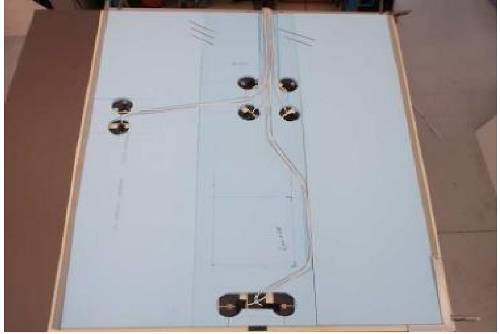
It was developed with a dual objective: to offer an innovative antenna concept manufactured entirely from composite materials and to embed the antenna within a vehicle body panel using conventional processes such as infusion or pre-impregnated curing. This new communication technology allows direct communication between composite panels and their radio frequency environment (smart composite structures) without the need for external antennas.
The fundamental idea behind this innovation is to manufacture all the DTT (Digital Terrestrial Television) antenna components entirely from composite materials, including the conductive components of the radiating and reflecting elements. To this end, numerous carbon or hybrid reinforcements were characterized. The first step in designing a carbon fiber composite antenna was to determine the electrical properties of the selected carbon fiber fabric. Secondly, the DTT composite antenna (planar Yagi topology) was designed using numerical simulation. The manufacturing process is currently being optimized to improve the Technology Maturity Level (TRL) and Manufacturing Maturity Level (LMR) of these products. Close contacts have already been established with automotive industry suppliers to market the future composite panels for communication equipment.
The application developed and tested here is a digital terrestrial television (DTT) antenna on the roof of a camper van. This antenna, made entirely of composite materials, must be omnidirectional so that camper van occupants can watch television without any manual tuning or adjustment, regardless of whether the camper van is moving or stationary.
cnPilot™ e430W Access Point with 802.11ac Wave 2 Connectivity
Cambium Networks introduces the new cnPilot e430W, a cloud-managed wireless access point for businesses. The new device is compatible with the 802.11ac Wave 2 standard and is ideal for providing connectivity in hotels, resorts, and residential complexes. The access point...