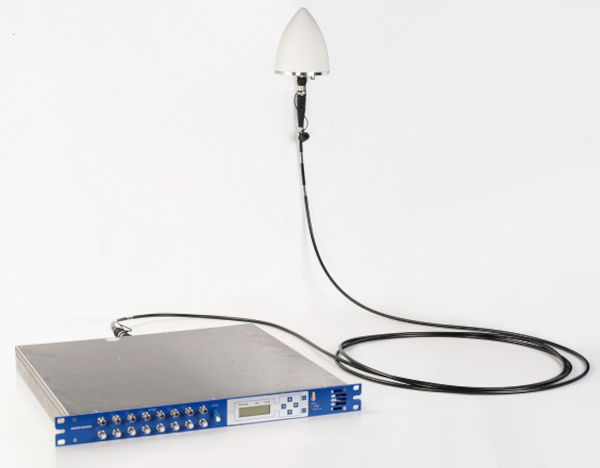
“As data volume and transfer speeds continue to increase, so does the requirement for precise time synchronization, with GNSS timing signals in use in many applications, from data centers to headquarters,” says Product Manager Dominik Tibolla at HUBER +SUHNER. “Using GNSS signals from satellites allows for the acquisition of precise and accessible timing information from atomic clocks, while combining this with fiber optic distribution enables lower attenuation over longer distances.”
Traditionally, power is delivered via copper to a GNSS antenna. This typically requires a separate power cable to be installed alongside the signal distribution cable. HUBER+SUHNER's GNSS and Power over Fiber solution eliminates the need for a separate power cable, as it uses the fiber optic connection to the antenna for both power and signal distribution.
GNSS and Power-over-Fiber solutions go beyond the limitations of existing technology. They allow for a significant increase in the distance between the source and receiver, from just a few meters to several kilometers. Satellite signals typically don't reach indoor locations due to the blocking effect of the building structure, but by combining this with internal fiber distribution, HUBER+SUHNER's GNSS and Power-over-Fiber solution distributes GNSS signals to every corner of a building's interior, providing a more secure, reliable, and flexible connection.
Using fiber as a power distribution medium also offers a secure and unlimited timing reference signal distribution with reduced interference. Providers can also leverage their existing infrastructure, paying only for what they use within the network and becoming future-proof with easy and flexible expansion opportunities.