With well-designed GPS synchronization receiver technology, GPS users can obtain extremely precise synchronization from the synchronized atomic clocks aboard GPS satellites. This coordinated synchronization allows adjacent receivers to align with the same time reference. The space-based atomic clocks of the GPS system are synchronized by the US Naval Observatory (USNO). The USNO conducts continuous measurements with the Bureau International des Poids et Mesures (BIPM), the Paris-based international standards organization responsible for maintaining world time, to ensure that time is coordinated with the rest of the world. This coordinated, or "absolute," world time is more commonly known as UTC – Coordinated Universal Time. Although GPS, developed and maintained by the US Department of Defense, was the first positioning, navigation, and timing (PNT) satellite constellation deployed, several Global Navigation Satellite System (GNSS) technologies are now deployed worldwide for PNT. Examples of other GNSS systems include Galileo (EU), GLONASS (Russia), BeiDou (China), QZSS (Japan), and IRNSS (India).
As wireless technologies have progressed through successive technological iterations, from 2G to 5G, network synchronization architectures have evolved in parallel. While 2G/3G distributed RANs used GPS synchronization receivers embedded in macrocell sites, 5G networks are moving to a more centralized and/or weighted model where GPS serves as a network-based clock source for distributed synchronization. Synchronization architectures
have developed in three distinct phases. In Phase 1, physical or packet-level synchronization was designed for frequency networks, with GPS deployed locally on the distributed RAN (DRAN) base station tower for TDD applications. In Phase 2, more centralized GPS sources were added, and synchronization was delivered in packets to "groups" of baseband units (BBUs). Both Phases 1 and 2 utilized dedicated synchronization links from the BBUs to the radios. Phase 3 will extend packet synchronization protocols directly to radio units, without relying on proprietary synchronization and with fewer GPS requirements at DRAN base stations. With the introduction of open RAN concepts in 5G, BBU functions will be classified as centralized (CU) and distributed (DU), evolving toward virtualized and server-based functions that will no longer need to be included in the synchronization path.
A significant technical consideration is driving the migration from a distributed GPS synchronization architecture to a network-based synchronization architecture based on the Precision Time Protocol (PTP), the telecommunications version of the IEEE 1588 synchronization protocol over Ethernet. The former relies exclusively on GNSS receivers, while the latter introduces the concept of combining GNSS receiver and PTP Grandmaster Clock technologies. The most frequent synchronization problem in wireless communications is co-channel radio interference. Deploying a GPS receiver at a cell site, when the receiver is tracking the satellites correctly, allows for the proper allocation of transmission time slots. This, in turn, prevents radios operating on adjacent or nearby frequencies from interfering with each other. In a group of radios with overlapping coverage, if a GPS receiver fails or stops tracking correctly, the radio connected to that receiver will interfere with adjacent radios as synchronization degrades or phase errors accumulate. Synchronization degradation occurs very rapidly because the radios use low-cost, low-performance oscillators (one of the design goals of radios is cost reduction through the use of lower-specification components).
To avoid interference problems, once synchronization begins to degrade, the radio should be taken offline or the services affected by the synchronization degradation should be shut down immediately. To mitigate this type of failure scenario, a PTP-based synchronization service can be deployed, in which the cluster radios are synchronized to a PTP grandmaster clock with an integrated GPS receiver. If the PTP master clock's GPS fails or experiences tracking problems, the radios synchronized to the master clock will remain in phase with adjacent radios and will not experience interference issues. High-quality oscillators can be deployed on the PTP master clock to maintain time alignment with UTC for extended periods, and PTP-based backup scenarios can be included in the architecture to help maintain time traceability to UTC in failure scenarios. The PTP master clock network-based synchronization services approach is a highly resilient and cost-effective solution that provides the added benefits of radio group phase alignment in GPS failure scenarios. It also brings GNSS deployment to centralized points of presence where security and good line-of-sight to the satellite constellation can be carefully engineered.
Phase 1: Distributed GPS, GPS synchronization receivers integrated into macrocell sites for CPRI synchronization applications.
In this application, the synchronization source is a GPS receiver integrated into the BBU, which is located alongside the radio head (RH), typically at the cell base. The BBU retrieves the synchronization from the GPS receiver and transfers it to the RH over a few meters of fiber using the Common Public Radio Interface (CPRI), as shown in Figure A.
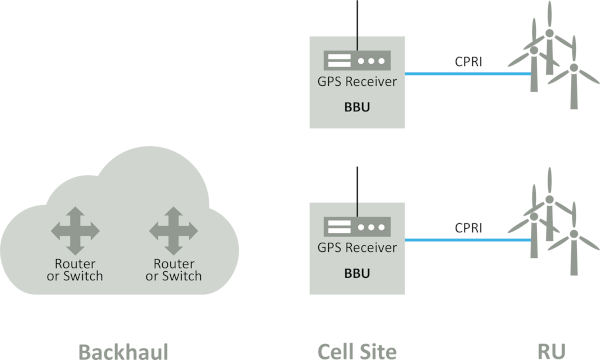 Figure A. This figure shows a GPS synchronization receiver integrated into the BBU and is an example of a distributed GPS synchronization architecture in a DRAN architecture. Synchronization is provided from the BBU to the radio via the CPRI link.
Phase 2: Synchronization services based on the GPS source network, PTP grandmaster clocks at the radio cluster aggregation points for CPRI synchronization applications.
In this application, the BBU is located away from the RH. BBUs are typically grouped into hubs known as centralized RAN locations (cRANs), which are aggregation points for the RH clusters. The time source can be a GPS receiver located in the cRAN hub, with the GPS signal routed from the antenna to the receivers integrated into the BBUs. Alternatively, the GPS receiver can be combined with a PTP master clock, in which case a PTP synchronization service is provided to the PTP slaves in the BBU. Once the BBU has regained synchronization from the PTP stream or the GPS receiver, it transfers the synchronization via the CPRI link to the remote radio heads (RRHs). The CPRI link in 3G and 4G service architectures has a distance limitation of approximately 17 km. See Figure B below.
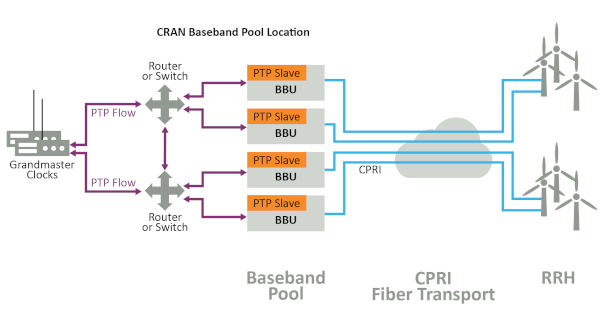 Figure B. This drawing represents a PTP grandmaster as a network-based synchronization source for a radio cluster, transferring time from a PTP slave in the BBU to the radio cluster via the CPRI link.
Phase 3: Network-based synchronization services from the GPS source, PTP grandmaster clocks at the radio cluster aggregation points for Ethernet synchronization applications.
5G will require radio densification and additional lower and higher frequencies than 4G, implying more careful synchronization design to avoid increased co-channel interference between radios. At the same time, the BBU is being disaggregated into two functions, the distributed unit and the centralized unit, which can be virtualized, and CPRI-based timing is being moved to PTP over Ethernet directly at the radios. This will bring about a huge change in synchronization architectures: GPS will necessarily be moved to the radio cluster aggregation points, and PTP will become ubiquitous throughout the network. Such an architecture will require a robust and resilient GPS deployment deep within the network and more PTP to provide both synchronization to the 5G Radio Units (RUs) and systematic backup and protection for the GPS clocks.
Undoubtedly, 5G services will increasingly rely on PTP engineering for resilience and deterministic synchronization across the network. As Open RAN architectures gain traction and are adopted for 5G deployments, PTP synchronization flows will terminate at the 5G radios, and the DU will no longer need to be part of the synchronization chain from the grandmaster clock to the 5G radio. This is illustrated in Figure C below.
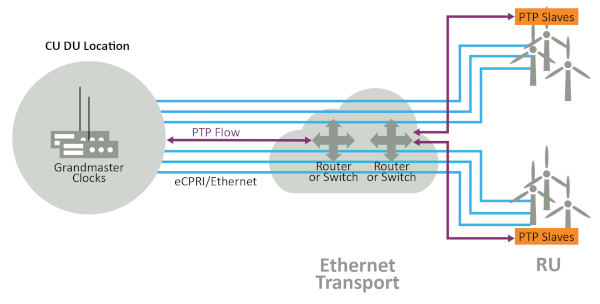 Figure C. This illustration represents a PTP master clock that provides time transfer using the PTP protocol directly to PTP slaves on 5G radios.
Summary:
5G introduces some significant changes that encompass almost every aspect of mobile wireless network architecture, including the RF frequencies used, radio I/Q data transport, transport architecture, and how the network is synchronized. The reliance on GPS, seen in 3G and 4G systems, is shifting to point-to-point (PTP) synchronization due to new security and reliability concerns, the need for extremely tight guaranteed synchronization for 5G radios without line-of-sight to satellite systems, and the operator's preference for guaranteed phase alignment and control of critical synchronization services.
More deterministic and stringent synchronization that enables ubiquitous, always-on broadband services will be the hallmark of 5G networks.
Author: Jim Olsen, Senior Technical Applications Engineer at Microchip TechnologyInc.