As a result, companies across Europe must ensure their employees are not exposed to fields exceeding specified limits, some of which have been recently adjusted. This involves monitoring and minimizing risks, including preventive measures where necessary. Narda Safety Test Solutions develops and manufactures powerful and intelligent measuring equipment ideally suited for these tasks.
The EMC Directive defines the “minimum health and safety requirements concerning the exposure of workers to the risks arising from the physical effects of electric, magnetic and electromagnetic fields in the frequency range between 0 Hz and 300 GHz.” The limit values, based on the recommendations of the ICNIRP (International Commission on Non-Ionizing Radiation Protection), have been revised to reflect the latest scientific developments and refer exclusively to the direct and immediate effects on the human body.
Corporate Responsibility: One of the requirements of the EMC Risk Directive is that companies must conduct an assessment in every work environment. The need to ensure that maximum values are not exceeded means that each risk must be evaluated and exposure levels determined in accordance with the Directive. Calculated values or the
manufacturers' own emission specifications can be used, especially in offices and laboratories where only low-current equipment is used. However, measurements are essential where high levels of exposure may exist, such as in metallurgical plants with furnaces and industrial welding equipment.
This new set of rules stipulates that qualified technicians must measure field values at regular intervals and document the results in a verifiable manner.
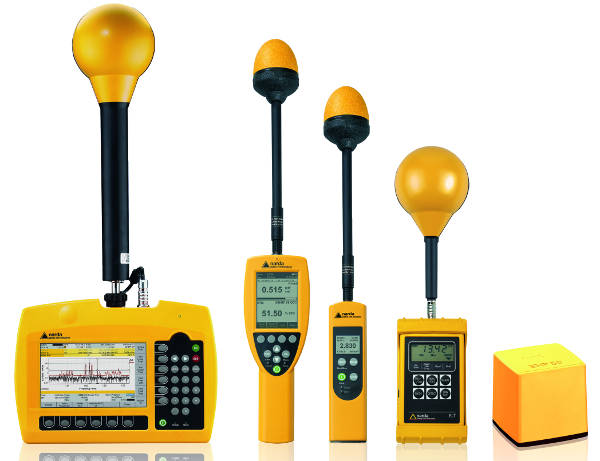
Narda – the individual solution for every case: Narda Safety Test Solutions develops and produces powerful and intelligent measuring equipment, especially suited for these tasks. These precision instruments, from the leading specialist in EMC measurements, allow for the recording of all relevant values for assessing safety according to the Directive, in real time and with minimal effort. The product range includes broadband and selective measurement instruments, as well as personal monitors that form part of a complete personal protective equipment (PPE) kit. For example, it is possible to automatically detect the least favorable exposure levels from a biophysical perspective in complex situations typical of multi-frequency environments. The equipment displays the result directly as a percentage of the permissible exposure limit, streamlining the process and preventing misinterpretation. 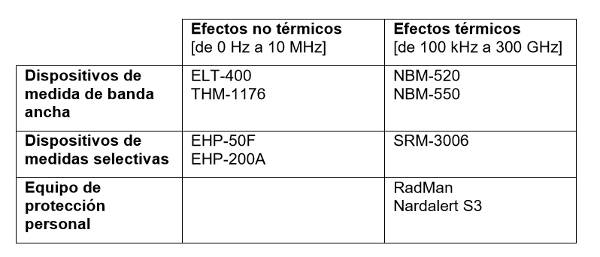 Table: Range of measuring equipment, including powerful Narda software for verifying exposure values, in accordance with Directive 2013/35/EU.
Description of the Directive: The EMC Directive considers two types of biophysical effects caused by electromagnetic fields. Sensory effects, such as the stimulation of muscles, nerves, and sensory organs at frequencies between 0 Hz and 10 MHz, which can cause temporary alterations in sensations; and thermal effects caused by frequencies between 100 kHz and 300 GHz (high frequency), which cause the heating of human body tissues due to energy absorption. For example, the microwave band covers from 300 MHz to 300 GHz.
The exposure limit values (ELVs) defined in Directive 2013/35/EU, separately for sensory and thermal effects, are the permissible limits for the worker's body. However, since these cannot be measured in practice and can only be calculated using complex methods, the Directive specifies so-called action levels (ALs), which are the upper limits for field values and can be measured directly in the workplace. If the ALs are met and verifiable, it can be said that the ELVs are also adequate. However, any violation of the ALs, however small, requires the use of protective systems or preventive measures, such as shielding or the use of filters.