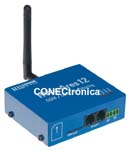
 The HWg-Ares12 unit contains a backup battery for 4 to 12 hours of operation, a terminal block for connecting external contacts, and inputs for external sensors (temperature, light, voltage, humidity, and others). USB configuration is very easy; the user does not need to install anything. The utility configuration is located on the automatically recognized USB disk (without the need for driver-
ladores).
The typical application of Ares12 involves sending an SMS or email in the event of an external power failure. The backup battery simultaneously powers the external sensors, making remote monitoring easy. For example, the temperature of refrigerators can be monitored even during a power outage. SMS messages and emails are sent to up to five phone numbers or addresses. The alarm text is editable.
For ease of use, the free HWg-PDMS software can be used to display value graphs and export the data to MS Excel.
HWg-Ares12 can be remotely controlled via the Nagios control system using an SNMP plug-in module. On a LAN, most protocols are based on a query-response principle, where the central server queries individual sensors. This system, when used over a GPRS network, requires a reserved APN or IP address and VPN. Both methods work very well only on certain GSM networks and in certain countries. Furthermore, setting up and maintaining the entire system is complex. HW Group presents the HWg-Push protocol, which is HTTP-based, with all communication initiated by the GSM sensor. This system is very easy to set up and operates on all GSM networks. Another advantage is its low operating cost (a standard data plan is sufficient).
HWg-Ares 12 enables easy monitoring of remote sites where LAN connectivity is unavailable. Installation takes only minutes and requires GSM signal coverage. Measured values can be viewed immediately in HWg-PDMS, and the device can be integrated into SCADA or SNMP control systems.