Rohde & Schwarz has applied an innovative concept to the system configuration to achieve this unprecedented level of efficiency. Attenuation has been significantly reduced throughout the RF chain, and the amplifier now incorporates advanced, efficient 50V LDMOS power supply transistors. Also noteworthy are the specially developed power supplies that allow the transmitter's control unit to optimize the transistor supply voltage, resulting in an exceptional increase in efficiency.
Another significant factor in the increased efficiency is the optimized liquid cooling system.
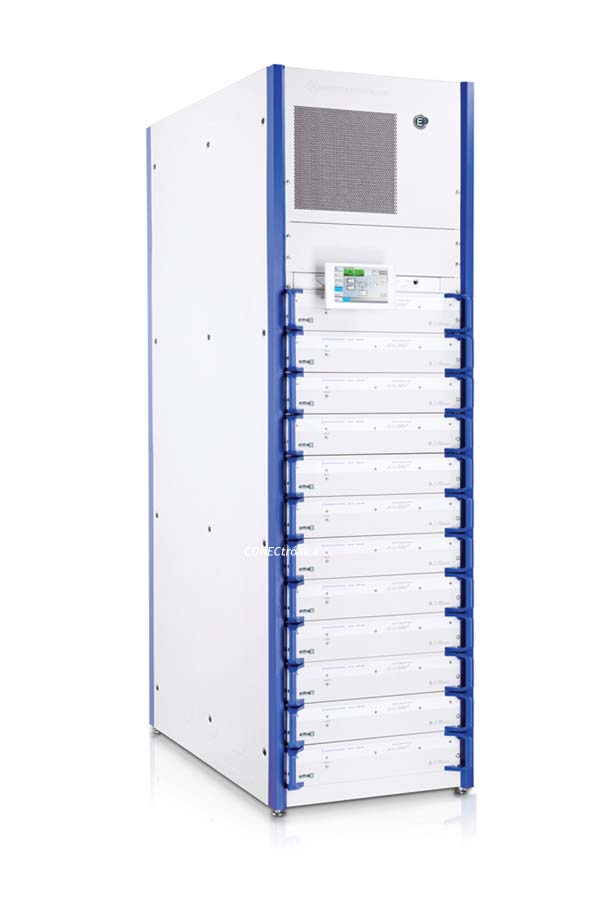
With a power output of 15 kW for COFDM standards in a single rack, the R&S THU9 offers the best power density on the market. The maximum power output per rack is 18.5 kW for ATSC and ATSC Mobile DTV, and 30 kW for analog TV. This high power density makes the R&S THU9 the most compact system in its class. Depending on the configuration, up to four independent transmitters can be integrated into the rack. If required, these can be combined into an N+1 system. The MultiTX concept maximizes available space and reduces infrastructure costs.
The new R&S TCE900 exciter also contributes to increased system flexibility, as it can be configured as a transmitter control unit or as an exciter using plug-in cards. Because the base unit is the same, the network operator can change its functionality directly at the transmitter site. The exciter can be software-switched from an analog TV standard to a digital one, such as DVB-T/-H, DVB-T2, ATSC, ATSC Mobile DTV, or ISDB-T/ISDB-TB. Multiple transmission standards can also be installed on the same exciter. The transport frame is transmitted to the R&S TCE900 exciter via the conventional ASI interface or Gigabit Ethernet. External ASI-IP converters are no longer required, resulting in space and cost savings.