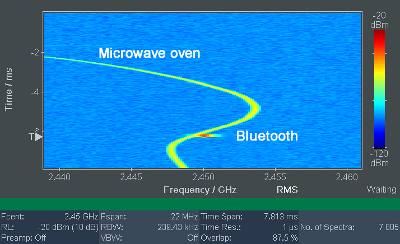
Because the frequency spectrum is limited, modern communication methods increasingly rely on FHSS (frequency-hopping spread spectrum) techniques. By continuously changing the frequency, devices can more easily find unoccupied frequencies or channels. Typical applications in the ISM band include WLAN and Bluetooth, along with drone remote control. Some GSM operating modes also employ frequency hopping. Illegal transmitters also use this method to make them harder to detect. This type of interference can even occur accidentally in legal transmitters. For example, if several mobile phone transmitters share the same location, the rectifying effect of a few rusty rivets on the mast can generate interference that is very difficult to distinguish from legitimate signals.
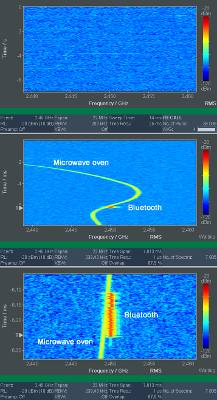 In the IDA-2's new "High Resolution Spectrogram" display mode, the signal type can be identified based on its variation over time. The instrument records the spectrum line by line, indicating different levels with distinct colors, allowing for a quick overview of spectral and
temporal relationships. With a 1 μs resolution, LTE frames, for example, can be seen and immediately distinguished from other underlying signals due to their different frequency and timing characteristics. Frequency and time signatures allow for conclusions to be drawn about the source type and interference in multipurpose frequency bands, such as ISM. The IDA-2's Magnitude mode displays signal levels as a function of time and is useful for triggering, identifying signals through their temporal structures, and ultimately, pinpointing the signal source.
Technical Fundamentals:
The High Resolution Spectrogram and Magnitude modes are based on the I/Q Analyzer mode. The IDA 2 operates with zero span, meaning it is tuned to a fixed frequency or a specific channel, selectively capturing and recording the digitized data. A special feature of this instrument is its ability to select channel bandwidths (CBW) up to 32 MHz.
In High Resolution Spectrogram mode, the IDA 2 analyzes the data using an FFT algorithm with user-defined parameters. For example, the FFT produces a usable bandwidth of 22 MHz for a channel bandwidth (CBW) of 32 MHz. With a 256-point FFT, the IDA 2 calculates the spectrum with a
resolution bandwidth (RBW) of approximately 240 kHz. If a window with an 87.5% overlap is selected, the resulting spectra will have a 1 μs temporal resolution, meaning one million spectra per second. For this reason, conventional analyzers compress data to resolutions of 20 ms or better. The IDA 2 is the first portable device that stores uncompressed data and can display it at its original resolution, like a zoom lens: each row of pixels corresponds exactly to a spectrum, and the color corresponds to the specific level. Markers can be used to display each independent spectrum in the conventional format, level vs. frequency.
IDA 2 Description:
The IDA 2 Interference and Direction Analyzer has been specifically designed to identify and locate sources of electromagnetic signals in communications and security applications. In communications, it is important to locate and eliminate both intrinsic and extrinsic interference. In security applications, the IDA-2 can be used to locate unknown transmitters and identify potential hazards. It can automatically determine the direction of origin using a horizontal sweep and display the relative angle on a polar diagram. By taking multiple measurements, it can automatically calculate and display the exact position of the interfering source. The result can be overlaid on any electronic map or the user's own map, locating the source with excellent accuracy, just as it would appear on a navigation system. Determining
the position of the interfering source relies on a GPS receiver in the measuring instrument and an electronic compass in the antenna, which determines the direction, elevation, and polarization. Optimized antennas for different frequency ranges are available and can be inserted into the device horizontally or vertically. The IDA-2 automatically recognizes the antenna used and applies the correction data stored in the device. An optional adapter allows the use of antennas from other manufacturers. Ideal for field work, the IDA-2 weighs less than 3 kg, including the battery. The antenna, which is powered through the basic unit, weighs less than 1 kg. The rechargeable battery can be changed anywhere, without interrupting operations.