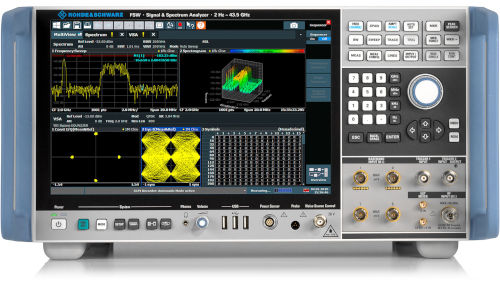
In this configuration, the broadband baseband signal is converted to the selected 140 GHz frequency by the R&S TC RSE converter. The R&S SMA100B analog signal generator provides the local oscillator frequency to the converter. Transmission is over-the-air (OTA) with the converter connected to a horn antenna. The transmitted signal is received by another horn antenna and its frequency is reduced. The R&S FSW, with the new 8.3 GHz bandwidth option (R&S FSW-B8001), analyzes the signal and performs signal quality measurements such as error vector magnitude (EVM) to analyze transmission performance. Several common modulation formats used in the industry are shown.
As wireless communications and sensing technologies advance, the need for greater bandwidth increases. These developments extend frequency limits into the sub-THz and THz ranges and, following the process initiated with 5G, make over-the-air (OTA) testing mandatory. At these frequencies, the degree of integration of RF frontends increases, and their characterization with respect to signal quality (EVM) and out-of-band emissions (ACLR, SEM, spurious emissions) necessitates a flexible OTA test setup that covers a wide range of frequencies, from microwaves and millimeter waves to sub-THz.
The proposed configuration is easy to install on the R&S ATS1000 antenna test system. This allows design engineers to characterize RF frontend prototypes and reference designs intended for use in future devices supporting mobile or other wireless technologies, and utilizing much wider bandwidths. For example, the IEEE 802.11ay standard allows channel bonding, which currently creates a signal with a bandwidth of more than 8 GHz.