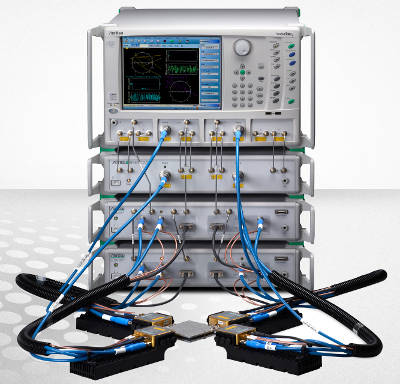
The new ME7838A4 provides wafer and signal integrity engineers with a new level of performance when performing differential measurements, giving them greater confidence in their next-generation communications system designs.
A key advantage of the VectorStar ME7838A4 4-port broadband system is the integration of the 3743A millimeter wave modules. These modules, which utilize an exclusive Anritsu design incorporating nonlinear transmission line technology (NLTL), are significantly more compact than competitor models, facilitating board mounting in space-constrained wafer test stations. Furthermore, these smaller, lighter modules improve overall performance, including superior raw directivity, resulting in enhanced calibration stability. Modules are available to expand the VectorStar ME7838A4 to a 145 GHz, 4-port system.
The VectorStar ME7838A4 4-port wideband system utilizes an internal substrate-mounted power supply for excellent thermal stability, resulting in best-in-class calibration and measurement stability of 0.1 dB over 24 hours. It also boasts best-in-class speed: 55 ms for 201 points at 10 kHz of intermediate frequency bandwidth (IFBW).
Engineers take advantage of the unparalleled background noise sensitivity for millimeter waves and the only real-time electronic power leveling for millimeter waves available on the market, eliminating the need for time-delayed software correction tables. Because internal frequency multiplication starts at 54 GHz in the VectorStar ME7838A4, compared to 67 GHz for other 4-port, wideband systems, RF cable losses are reduced, improving dynamic range and phase stability.
Installation and operating costs are reduced with the VectorStar ME7838A4. Test station positioner costs are lower thanks to the compact size and lighter weight of the modules. Significant savings are also achieved through longer calibration intervals.
Anritsu's advanced True Mode Stimulus option is available for the VectorStar ME7838A4. This allows engineers to program two interval signals to deliver a true 180° differential signal (or 0° for common mode) for comprehensive device analysis.