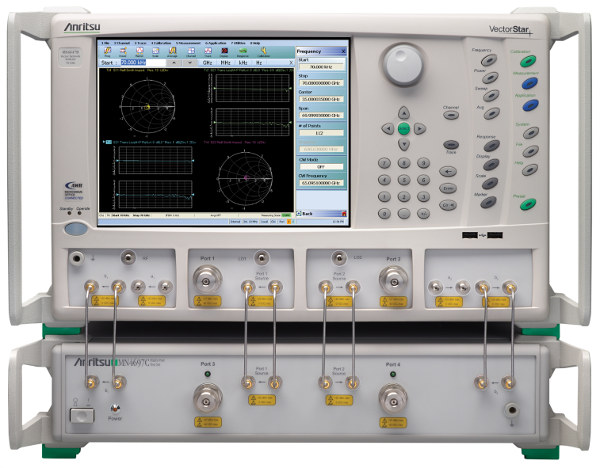
110 GHz.
The new differential noise option enhances the VectorStar's 2-port single-terminate noise measurement capabilities, enabling vector network analyzers to perform measurements on 3- and 4-port single-terminate devices in both differential and common modes, and for various processing options. Anritsu's differential noise option incorporates a cold source measurement technique similar to the 2-port method, minimizing mismatch errors for better accuracy than the conventional Y-factor noise source method. The new, improved noise figure option adds the ability to achieve vector correction levels on both 2-port and multi-port devices for superior accuracy, especially when mismatch is significant.
The analysis of correlated and uncorrelated noise measurements can be performed using the new differential noise technique. This results in a more comprehensive characterization of the device's actual performance, leading to greater confidence in the design. This method is superior to conventional techniques that rely on an RF balun with only a description of the S-parameter or negligible correlation between the output ports of the device under test, which provide an inaccurate characterization of differential devices. As operating frequencies continue to rise due to 5G, the ability to characterize device performance more accurately will become increasingly important.
Accuracy is further ensured by the wide range of network instruments compatible with VectorStar. For example, vector network analyzers can embed or de-embed single- or differential-terminate probes and other networks during wafer noise measurement, and can also correct receiver calibrations for other configuration changes. The result is a more accurate characterization of noise in differential devices during wafer measurements.
The MS4640B VectorStar vector network analyzers offer a frequency range between 70 kHz and 70 GHz. This range can be extended to 145 GHz and 1.1 THz in wideband configurations. VectorStar is capable of measuring noise in both single and differential terminations, between 70 kHz and 125 GHz.