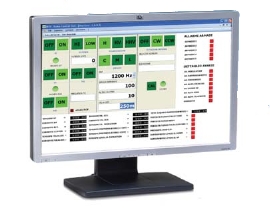
The RCP-10 uses a COTS industrial PC, equipped with added hardware and dedicated software running under the Linux operating system.
The RCP-10 computer contains two hard drives connected in RAID mirror mode and has hot-swappable redundant power supplies for exceptional reliability.
The RCP-10 receives azimuth/elevation data from the antenna control unit via dedicated parallel or serial I/O ports and exchanges commands and status with the various radar subsystems. The RCP-10 controls the radar signal processor and receives data via the Ethernet LAN.
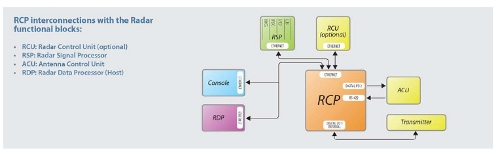 The RCP-10 accepts commands from a host device (such as a radar data processor, console, or any other user provided by the system) via Gigabit Ethernet and transmits the data in volume format, along with the status data collected by the entire radar system, back to the server.
The optional remote control unit is a local control unit that acts as a user interface to control and monitor radar functions when in LOCAL (maintenance) mode.
The transmitter interface is used to control the radar transmitter and receive TX status/BITE information. This can be via a parallel or serial interface, depending on the transmitter type.
The azimuth ACU and elevation servo control receive scan commands from the RCP-10 and orient the antenna accordingly.
Main functions
include scan programming (automatic sequencing of desired scan programs at predefined times);
transmitter-radar management (LV, HV, radiation) with related alarm management; and
antenna control management.
Radar signal processor data ingestion;
Signal processing options control;
Archiving and delivery of radar data (moments) to clients;
Calibration management;
Local radar control for maintenance purposes;
BITE management.
The radar signal processor (RSP) calculates the moment data sent to the RCP-10 for the required data format. The RSP receives the configuration parameters required to produce the desired data moments from the RCP-10.
The client console provides a graphical user interface from which all radar functions at the radar location can be controlled and monitored, including analysis scheduling and all processing parameters.
The RCP-10 implements a powerful scan scheduler that can be programmed by the RDP or the console, allowing the RCP-10 to independently execute programmed scan patterns for a given radar without requiring intervention. This feature enables the radar to continue operating even in the event of a temporary loss of communication with the RDP.