Addressing the challenges of multiport and multisite testing
Devices with multiple ports require fast and accurate multiport network analysis. Optimize your vector network analyzer configuration to minimize testing costs for these devices.

Better RF ICs (RFICs) are needed, and for the RFICs to be better, the test equipment must be able to check the limits of the IC to be developed.
The result is that higher-performance RFICs enhance the capabilities of the state-of-the-art test equipment used in their development, paving the way for the next generation of instrumentation that will be used to push the boundaries once again. All of this underscores the importance of maintaining a cooperative relationship between high-performance IC design centers and leading ATE manufacturers.
Switching Transients and Fast Settling Time: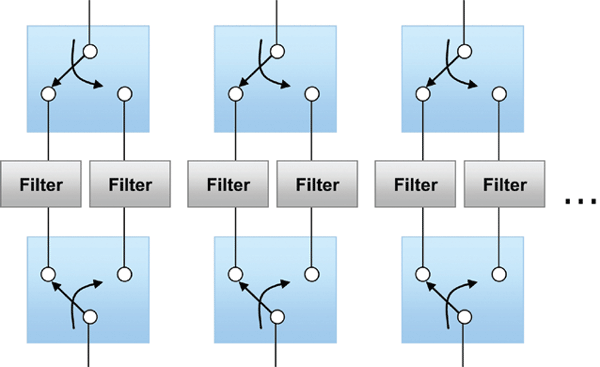 One of the most important aspects for ATEs is a fast setup time, because it allows the instrumentation to take measurements more quickly, increasing performance, usability, and reducing manufacturing test costs. All these improvements add up to measurable advantages for ATE manufacturers who need to succeed in an extremely competitive environment. The well-known challenge is that a typical GaAs-based switch exhibits gate delay in the settling time (see Figure 3), resulting in phase loss and insertion loss drift.
As a rule, ATE manufacturers specify the insertion loss of the switch at 0.05 dBm in 20 µs. Simply put, the faster the switch stabilizes within this 0.05 dBm limit, the faster the ATE can provide the measurement.
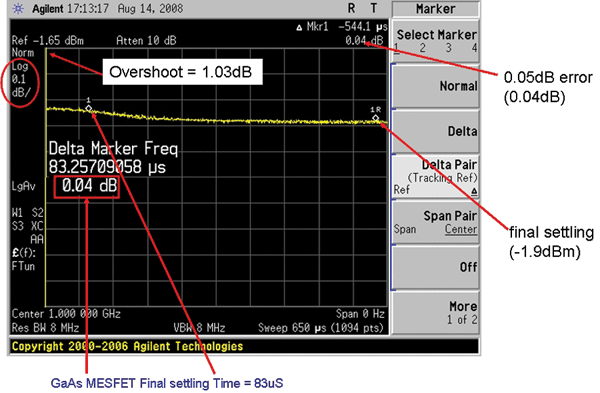 Figure 3 shows a typical GaAs MESFET switch with a final settling time of 83 µs. Note also that this GaAs switch also has an overshoot of ~1 dB following a switching event. This overshoot means that the dynamic stability can be up to 26% higher than the final value, and if multiple switches are used, the dynamic stability will be even greater. ATE engineers have had to compensate for these transients in their designs for many years.
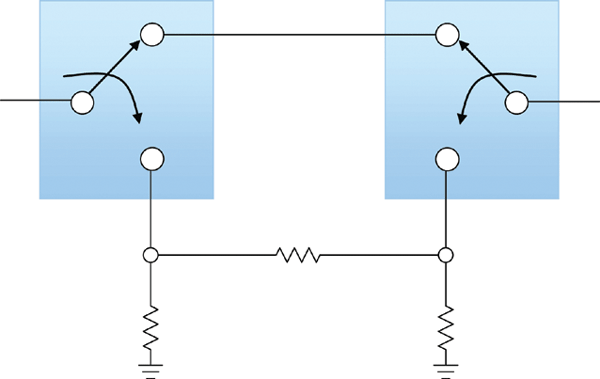
In contrast, Figure 4 shows the performance of the Peregrine Semiconductor PE42552 UltraCMOS™ switch. Note that this device stabilizes within an insertion loss of 0.05 dBm in 13 µs (faster than ATE's manufacturer specification of 20 µs). And it also has no overshoot.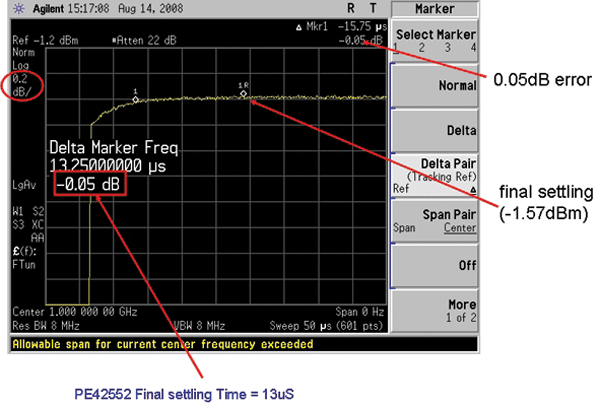 In applications where switches are used for attenuation (Figure 1), the transient settling time delay during switching (as in Figure 3) can result in errors in the attenuators or the switching function. In DSAs, for example, it is important to have accurate signal amplitude and phase so that the rest of the instrument knows the correct signal level.
Unfortunately, the transient settling time in high-performance GaAs switches is unpredictable, making "design and manufacture based on them" a challenge for ATE companies. Using an alternative device, such as a silicon switch, eliminates these design problems. To date, only Silicon-on-Sapphire (SOS) UltraCMOS technology has been able to support these demanding switching requirements.
Low-Frequency Characteristics and Linearity:
Test and measurement equipment leverages broadband performance, making it a more attractive investment for managing multiple communication protocols. Consequently, the components within this equipment must also be broadband. Many GaAs switches are specified to operate at DC and above. GaAs switches have a typical corner frequency of 100 MHz, and below this corner frequency, linearity degrades significantly, leading to noise figure issues. Currently, designers can utilize a single switch that offers high performance in the kilohertz range up to 7500 MHz. For example, the SPDT PE42552 switch operates between 9 kHz and 7500 MHz with high linearity performance across this frequency range.
Linearity at lower frequencies influences a switch's suitability for use as a broadband component. In general, any nonlinearity of the components in test and measurement equipment can cause intermodulation distortion (IMD), which can inhibit the equipment's ability to provide an accurate measurement. This is especially problematic when the linearity of the IC in the test and measurement equipment is as good (or as bad) as that of the device under test. As a result, test and measurement equipment designers demand the best available linearity. Figure 5 shows that the PE42552 performs significantly better than a GaAs MESFET switch at low frequencies.
ESD Protection 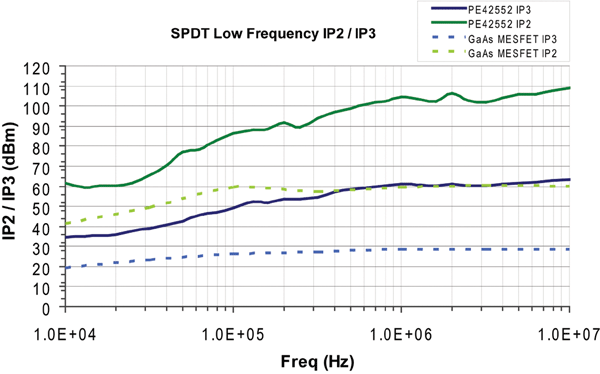 Typical GaAs MESFET circuit breakers are characterized by their Class 0 (
Reliable Performance
: Accuracy is a key metric in ATE design. To achieve the required performance levels, ATE manufacturers need to minimize the variation in the performance of the switches they use. One inefficient way to do this is to shield each batch of switches and discard those that meet specifications. MEMS switches can be used as an alternative, but this technology has reliability and repeatability issues. High-availability CMOS switches offer batch-to-batch repeatable performance due to the inherent nature of the silicon process. By relying on the reliability of switch performance, ATE manufacturers can eliminate the pre-shielding stage and accelerate production and delivery.
In addition to the aforementioned reliable broadband and linearity performance, the other important RF parameter for switches used in high-end test equipment is insertion loss reliability. Insertion loss is important because when there are many switches in the signal path, the loss of each switch is multiplied. The total loss, especially in higher power paths, results in higher power consumption. The insertion loss (and therefore the noise figure) of the switches can also limit the dynamic range in a receive path. Figure 6 shows that the typical insertion loss for an UltraCMOS wideband switch is [value missing].
Insertion loss performance can be closely tied to linearity. For example, GaAs-based RF switches tend to introduce an increase in insertion loss and chip size with linearity improvements. This occurs because conventional circuits require multiple stacked or multi-gate FETs and large gate widths to achieve low distortion, resulting in high parasitic capacitances and degrading insertion loss. In contrast, UltraCMOS technology consists of a stack of FETs fabricated on a perfectly insulating sapphire substrate, providing the ability to allow the passage of high-power RF signals.
CMOS: A Matter of Control.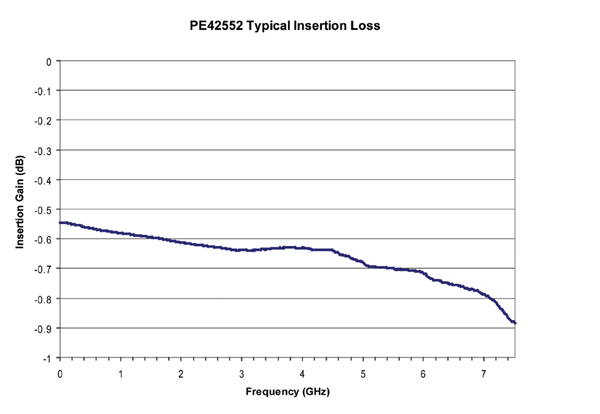 Having a CMOS interface on a device makes it easier for any designer to use, and this is also true for test and measurement design. Typically, a system logic function is implemented in CMOS; therefore, if the switch is manufactured using CMOS processes, the circuit builder can easily include the logic within the circuit itself.
For example, the PE42552 SPDT switch was designed with integrated CMOS control logic that is controlled by a single-pin, low-voltage CMOS control input. Another way to enhance switch functionality is with a user-defined logic table. Thus, an UltraCMOS switch incorporates a logic select pin that reverses the logic polarity for continuous switching applications, effectively changing the logic definition of the control pin.
As test and measurement equipment manufacturers develop tools for LTE (Long Term Evolution) mobile phones, WiMAX, and possibly a convergent version of the two, the capabilities of their test equipment will need to be stretched to the limit. Fortunately, they can offer the bandwidth, repeatability, and accuracy their customers demand because UltraCMOS technology has been commercially available for years, is mass-produced, and their devices have already been proven in the ATE market. Ultimately, today's RF test instrumentation must perform extremely accurate and repeatable measurements, and the good news is that test and measurement equipment suppliers have access to the devices that will allow them to achieve their goals.
1 Baker, Ray. “CMOS-based Digital Step Attenuator Designs,” Wireless Design & Development Magazine, May 2004.
Devices with multiple ports require fast and accurate multiport network analysis. Optimize your vector network analyzer configuration to minimize testing costs for these devices.
AT4 Wireless announces that it is now ready to provide testing services for Bluetooth 4.1 devices. AT4 Wireless is ready to provide testing services in accordance with the new Bluetooth® base specification update, Bluetooth v4.1.
Inycom, the official and sole distributor of NARDA in Spain, is offering a special deal for EMC Certification testing. This deal combines the PMM 9010F Receiver with the PMM9030 or PMM9060 frequency expansion modules at special prices until December 31, 2013.
The Agilent 53200 series of universal RF frequency counters/timers corresponds to the first frequency counters that meet LXI Class C.
Agilent Technologies Inc. introduces PrecisionProbe software for its award-winning Infiniium 90000X and 90000A Series oscilloscopes. This software, which works with the hardware built into the Infiniium oscilloscopes, allows engineers to automatically characterize and correct...
Agilent Technologies Inc. announces the addition of disturbance analyzer capabilities as a standard feature on its MXE N9038A EMI receiver. For those who need to perform discontinuous or click disturbance measurements, the MXE simplifies and automates the collection and analysis of these measurements.





Keysight Technologies has announced a collaboration with NTT DOCOMO and NTT to boost...
Avatel Telecom has signed a wholesale agreement with MasOrange that will come into effect on June 1st and...
RETN announces the launch of a new end-to-end trunk route linking Drobeta,...
The Global Certification Forum (GCF) and TCCA announce that interoperability testing (IOP) is now...
Spain will have, for the first time, a specific association for the development of its ecosystem...
Social networks
 |
 |
 |
 |
 |

You can subscribe to the Conectrónica magazine in 2 formats.
Digital Format: 5 downloadable PDF editions at an annual cost of 60 Euros (VAT included)
Paper Format: 5 editions to be received by mail at an annual cost of 180 Euros (VAT included).
Contact our subscriptions department at subscriptions@conectronica.com
Payment via Bizum or bank transfer

Digital transformation has turned data networks into a critical infrastructure for...
Antennas remain one of the most critical and, at the same time, most misunderstood elements in...
Returning to Barcelona in February 2026, Integrated Systems Europe (ISE) presents its program of...
Mouser Electronics, Inc., in collaboration with Qorvo and other technology innovators...
The GAIA Cluster has participated in the European project "Engineers of the Future", co-financed by...
VIAVI Solutions Inc. has announced the launch of AI Experts, the first addition to its...
Connectivity is a fundamental infrastructure, and reliability standards continue to rise...
In the rapidly evolving field of optical networks, the demands for greater flexibility and...
The local area network (LAN) ecosystem is undergoing a phase of accelerated transformation in 2026, driven by...
The rapid increase in data traffic is driving the construction of new infrastructure worldwide...
Legrand has announced the launch of Chroma Link™, a fiber optic cabling solution with...
Hollow Core Fibers (HCF) represent a significant evolution...