Commercial radio technology has certainly reached a turning point in many ways. Market demand for wireless communications continues to accelerate, driven by the shift to data-intensive applications such as text messaging, web browsing, and video. Customers are always expecting greater wireless bandwidth, and service providers want to sell high-value services beyond voice; this is a given market.
To support these new customer demands, the underlying technology that provides voice and data services is evolving. These applications require high transmission speeds for ease of use, creating new access routes for the use of a limited frequency spectrum. More spectrally efficient modulation types and digital coding schemes have been used, with improved bandwidths—from 200 kHz in the 1990s to the current 40 MHz.
Trends in Communication Technologies
Perhaps the most important trend in wireless communications is the shift from single-carrier modulation to OFDM (Orthogonal Frequency Domain Modulation) and the move from SISO (Single-Input Single-Output) to MIMO (Multiple-Input Multiple-Output) configurations. Single-carrier modulation formats transmit one data symbol at a time on a single-frequency carrier. To increase data transmission rates with this type of modulation, the symbol rate of the data is increased. However, as the symbol rate increases, issues such as multipath signal fading become more pronounced, especially in high-mobility applications. In OFDM modulation, multiple carriers are used, and data is transmitted in parallel on all of them. This allows for slower symbol rates per carrier, reducing the impact of issues such as multipath signal fading. OFDM modulation requires a higher level of DSP (digital signal processing) in mobile devices. However, with the advancement of DSP technology, this level of performance can now be included in a mobile device at a reasonable price and power consumption. OFDM modulation is used in WiFi, WiMAX, and the emerging LTE (Long Term Evolution) standard for mobile phones.
 The shift from SISO to MIMO technologies allows multiple data streams to be transmitted simultaneously, using the same frequency spectrum. These parallel data streams can be used either to increase data throughput by transmitting different data streams to each antenna or to increase coverage by sending the same data stream to all antennas.
This change has been driven largely by consumer demand for mobile services and by the decreasing cost of the DSP technology required to deploy high-bandwidth wireless systems. MIMO technology can now be used in a wide range of commercial communication devices, including mobile phones, PDAs, and laptops. The net result is high data transmission speeds with these consumer devices.
Trends and Challenges in
MIMO Testing: MIMO achieves spectral efficiency to a new level, enabling multi-signal transmission and reception. However, with high spectral efficiency comes a high level of complexity.
There are a number of significant challenges involved in moving from SISO-based systems to MIMO that test engineers and technicians must consider.
Another challenge created by the complexity of MIMO and OFDM is the number of streams that can be supported by the test system within the same time frame. For example, wireless LAN (WLAN) and LTE support four stream configurations, and current WiMAX technology supports two streams.
A challenge at the test receiver end is decomposing a mixed signal into multiple independent signals, or streams. However, the biggest challenge concerns synchronization. Transmitting multiple signals requires precise synchronization of multiple channels in phase and sampling adjustment. Thus, signal analyzers and signal generators must be precisely tuned to make accurate and repeatable measurements.
Another challenge for test equipment is bandwidth (BW). For example, WiMAX and LTE require a bandwidth of 20 MHz, while WLAN (802.11) requires 40 MHz. Therefore, test equipment needs the flexibility to handle wide bandwidths, ideally without requiring the acquisition of additional instrumentation.
The use of multiple standards in numerous wireless devices is growing, or a single manufacturer may produce multiple devices using different standards. Consequently, test equipment needs to accommodate a wide range of formats (e.g., GSM, GPRS, EDGE, WCDMA, cdmaOne, and cdma2000). The instrumentation must be able to perform the necessary measurements for all of them accurately, for example, with small errors in vector quantities (EVMs). When a manufacturer adopts new standards, it creates migrations in test equipment. Ideally, one would want to upgrade test equipment for new cellular and modulation formats easily and cost-effectively—perhaps with only software updates.
Industry Response to Cost Sensitivity: As wireless devices become increasingly complex, competitive pressure is driving down profit margins. At the same time, testing is becoming more difficult, pushing up unit costs. Faced with shrinking margins, manufacturers are looking to reduce costs wherever possible, including test equipment and testing costs. This applies not only to the production floor but also to R&D labs. In both environments, there is a growing need for cost-effective test equipment with enhanced functionality, high throughput, and ease of use.
Regarding the number of streams in a given time frame in WLAN, LTE, and WiMAX, a primary objective is to keep the cost per stream down without sacrificing performance. However, the costs of test equipment, particularly for MIMO systems, can multiply rapidly.
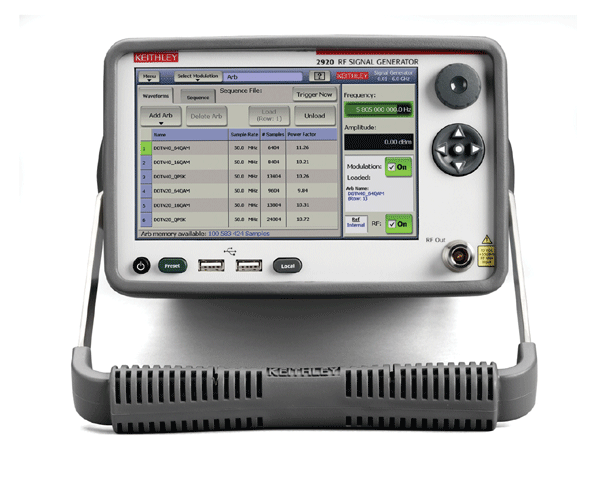
Equipment designs have never been geared toward these issues. For example, Keithley's next-generation MIMO test platform makes it simple and cost-effective to add support for new signal standards and MIMO configurations. It consists of the new Model 2920 RF Vector Signal Generator, the Model 2820 Vector Signal Analyzer, the Model 2895 MIMO Timing Unit, and the SignalMeister™ waveform generation software.  This system supports up to 8x8 MIMO measurements and is typically used for wireless standards such as 802.11n WiFi, 802.16e Mobile WiMAX Wave 2, and future standards such as 3GPP Release 8 LTE and UMB (Ultra Mobile Broadband).
These capabilities are the result of recent industry innovations. For example, a DSP based on software-defined radio (SDR) architecture easily adapts to changing test requirements. SDR-based instruments can generate or analyze virtually any signal with just a simple software extension. This extends the equipment's lifespan by making it easy to expand the test system. DSP technology also provides exceptional performance. It ensures accurate, repeatable signals that help minimize measurement errors. Similarly, DSP-based vector signal analyzers can measure low levels of EVM on a per-channel, per-symbol basis.
DSP technology also contributes to increased throughput. It allows for faster tuning, with frequency switching in less than one millisecond for multiple frequency steps. Likewise, the settling time after signal amplitude changes is also just a few milliseconds. A DSP platform is typically complemented by a relatively large waveform memory. This allows many waveforms to be stored simultaneously for instant recall.
By combining all these technologies in the most cost-effective way, the latest generation of RF test equipment helps wireless device manufacturers drive down their overall testing costs. They can perform more tests, faster, and achieve shorter time-to-market results, while ensuring that critical parameters are correct.
About the author:
Mark Elo is the marketing director at Keithley Instruments . He joined the company in 2006 after working for Agilent Technologies in marketing and R&D management roles. Elo holds a Bachelor of Science degree with honors in engineering from the University of Salford, Lancashire, England, and an MBA from Herriot-Watt University in Edinburgh, Scotland.
Keithley Instruments is represented in Spain by the company Instrumentos de Medida, SL