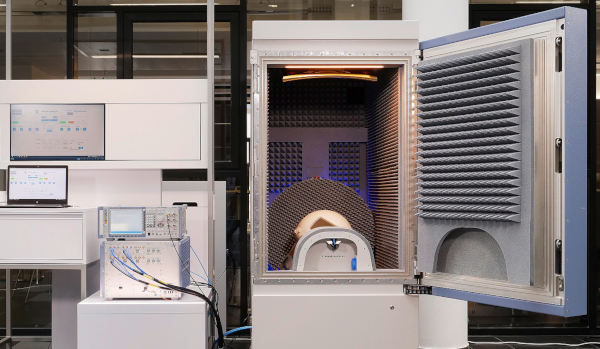
5G NR requires new testing and measurement systems. The introduction of the new millimeter-wave-based FR2 frequency range for 5G and the increasing use of active antennas without physical connectors necessitate over-the-air (OTA) testing. Rohde & Schwarz has developed a solution capable of performing the first 3GPP RF compliance tests in the FR2 frequency range. The device tested is a 5G smartphone placed in an R&S ATS1800C chamber. The chamber is also available with a new, specially configured 3D testing setup for extreme temperatures.
The R&S TS8980 now offers 5G NR signaling functionality with the new R&S CMX500 Radio Communication Tester.
The R&S TS8980FTA supports mobile technologies from 2G to 5G on a single platform. Easy 5G upgrade is a unique feature of the R&S TS8980FTA. Users who already own a previous version of the R&S TS8980 can upgrade to 5G NR for the FR1 range by adding the R&S CMX500 as an expansion unit. While all FR1 tests are conducted in controlled mode, FR2 tests must be performed wirelessly. This is achieved by expanding the R&S TS8980FTA with a very compact CATR system.
The CATR procedure uses a reflector to minimize the space required during OTA testing. For 5G user equipment conformance testing in the FR2 frequency range, CATR designs are the best choice because, for measurements, plane wave signals are available at distances of decimeters from the reflector instead of meters, as is the case with direct far-field measurements. A CATR setup is reciprocal and can be used to measure both the transmission and reception characteristics of the device.
The setup includes the new R&S ATS1800C, based on CATR, for testing in the FR2 range. It is a high-end, ready-to-use chamber that occupies a footprint of only 1.3 m². The solution includes a gold-coated reflector that provides a large 30 cm quiet zone and meets the 3GPP conformance testing requirements for 5G NR. The solution is completed with a configuration for testing at extreme temperatures. The solutions have a frequency range between 18 GHz and 90 GHz, allowing their use beyond the current FR2 bands.