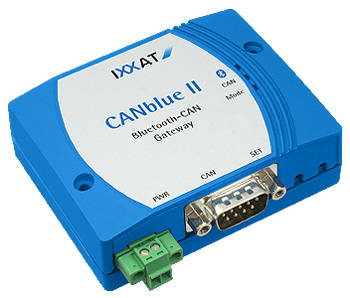
For service applications, it allows wireless access to CAN systems using the standard Bluetooth interface available on any laptop. This enables diagnostic data to be read, or system configurations to be performed simply and flexibly, even when components are difficult to reach.
Using multiple CANblue II units, different segments can be joined into a single network. This enables a reliable connection of moving parts, such as turbines, and serves as a bridge to connect different subsystems separated by up to 200 meters. Errors common in ring connections or the costly installation of long CAN lines can be avoided.
Not only that, Bluetooth-based communications offer significant advantages in terms of range and noise immunity, compared to traditional WLAN solutions.
The following modes are supported:
Bridge mode
allows the user to create a CAN-Bluetooth-CAN bridge using two CANblue II units. Message exchange occurs at Layer 2 and is transparent. The device can also be used in systems with CANopen, DeviceNet, or client-specific protocols. CAN-ID filters can be set for data exchange via Bluetooth. By using more than two CANblue units, multiple buses can be linked together.
ASCII/Binary protocol mode:
In this mode, the functions for transmitting and receiving CAN messages and for configuring the CANblue II are available to the user based on simple ASCII commands and optimized binary CAN messages. The CANblue II is ideal for non-Windows systems or embedded platforms.
PC operation mode with VCI driver support.
Because it is supported by the VCI CAN driver, the CANblue II can be operated with all IXXAT tools and customer-specific software. Furthermore, wireless access to CAN systems via Bluetooth can be easily implemented using the provided software and VCI-based tools.