Many of today's smart factories are limited by existing wiring architectures. These systems use proven networks—such as Industrial Ethernet, Profinet, and CANbus—to connect the sensors, actuators, and controllers of automated equipment. Because these connections are made via cable, any modification to the installations, however small, is slow and expensive.
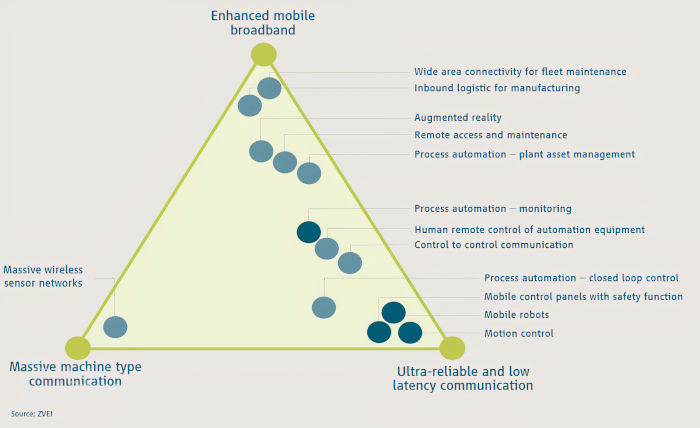
Previous generations of wireless networks—even 4G/LTE, despite being faster—could not provide the real-time response required for autonomy or a sufficiently low latency level. Furthermore, an industrial plant is a highly complex environment with significant interference and electrical noise, which hinders the performance of many previous wireless communication technologies. The enhanced network capabilities of 5G (Figure 1) address some of these issues and increase system flexibility and efficiency.
One of the key features of any automated factory is monitoring. 5G brings massive machine-to-machine communication (mMTC), a function capable of meeting the requirements for deploying large-scale wireless sensor networks (WSNs). Energy efficiency has also improved with 5G, which is essential for extending the battery life of connected devices and minimizing maintenance.
In motion control and industrial robotics, where real-time accuracy and sensitivity are crucial, engineers have been using Time-Sensitive Networking (TSN) with wired industrial Ethernet, but 5G, with its ultra-reliable, low-latency communication (URLLC), is a viable wireless alternative that is also ready for cloud-based robotics.
Three related technologies are beginning to gain traction in the industrial plant environment: virtual reality, augmented reality, and artificial intelligence (VR/AR/AI). 5G operates at high speed, offers URLLC, and enables edge processing. In these cases, energy-intensive computing processes can be carried out in the cloud, allowing the use of simpler and cheaper devices on-site.
The Challenges and Opportunities of 5G Deployment:
To protect investments in wireless and wired network technologies, 5G projects must integrate seamlessly with existing infrastructure. Currently, one of the main challenges is that indoor coverage has never been a priority for network operators. Advances in Open-RAN technology are reducing the total cost of ownership of 5G radio access networks (5G RANs), making the deployment of private 5G (non-public network or NPN) a realistic option. Companies that choose this option should know that regulators worldwide are allocating cost-effective and dedicated spectrum for private 5G. Furthermore, depending on the factory's operational needs, private 5G can be completely isolated from the public network or shared.
5G and the Connected Car
: According to predictions, the automotive sector will also be one of the pioneers in the implementation of 5G, although it will probably still be a few years before Level 5 autonomy becomes a commercial reality. However, it is likely that the next car we buy will have internet access to manage telematics, vehicle-to-everything (V2X) mobile systems, and infotainment.
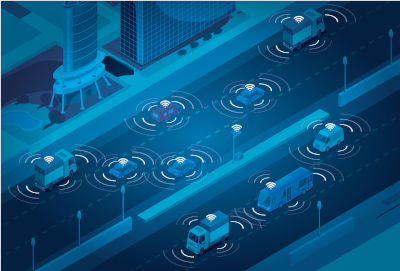 The current connected car can generate up to 4 TB of data per day, equivalent to about 500 movies. With the latest advances in V2X communication technology, this data is already being used in numerous ways. For example, data from engine management systems is sent to remote service centers for predictive maintenance, and information on local traffic and weather conditions can be fed into public safety systems. In fact, even information on driver behavior and vehicle mileage can be entered into databases to implement usage-based insurance plans.
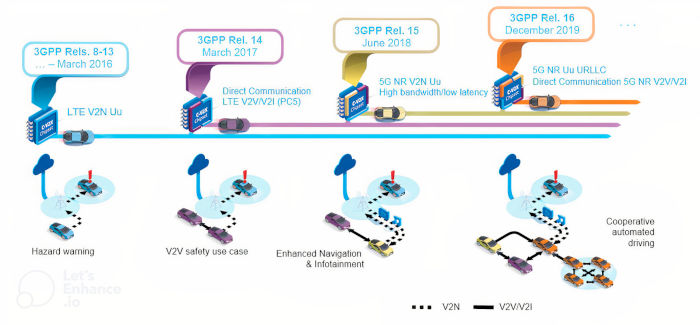
Over the past five years, the Third Generation Partnership Project (3GPP)—a global body for standardizing mobile telecommunications technologies, including radio access functions, backbone networks and services, and providing a comprehensive system description for mobile telecommunications—has been increasing the functionality of C-V2X in line with advancements in mobile network technology (Figure 3). The features in Release 16 are paving the way for the deployment of advanced driver assistance systems (ADS).
 Although it seems that autonomous cars are still a long way off from being available to the public, some very important tests have already been carried out. Companies like Tesla, Google, and BMW have been in the news and are helping to raise everyone's expectations and drive these initiatives forward. Many high-end vehicles already have some level of autonomy (some up to level 3), which also depends on C-V2X technologies.
Although 4G/LTE networks power many of the applications mentioned above, the volume of data to be shared continues to grow, increasing the pressure on available bandwidth. Furthermore, crucial power management and integrated security systems are becoming increasingly sophisticated, making low latency essential. To achieve greater levels of autonomy, network speed and cloud-to-edge processing capabilities must support latency comparable to human reflexes. Similarly, for more sophisticated AAC (Augmented Awareness and Communications) systems, the connected car must respond to surrounding events in real time. The current wireless network is reaching its limits and becoming an obstacle: without 5G, there will never be truly autonomous cars.
Conclusion:
Most 5G network deployments have focused on improving 4G/LTE, adhering to the 3GPP "Release 15" (5G New Radio Non-Standalone or 5G NR NSA) specifications, which has enabled the launch of a limited range of 5G services. However, the true potential of 5G lies in the deployment of "Release 16" and, in the future, "Release 17." Some applications, such as autonomous factories and cars, will only become a reality when they can easily access this higher level of network performance. The initial 5G rollout has been somewhat cautious and has been hampered by the global pandemic. Undoubtedly, the second wave of this deployment will accelerate demand for a wide range of applications that are yet to be discovered.