It is impossible to align standard rigid connectors if they are mounted without precise alignment, but it is possible with floating-type connectors. Even if the connectors are mounted misaligned, a floating-type connector (green in color) can move within the space to properly align with its counterpart.
In this way, the connectors absorb the positional deviation in the plates and the positional deviation generated when installing the plates on which the connectors are mounted in the customer units.
Advantages of its use
It is possible to use multiple pairs of connectors on a single printed circuit board
It increases the degree of freedom in the arrangement of components and in the design of circuits,
It reduces the stress applied to the weld joints to prevent cracking in the weld.
Kyocera's floating connectors achieve a maximum F/P*1 mobility of 200% and allow customers to solve problems during the design phase thanks to their high contact reliability. *1 F/P F = Floating / P = Pitch
What are floating-type connectors?
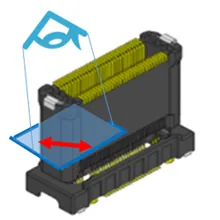
Structure of floating-type connectors
The elastic part of the contacts expands or contracts, and the movable, green insulating casing follows it.
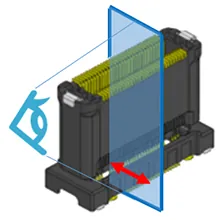
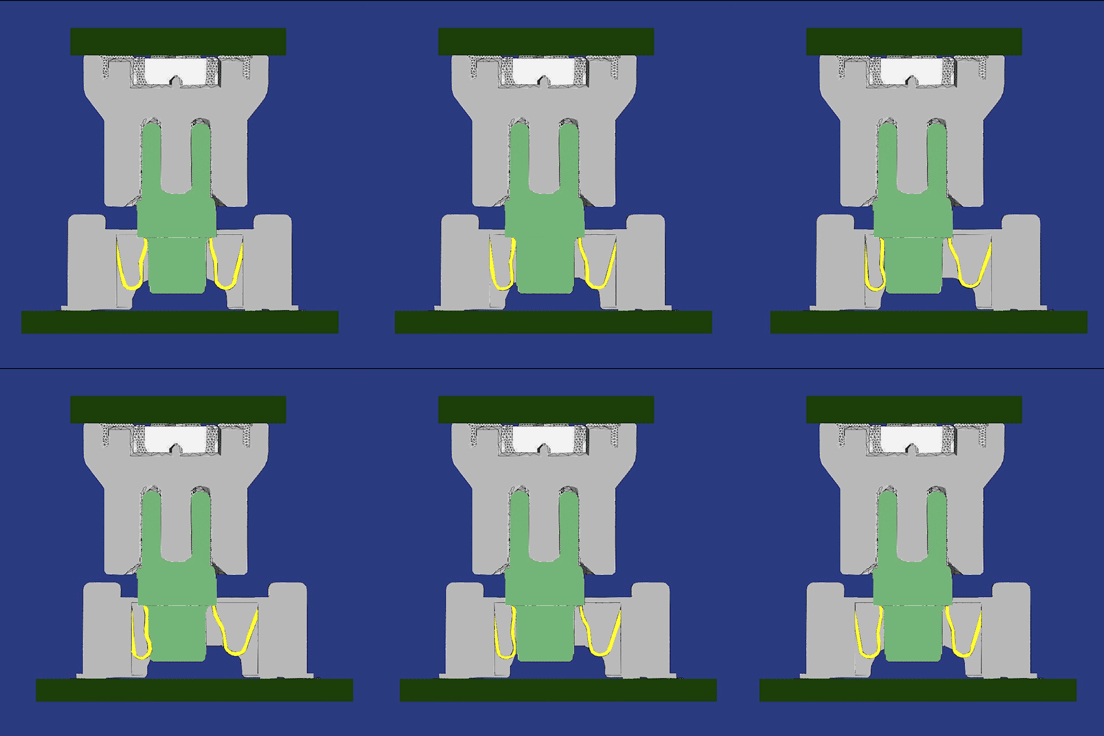
Side view (moving in the Y-axis direction)
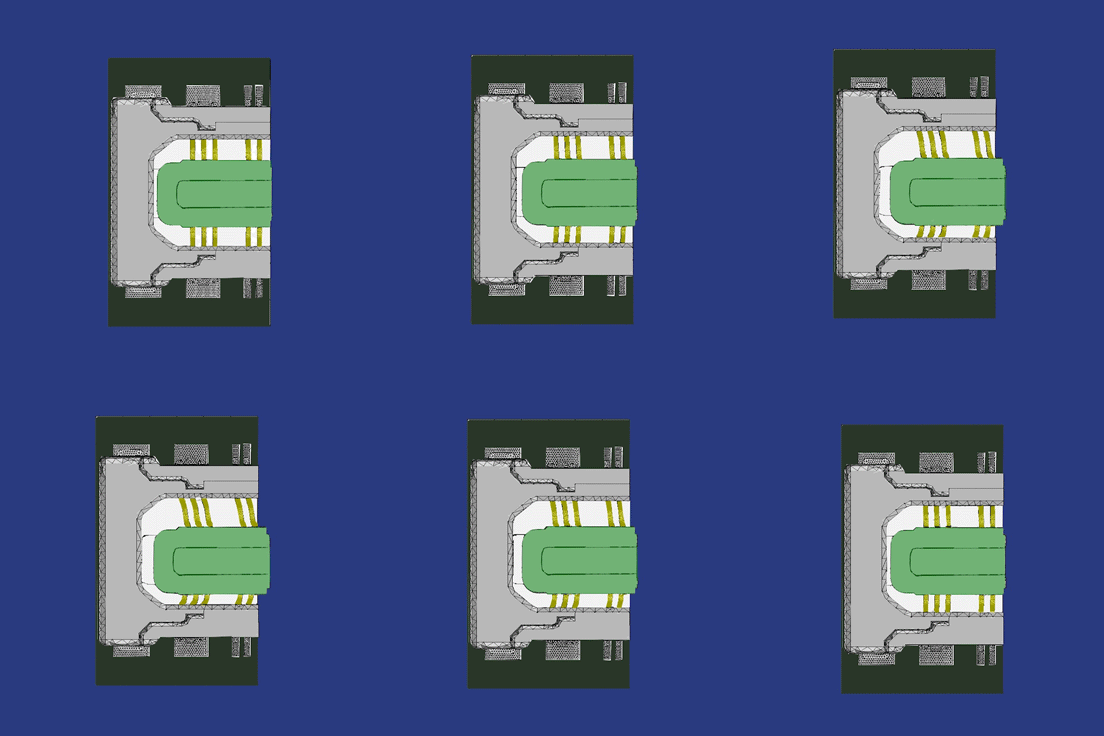
Top view (movable in the X and Y axis directions) floating floating floating floating sliding
Range:
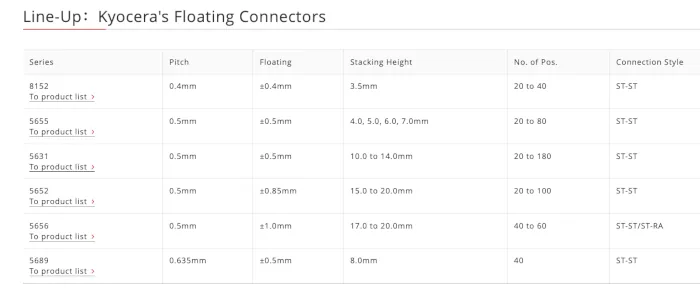
FloXY®HS 0.5 mm pitch board-to-board connectors with compact design
The increasing demands of SDVs and ADAS/AD systems in automotive applications require higher-performance connectors. Kyocera's "5631 Series" floating board-to-board connectors are a compact solution to support high-speed data transmission standards and in-vehicle applications. This is a new product in the FloXY®HS brand.
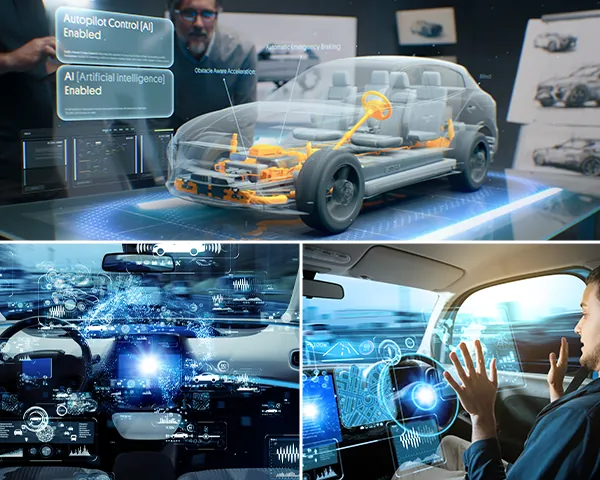
Background of development
With the widespread adoption of electric vehicles (EVs) and the rapid evolution toward dual-purpose vehicles (SDVs), innovation in Advanced Driver Assistance Systems (ADAS) and Advanced Driver Assistance Systems (ADS) is essential to paving the way for safer transportation. A vehicle's central mobility computer and Intelligent Vehicle Interface (IVI) are highly functional systems based on AI and over-the-air (OTA) updates. Connectors must meet the demanding requirements of processing large amounts of real-time data from LiDAR and high-resolution cameras. Key specifications include high data capacity, high-speed transmission, and exceptionally high reliability. To meet this market need, Kyocera has developed the "5631 Series" 0.5 mm pitch floating board-to-board connectors, which support high-speed data transmission.
What is an SDV?
SDV stands for "Software Defined Vehicle." With an SDV, the vehicle's performance and functionality are managed through software and cloud connectivity, and it can be updated with enhanced safety features and additional driving modes without physical modifications.
What is AD?
Autonomous Driving (ADD) stands for "Autonomous Driving." The system operates automatically without human intervention. On the other hand, "Advanced Driver Assistance Systems" (ADAS) support human driving and are characterized by improving driving safety and reducing the risk of accidents.
What is an IVI?
It stands for In-Vehicle Infotainment System, a type of state-of-the-art in-vehicle information and communications system. This system provides information and entertainment to drivers and passengers via the vehicle's network. In addition to the car's navigation and audio systems, it also allows for a more comfortable driving experience, for example, by watching videos, connecting to smartphones, and accessing the internet.
What is OTA?
OTA stands for Over the Air. It's a technology that uses wireless communication to send and receive data. OTA allows for wireless software and firmware updates. In connected cars, it's used to update navigation data and improve and update driver assistance systems.
Product specifications
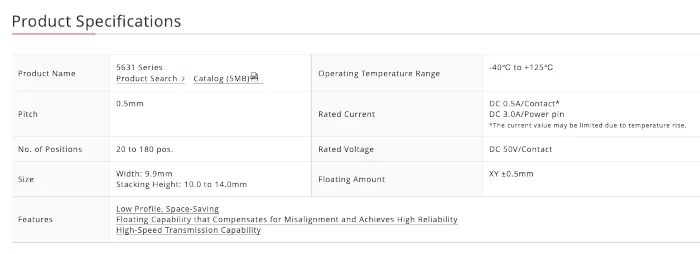
Characteristics
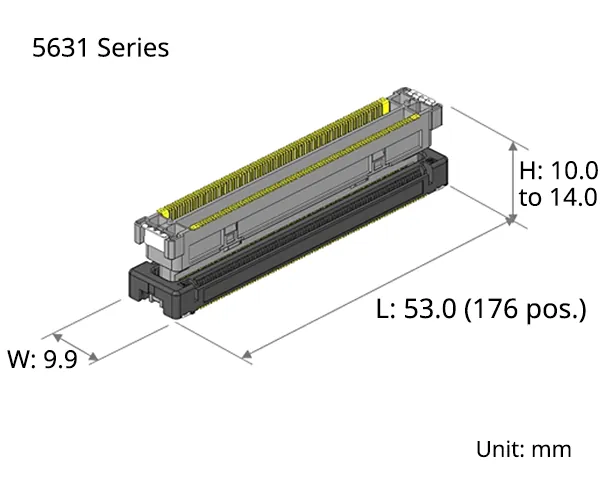
Low profile, space saving
This connector features a space-saving design, with a stacking height of 10 to 14 mm and a reduced width of 9.9 mm, and utilizes a precise 0.5 mm pitch floating mechanism for reliable, high-density applications. Along with Kyocera's 5652 series, we offer height variations from 10 to 25 mm. This allows us to meet our customers' design needs.
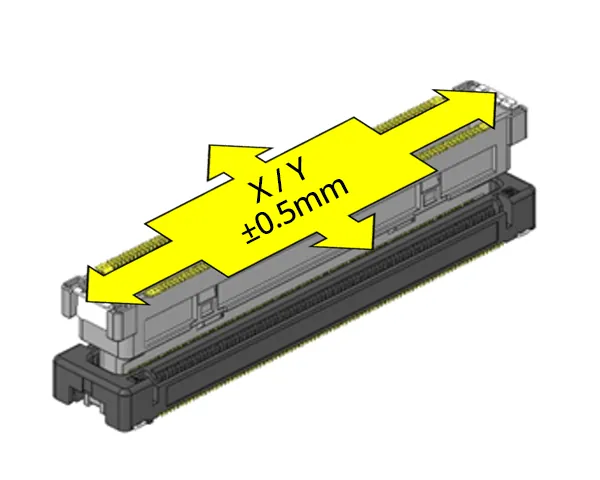
Buoyancy capacity that compensates for misalignment and achieves high reliability
The float capability is ±0.5 mm in the X and Y directions. The connector design compensates for variations in printed circuit board mating and minimizes stress on soldered joints to improve long-term performance.
High-speed transmission capability
Despite its floating capability, the design targets a differential characteristic impedance of 85 to 100 ohms, enabling compatibility with various high-speed transmission standards. It supports high-speed transmission standards such as PCI Express Gen.4 (16 GT/s) and USB 3.2 Gen.2. Applicable standards include PCIe Gen.1 (2.5 GT/s), Gen.4 (16 GT/s), USB 3.2 Gen.1/Gen.2, MIPI D/C-PHY, SATA 3.0, etc.
What is PCI Express (PCIe)?
A high-speed serial bus standard for connecting an expansion card (graphics card, SSD, etc.) inside a PC to the motherboard.
What is USB?
A general-purpose interface for connecting PCs and peripheral devices (mouse, keyboard, storage, etc.).