 “Meeting the demand for high-speed applications has become a common priority in the industry as network bandwidth continues to grow,” says Joe Dambach, responsible for new product development for the global market at Molex, adding: “The zCD interconnect offers an attractive form factor that will contribute to the widespread adoption of 400 Gbps technology.”
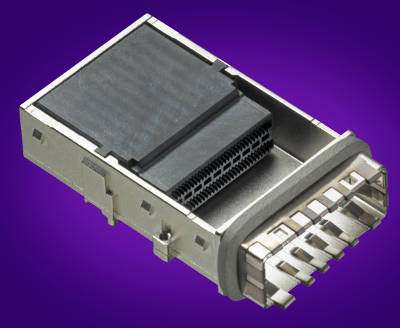
Molex zCD connectors will be available in a short version for passive or active copper cables and a long version for active optical cables (AOC) or transceivers. They feature a simple and practical design with a 0.75 mm pitch. An elastomeric gasket reduces and suppresses electromagnetic interference (EMI). Designed to accommodate a wide variety of thermal modules and heatsinks, the snap-in connector ensures a robust and simple board termination.
With industry-leading bandwidth density, zCD passive copper cables consist of 32 pairs (16 channels) per input/output port at 25 Gbps. A dual pluggable card system enhances shielding against interference across the cable interface. An interface with the integrated microcontroller for cable management offers customized host management functions via a standard I2C bus. Designed for use with 30 AWG twinaxial cables, these passive copper cables (up to 32 pairs) improve bend radius and provide greater flexibility in short-range 400 Gbps Ethernet systems and existing and legacy applications.
Based on single-mode silicon photonic technology, Molex AOC zCD Assemblies provide 16 bidirectional channels, achieving speeds of up to 28 Gbps, or a bandwidth of 400 Gbps, in a compact, standard interface. A hot-swappable transceiver allows for the insertion and removal of devices without system shutdown. Input and output equalization of the module optimizes the performance of each host system. Transmitting over distances of up to 4 km at a fraction of the cost and power of long-range optical modules, AOC zCD Assemblies are primarily designed for 400 Gbps Ethernet systems, but will also work with InfiniBand* and proprietary protocol applications.
“The zCD interconnect system offers a high degree of integration, excellent performance, and long-term reliability to customers who need to achieve speeds of 400 Gbps through individual lanes of up to 25 Gbps throughput,” concludes Joe Dambach.
Molex is a founding member of the CDFP MSA (Multi-Source Agreement) consortium, which is dedicated to defining specifications and promoting the adoption of hot-pluggable, interoperable 400 Gbps modules. For information about CDFP MSA, visit cdfp-msa.org.