

'
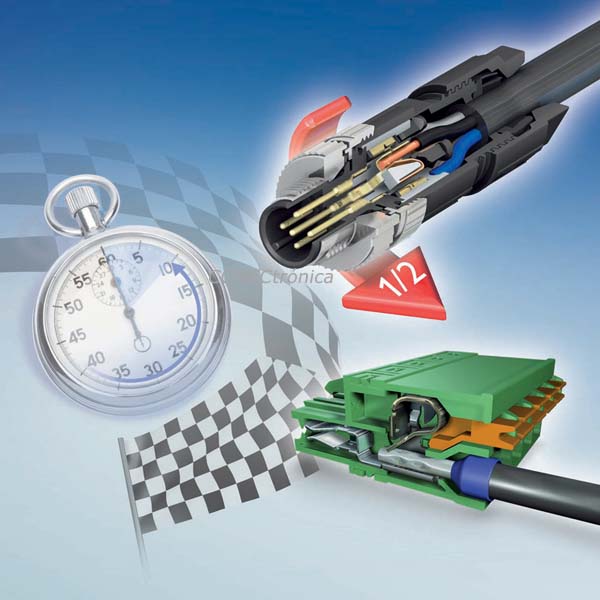
Quick Connections: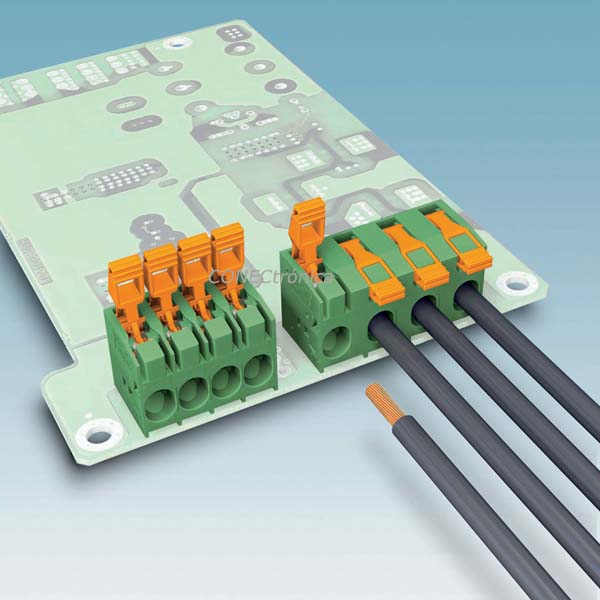 Complex soldering systems, expensive crimping, and the tedious process of screwing terminals are a thing of the past. To maintain their competitiveness sustainably, companies require connections that are easy to use and can be wired in the field. Furthermore, they must be able to be assembled without special tools and provide a long-lasting connection. Quick-connect technology connectors in the Phoenix Contact product range allow manufacturers of devices, machines, and wiring harnesses to select the perfect solution for their applications from a wide range of options. Convenience and tool-free operation will no longer be a barrier to connection, even when space and time are at a premium.
'
Spring-Loaded Connection – As Light as a Feather
When it comes to quick connections, spring-loaded connectors are the most popular. Using simple push-in spring technology, terminal blocks, circular connectors, and PCB plug connectors can be easily connected. For example, M12 spring-loaded connectors allow for simple and secure wiring of rigid and flexible conductors, with or without ferrules. The M12 spring connector is highly recommended for fieldbus wiring due to its simplicity and color coding. Choosing the right connector type in the field isn't just about selecting the connection system itself, but also about ensuring a perfectly constructed shield. This is why these signal and fieldbus connectors feature a new housing design. During assembly, the shield connection, strain relief, and sealing are all completed in a single step. This method saves money and reduces assembly errors. Phoenix Contact's M12 spring-loaded connector program consists of straight and angled versions, in 4 and 5 poles.
 Spring-loaded connections are also becoming increasingly common in equipment wiring. In the power sector, due to the large cable cross-sections involved, the most widely used systems to date are the classic screw and bolt connections. The new PLH 16 PCB terminal blocks from Phoenix Contact demonstrate that power electronics can also be wired quickly and efficiently (Figure 1). Conductors with a cross-section of up to 16 mm² can be quickly connected using this lever-operated PCB terminal block. This innovative technology is simple and intuitive: the cable is inserted into the designated receptacle with the spring open, and then the lever is simply pressed down slightly to close the spring and establish contact.
Insulator displacement connection – Significant time savings
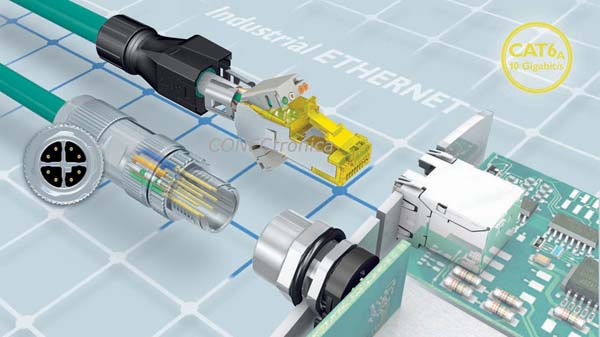
In industrial environments, connectors are subjected to demands far exceeding those of an office setting. However, in both areas, data transfer rates and data volumes are constantly increasing. Consequently, Phoenix Contact offers high-quality components with quick-connect technology for classic communication interfaces. Thanks to its new shielding design, the new RJ45 connector for Cat6A can handle transmission speeds of up to 10 Gbits/s (Figure 2). Assembly is also quick and easy: the conductors are inserted into the housing and cut flush. The contact pads are then pressed down, and the housing is snapped onto the rest of the connector. During assembly, the conductor insulation is automatically pierced by the eight cutting elements inside the connector, establishing a highly reliable contact that can be reused up to 10 times.
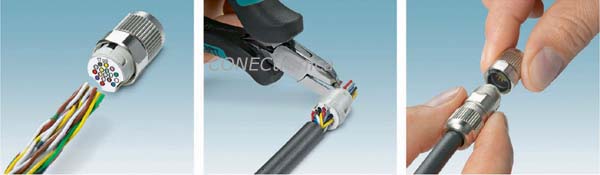 Other types of plug-in connectors also employ this insulation displacement technique. Examples include IDC terminals and QC connectors for printed circuit boards, as well as circular connectors. The main advantage of this technology is time savings, since it eliminates the need to strip the cable insulation: contact is made directly through the insulation.
Piercecon and Piercing Connection – Space Savings
Often, a quick connection is required, but also a compact one. This is because industrial devices are becoming increasingly smaller. The same applies to distribution boxes when wiring sensors and actuators.
The trend toward miniaturization is a reality followed by, among others, heat-sealed cables and the new M8 and M12 circular connectors with Piercecon technology for in-situ assembly (Figure 3). This technology allows for a high density of contacts to be wired in a minimal space. The electrical connection is made through an internal pin that penetrates axially into the cable, making electrical contact with the copper conductors. Thanks to Piercecon technology, the user avoids the laborious task of soldering or screwing connections.
The Piercing connection system, very similar in concept, is used for printed circuit board applications, where space is of the essence. Every millimeter saved on the board can offer enormous benefits. In line with this, the new mini PTSM and PTPM connectors have been developed, both with a flat and compact design. Their Piercing connection technology allows for immediate, tool-free connection of conductors without stripping (Figure 4). The corresponding base housing is available in horizontal and vertical versions, and for both THR reflow soldering and SMD, and can be assembled automatically with "pick & place" machines.
The user has the final say.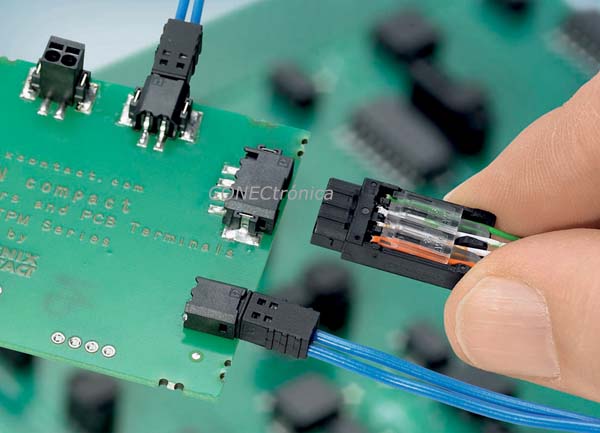 Phoenix Contact's quick-connect technologies offer an optimized solution for every
existing application.
Quick-connect components can be easily connected and assembled in the field in a very short time. Their connection technologies will undoubtedly replace conventional systems in the not-too-distant future. Furthermore, more and more connection variants will be launched on the market, and to meet individual needs, customized developments and solutions will help expand the already extensive range of available connectors. [
Place in a prominent box (with its corresponding 3-photo montage): Overview of
quick-connect technologies.]
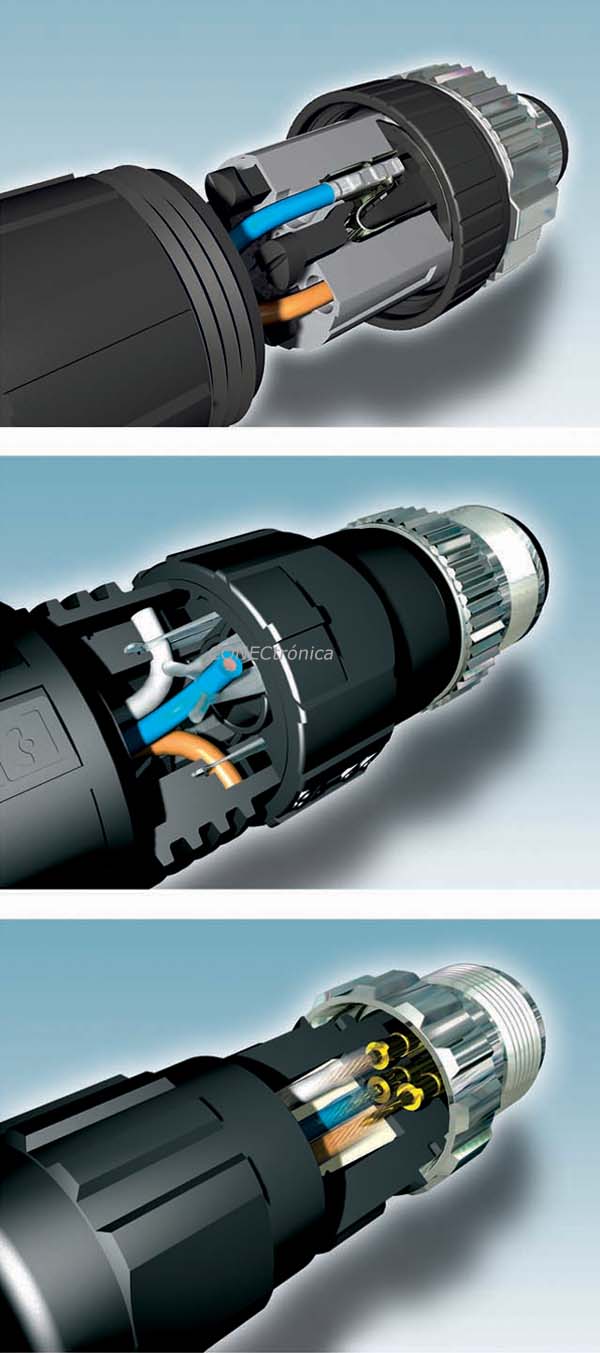 Overview of Quick Connect Technologies:
The advantages of quick connect technology include tool-less assembly, high contact density, and shorter installation times at lower prices. Whether connecting equipment, machinery, and plants, or wiring in the field, on-site connections are simplified. But what specific benefits does each technology offer?
Spring connection
- Quick and direct connection technology, no tools required
- Simple and intuitive handling
- Color coding
- Minimal force required for connection, even with large cable cross-sections
Insulator displacement connection
- Maximum reduction in connection times
- High reliability thanks to a defined contact force
- No need to strip the cables
- No need to use ferrules
- Reusable up to 10 times
Piercecon and Piercing Connection
- Minimum size for maximum contact density
- No need to strip the wires
Authors: Eva Andueza and Mónica González. Product Managers at Phoenix Contact, SA






