 As with all debates, there are pros and cons. For example, there's a belief that the unshielded solution is cheaper and easier to install and finish, whereas shielding has its own problems related to grounding. However, to make a final decision, the information needs to be analyzed in more detail.
In June 2006, the IEEE 802.3an-2006 standard for 10GBASE-T was ratified. This standard defines an application for 10Gb/s data transmission over twisted-pair cable up to 100 meters, including the use of both unshielded twisted-pair (UTP) and shielded twisted-pair (STP) cabling systems.
It's important to understand first that in 10GBASE-T applications, the noise source that most limits the ability to transmit 10Gb Ethernet over copper cabling is alien crosstalk. Since 10GBASE-T electronics cannot compensate for noise from adjacent channels, it must be canceled whenever possible by the cabling system to ensure reliable data transmission.
This noise is measured as Power Sum Alien Near-End Crosstalk (PSANEXT) and as Power Sum Alien Attenuation to Crosstalk Ratio at the Far-End (PSAACRF) by both ISO/IEC 11801 Ed 2.1 Class EA and TIA-EIA 568-B.2-10, where Cat 6A requires that the crosstalk be measured in a configuration of 6 wires around 1, on a central wire with six other wires tied around this first one.
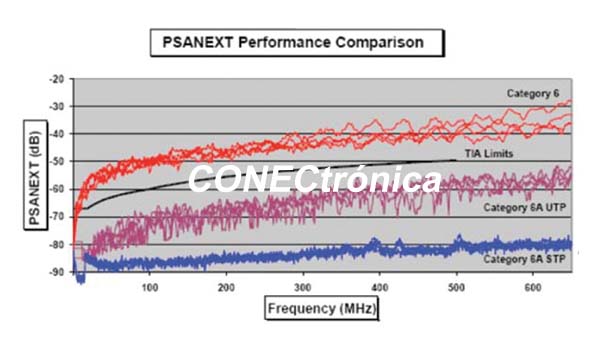
Figure 1 demonstrates that a Category 6 UTP system would not meet the required Alien Crosstalk limits for 100 meters of transmission over 10GBASE-T. It also shows the TIA limits; the ISO/IEC limits are somewhat more stringent, meaning that Category 6 falls far short of meeting the standard. While the Cat6A UTP solution does meet the requirements, it is very close to the limits.
This highlights the benefits of a shielded solution; however, there are different types of shielding available, and each has a different level of shielding effectiveness.
 When shielded cables are properly installed with grounding, the aluminum shielding inside the cable prevents signal coupling, which reduces alien crosstalk well below the required limits.
The measurement mentioned above indicates that shielded cabling systems provide a significant margin over the IEEE 802.3an-2006 standard for 10 GBase-T PSANEXT and PSACCRF. This increased performance means that time-consuming Alien Crosstalk measurements are no longer necessary.
Independent measurement
In a recent test conducted by a renowned independent laboratory, a Class EA cabling system from five leading manufacturers was selected, including two U/UTP, one F/UTP, and two S/FTP cables. The test involved the use of real 10GBase-T equipment and 10Gb/s traffic.
The test yielded surprising results, demonstrating that the UTP system exhibited significantly weaker ANEXT performance and coupling attenuation than the STP systems.
Other results included immunity to light interference, such as the radiated energy from fluorescent lamps that caused transmission problems, and immunity to radiation waves from electromagnetic fields, such as those produced by GSM mobile devices. Once again, the UTP system performed significantly worse than the STP systems.
Without having the full details of all the cabling systems that were used and the construction of the cables used, it is impossible to determine if all the UTP systems would fail to meet the performance requirements according to the regulations.
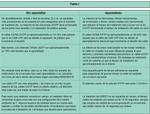
Each manufacturer uses different techniques to terminate the product, and most have developed their product to reduce termination time in shielded solutions. Therefore, greater care is required when terminating UTP products. This leads to an apparent equivalence between the two systems, but based on this, there are several differences between myth and reality, which we will detail in Table I.
Evidence shows that shielded solutions are preferable for most applications, but unshielded options can be viable for those who prefer them. However, the number of companies choosing shielded solutions is increasing as they begin to understand the benefits, while at the same time some of the myths surrounding shielded solutions are being dispelled.
So, shielded or unshielded? Despite numerous tests, it's impossible to determine a definitive answer, but what is clear is that the shielded solution appears to be better and is the one recommended by the Excel team.