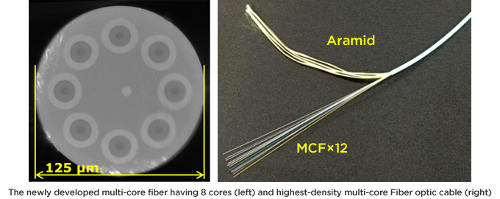
To address the increasing data traffic on short-haul interconnects used for parallel processing in supercomputers and resource disaggregation in data centers*1, optical interconnect technologies for high-density broadband transmission are being intensively researched and developed. Simultaneously, multi-core optical fiber (MCF)*2, which has multiple cores within a single fiber, has also been the subject of intensive research and development. MCF is envisioned as a next-generation optical fiber that can be deployed in ultra-high-capacity transmission systems. Most MCF developments have consistently allowed for a cladding diameter*3 thicker than standard 125-micron optical fibers to increase the number of cores while maintaining good optical properties for each core and suppressing core-to-core crosstalk*2.
For the first time, Sumitomo has developed an MCF with a cladding diameter of 125 microns, equivalent to standard optical fibers*1, and featuring eight cores with low core-to-core crosstalk. The MCF also boasts optical characteristics comparable to standard single-mode fiber (SSMF) specialized for the 1.3-micron wavelength band, where signal distortion can be suppressed. With these characteristics, the 125-micron cladding provides mechanical reliability*3 equivalent to that of standard optical fibers and allows the use of various technologies associated with standard optical fibers, such as cabling and connection technologies. The eight-core configuration was chosen because full-duplex (2×) 100-Gb/s (4×25 Gb/s) signals can be transmitted over an MCF using conventional transmission and reception technology designed for 25-Gb/s signals. The optical characteristics achieved have a high affinity to silicon photonic technology, which has highly integrated optical devices that operate in the 1.3μm band.
They manufactured a 12-MCF cable using the developed MCFs, which contained 96 cores within an outer diameter of 3 mm. The core density achieved was more than twice that of any other fiber optic communication cable. Transmission characteristics in the 1.3 μm band were also evaluated using a 1.1 km long MCF cable. Evaluation testing using a 100G Ethernet transceiver (100GBASE-LR4) revealed that the MCF cable ensures error-free transmission for 800 Gb/s signals (8 cores × 4 wavelengths × 25 Gb/s), which is eight times greater than that of SSMF. The transmission experiment results indicate that the developed MCF cable has a transmission capacity of at least 9.6 Tb/s (12 fibers × 8 cores × 4 wavelengths × 25 Gb/s). Improvements in transceivers can further enhance transmission capability.
*1 Resource Disaggregation in Data Centers
In resource disaggregation data centers, a server's internal resources (computing, memory, storage, communication, etc.) are disaggregated. This disaggregation makes resource allocation more logical, facilitates repair/upgrade of specific resources, and enables efficient resource utilization.
* 2 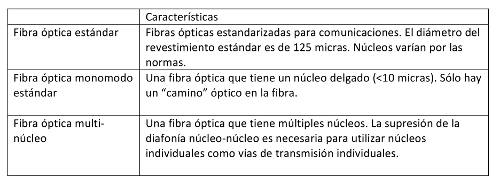
'
* 3 The cladding diameter and mechanical reliability of the optical fiber.
An optical fiber can break with a certain probability if mechanical stress, for example, bending-induced stress, is applied to the fiber for a long time. Mechanical reliability is high when the probability of breakage is low. A tighter bend radius and a thicker cladding diameter cause greater bending-induced stress. Therefore, a cladding diameter greater than 125 microns is not preferable for short-range transmissions, where tight bends are easily applied to the fiber.
* 4 Late Submission Items
These items are received after the regular submission deadline. Generally, these documents present important new material in rapidly advancing areas. Only those documents judged to be truly excellent and compelling are accepted for submission.