2.1 Attenuation
- Part of the signal is lost in the core, even though there is no refraction.
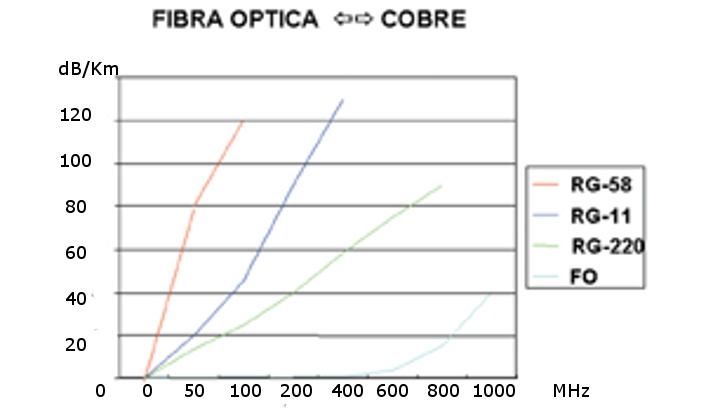
- It is measured in decibels (dB) per unit of length (dB/Km).
- Losses are caused by several factors and can therefore be classified as: Extrinsic / Intrinsic.
- EXTRINSIC:
Losses due to curvature:
- Manufacturing defects.
- Installation procedures.
- They are called microcurvatures and they have an influence over long distances.
Losses due to connection and splicing:
- Connection insertion losses (0.3 - 0.8 dB).
- Mechanical splices (0.4 - 0.2 dB).
- Fusion splices (<0.2 dB) typical value (<0.1 dB).
- Preparation of the splice or connection: Defective cut; Dirt on the surfaces to be spliced; Different characteristics of the optical fibers; Etc.
-INTRINSIC:
Inherent losses of optical fiber:
- Absorption losses by the transition metals Fe, Cu, Cr, Ni, Mn.
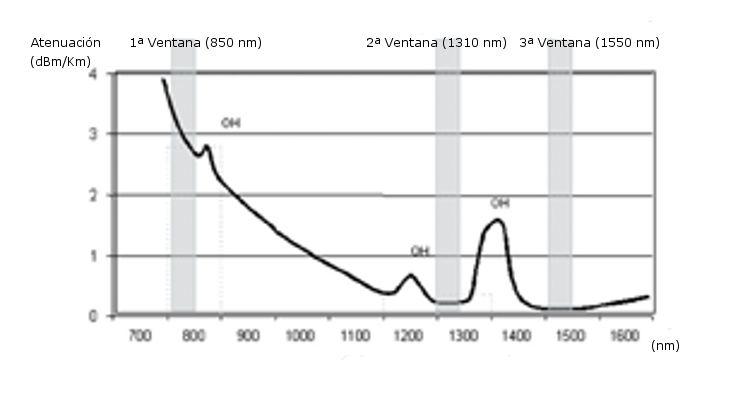
- Losses due to absorption by water in the form of OH ions.
Irregularities in the manufacturing process:
- Variation of the nucleus diameter.
Fresnel's Reflection:
- Amount of light that is reflected due to a change of medium. Reflected light (%) = 100x (n1-n2)2/(n1+ n2)2where :
n1 - Refractive index of the core.
n2 - Refractive index of air.
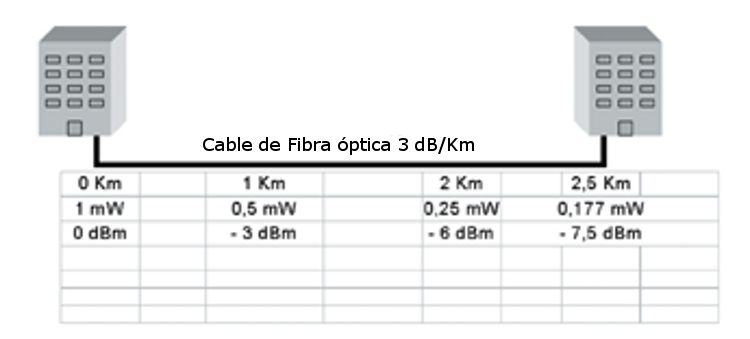
EXAMPLE OF OPTICAL FIBER ATTENUATION: 3dB/Km
Power (dBm) = 10 Log Power (mW)
'
'
-TRANSMISSION WINDOWS
They determine the appropriate wavelengths for low attenuation transmission.
'
2.2 Bandwidth
The medium's capacity to transport information.
Inversely proportional to losses: greater bandwidth = lower losses.
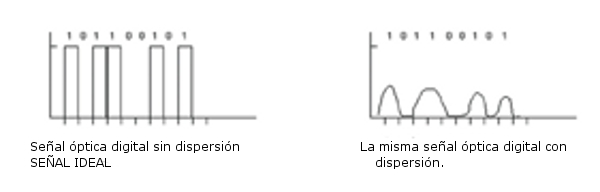
Limited by the total fiber dispersion (pulse broadening) in Multimode Optical Fiber and by the chromatic dispersion (Bchromatic) in Singlemode Optical Fiber.
The bandwidth of a multimode fiber can be calculated as follows: Btotal= (B-2modal + B-2 chromatic)-1/2
-MODAL DISPERSION
Known as multimode scattering.
Caused by the different modes that a beam of light follows in the fiber.
Lightning bolts travel different distances and arrive at different times.
'
-CHROMATIC DISPERSION
Pulse composed of several wavelengths.
Each wavelength travels at a different speed (because the refractive index varies with wavelength).
Chromatic dispersion ps/(nmxKm)
Maximum permissible dispersion = Optical fiber dispersion x Laser spectral width x Maximum permissible distance
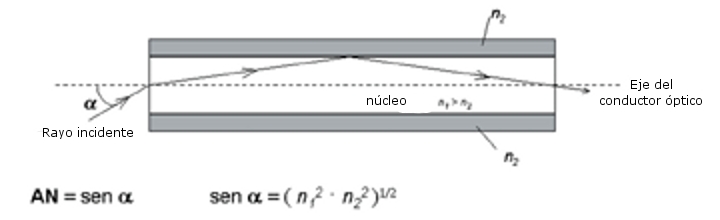
2.3 Numerical Opening (AN)
Maximum coupling angle for light rays to be captured by the core of the optical fiber.
The higher the AN, the lower the losses.
'
- MULTIMODE FIBER (MM) AND SINGLE-MODE FIBER (SM)
Refractive index of cladding > Refractive index of core.