HISTORY: ANCIENT GREECE-PHOENICIANS
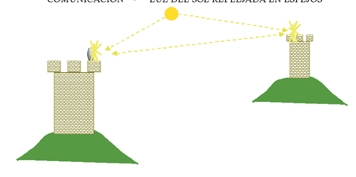
COMMUNICATION->SUNLIGHT REFLECTED IN MIRRORS.
'
A LITTLE MORE HISTORY:
- 1713-> René de Réaumur first spun glass.
- 1790-> Claude de Chappe invents the "optical telegraph" in France.
- 1854-> John Tyndall projects light through jets of water.
- 1888-> The fountains at the Glasgow and Barcelona International Fairs are illuminated.
- 1931-> Owens-Illinois discovers the method for mass-producing fiberglass for Fiberglass.
- 1958-> Invention of the LASER, first studies of light communication through the air.
- 1970-> Discovery of the first low-loss 150 μm Optical Fiber.
- 1975-> Corning Inc. develops the first commercial fiber optic cable. Initial tests by telephone companies.
- 1980-> Bell announces the installation of 611 miles of fiber optic cable in the Northwest corridor of the U.S. Saskatchewan Telephone installs 3,600 km of fiber optic cable in Canada. First TV signal transmission for the Lake Placid Winter Olympics.
- 1982-> MCI leases the New York to Washington fiber optic network to operate at 1310nm and be able to transmit 400 million bits per second.
- 1986-> The connection is made across the English Channel using an underwater cable.
- 1988-> TAT-8 puts into service the first trans-Atlantic Fiber Optic cable.
- 1996-> Fujitsu, NTT Labs and Bell Labs, in separate experiments and using different technologies, send 1 Trillion bits per second through SM Optical Fiber.
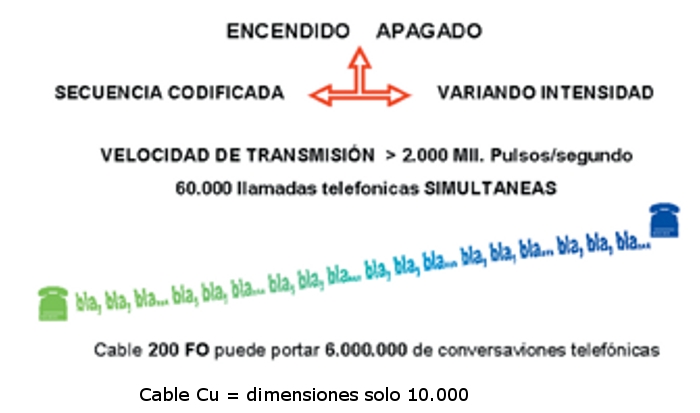
BASIC PRINCIPLE:
'
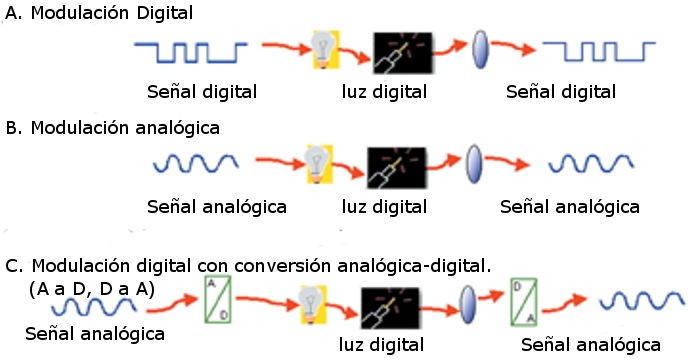
BASIC TRANSMISSION: THREE MAIN CATEGORIES
ADVANTAGES
- Large capacity.
- Reduced size and weight (easy installation).
- No electrical interference (clean communication free of EMI or RFI, lightning strikes, etc.).
- Versatility (Suitable for data, voice and video communication formats).
- Signal regeneration (signal repetition every x km).
DISADVANTAGES
- Opto-Electrical Conversion.
- Special installation (Specific equipment and tools for its handling).
- Repairs (Specific technical training of personnel).